Religion & Worldviews
Learn religion and worldviews
Study diverse religious and secular traditions in their historical and lived contexts, distinguishing description from belief.
Religious traditions & communities
Introductions to particular traditions, their communities, internal diversity and lived identities.
Christianity's major branches
How the Catholic, Eastern Orthodox, Oriental Orthodox and Protestant families formed, who has the final say in each, and how much each one varies inside.

Sunni and Shia Muslims
A dispute over who should lead after Muhammad grew into two communities that share the Qur'an and core practices such as prayer and fasting but differ over religious authority.
Hinduism
What Hindus share when there's no single founder, creed or church. Meet the main ideas, the gods, the scriptures and the daily worship of about 1.2 billion people.

Buddhism
How a teaching about suffering and its end, first given in northern India about 2,500 years ago, became the religion of more than 300 million people from Sri Lanka to Japan.
Beliefs & teachings
Conceptions of divinity, existence, morality, liberation, salvation and other teachings, where applicable.

Karma across Hindu, Buddhist and Jain traditions
Compare what karma means in three traditions. In Hindu teaching it's a law of action for an eternal self, in Buddhist teaching the intention behind a deed, and in Jain teaching fine matter that sticks to the soul.
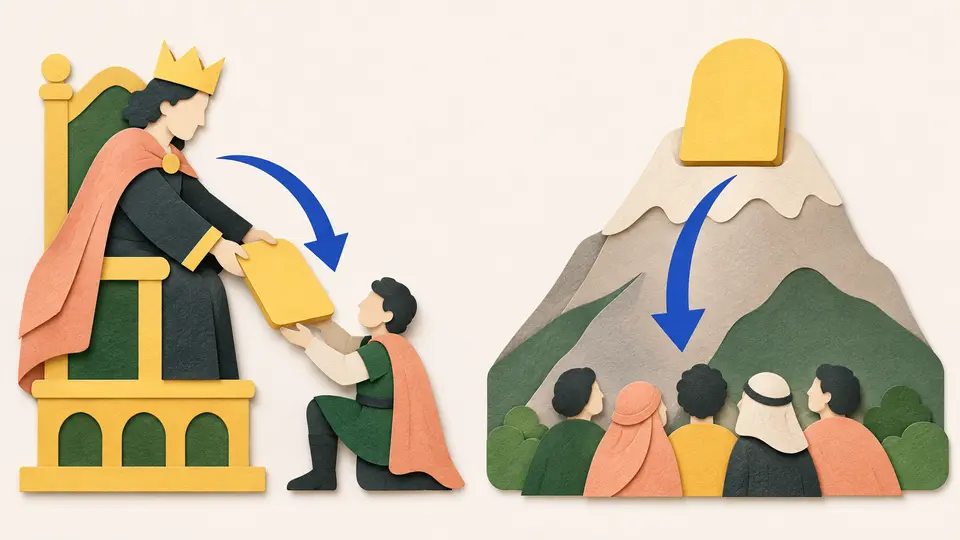
Covenant in Jewish traditions
The idea of a binding agreement between God and Israel shapes Jewish law, rabbinic teaching about non-Jews and the differences among Jewish movements.
Monotheism
What it means to believe in one God, how Judaism, Christianity and Islam each understand that oneness, where the idea came from, and how other faiths relate one and many.

Heaven, hell and the afterlife
What Judaism, Christianity and Islam teach about death, judgment and the world to come, where those ideas came from, and where believers inside each tradition still disagree.
Sacred stories & texts
Scriptures, narratives, oral traditions, interpretation, transmission and sources of religious authority.

The Dead Sea Scrolls and what they changed
What a shepherd found near the Dead Sea in 1947, what the 900 manuscripts hold besides the Bible, and why most scholars waited decades to read them.

The Vedas and oral transmission
Hindu reciters have carried the Vedas for some three thousand years by memory and sound. See how they did it, and why the tradition still trusts a living teacher over a manuscript.

The Bible
The Bible is a library of books written over about a thousand years. See what the Tanakh and the New Testament contain, who chose the books, how scribes copied them and why Bibles differ.
The Qur'an
Muslims hold the Qur'an to be God's speech, recited to Muhammad in Arabic over about 23 years. See how it's arranged, how it became one written book, and how Muslims interpret and recite it.
Rituals, festivals & sacred places
Worship, observance, celebrations, life-cycle practices, pilgrimage and places of religious significance.
Pilgrimage on the Camino de Santiago
Why pilgrims walk to a tomb in northwestern Spain, how a stamped card leads to a Latin certificate, and what the cathedral's own numbers can and can't tell you.
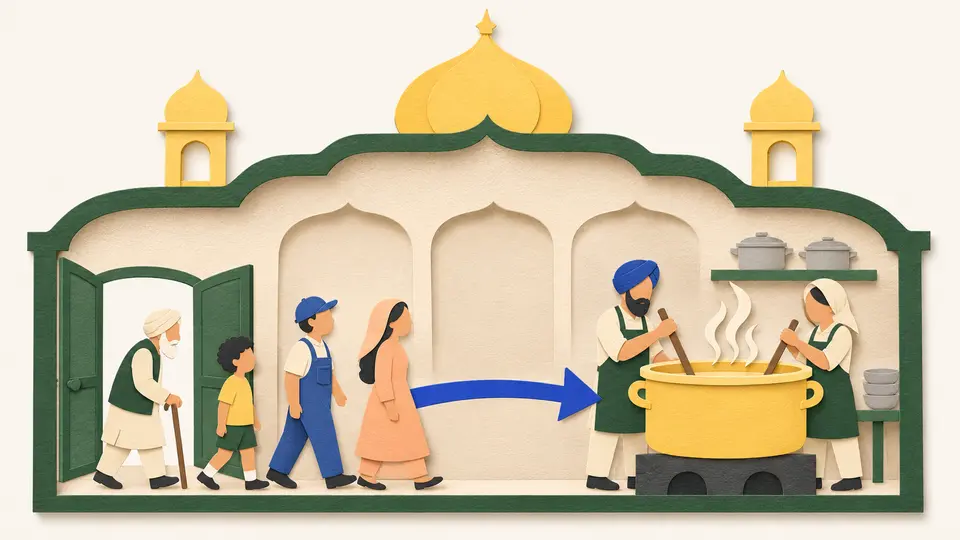
The Sikh langar, a free kitchen open to all
Anyone who comes to a gurdwara can eat a free meal there, sitting side by side with other diners, and Sikh service and giving keep the kitchen running.
Ramadan and Eid al-Fitr
For one lunar month Muslims fast from dawn to sunset. See what the fast involves, why Muslims keep it, who is excused, why its dates move through the seasons and how it ends in a festival.
Christmas and Easter
The two main Christian festivals mark Jesus's resurrection and his birth. See why Easter came first, how 25 December was chosen, why Easter's date moves and where trees, Santa and eggs really come from.
Religion, history & society
Historical change, institutions, encounters, social life and relationships between religion, politics and culture.
The Reformation and religious authority
Follow a dispute about indulgences into larger questions about scripture, church authority and how religious arguments spread.
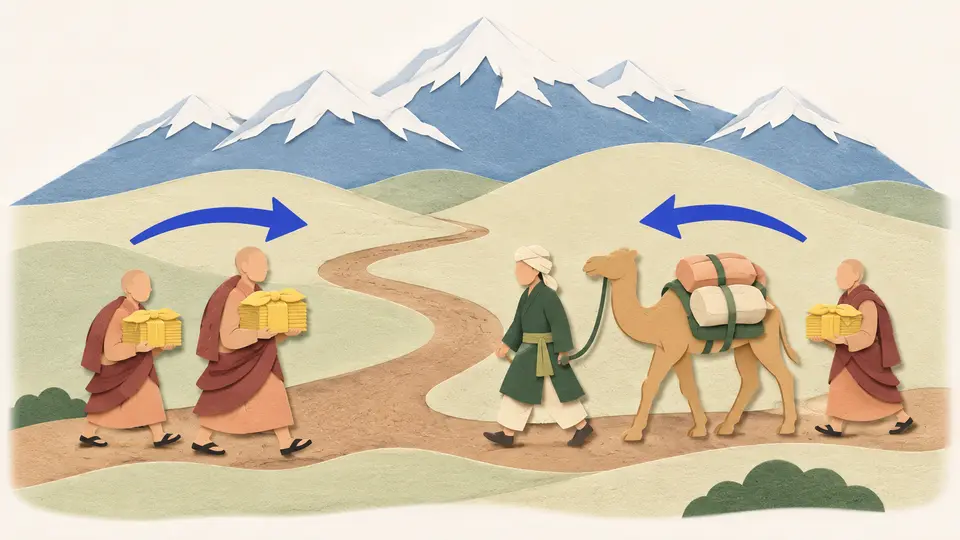
Buddhism on the Silk Road
How monks, translators and pilgrims carried Buddhism from India to China along the Silk Road, and what the caves at Dunhuang reveal about the faiths that met on the route.
Jesus of Nazareth
A Jewish preacher from Galilee was crucified by Rome around AD 30. See what historians can say about his life and teaching, and what Christians, Muslims and Jews believe about him.
Muhammad
A caravan trader from Mecca began preaching one God around 610, and by his death in 632 most of Arabia had accepted Islam. See his life as Muslims tell it and as historians study it.
Secular worldviews
Humanism, nonreligious identities and secular approaches to meaning, ethics and life.
Humanism and secular ethics
One modern humanist account of ethics, evidence and meaning, and why its principles don't speak for every nonreligious person.
Atheists, agnostics and the nones
What atheist and agnostic mean, who counts as a religious none and how people with no religion grew to nearly a quarter of the world's population.
Freethought and the history of atheism
Doubt about the gods is as old as belief. Meet India's Charvaka materialists, Greek skeptics, the first open atheists of the 1700s, the freethinkers of the 1800s and the New Atheists.
Is the world becoming less religious?
Sociologists once expected modern life to make religion fade. See why, where the forecast came true, where it failed, and what goes first when faith does fade.
Guided paths in Religion & Worldviews
- Texts, practices and authorityStudy religious traditions through their internal differences, ancient manuscripts, a pilgrimage and disputes over who holds authority. 6 topics.
- What keeps a religious tradition goingFollow religions across centuries and borders to see what keeps a tradition going, from texts held in memory to a kitchen that feeds anyone. The route ends with people who have no religion. 6 topics.