Mathematics & Logic
Learn math and logic
Use numbers, shapes, patterns, uncertainty, and logical reasoning to make and test clear statements about the world.
Numbers & patterns
Arithmetic, fractions, ratios, number systems, sequences, primes, divisibility and number theory.

Percentages and why the base matters
See why a 20% fall takes a 25% rise to undo, why 5% to 10% is both five points and a doubling, and why you can't average two percentages.
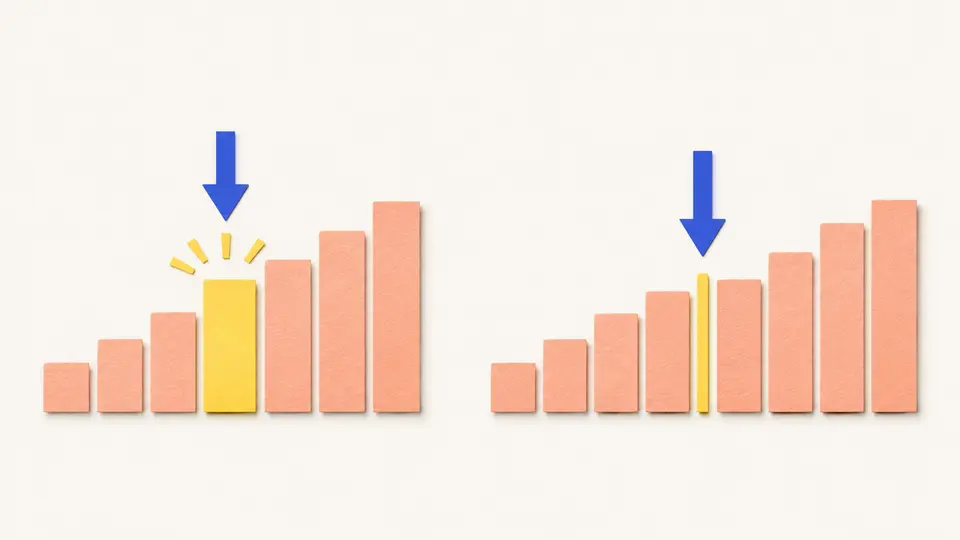
When the average is the wrong summary
When one number stands in for a whole set, which number you pick changes the story. Mean, median and mode tend to pull apart when the shape is lopsided.
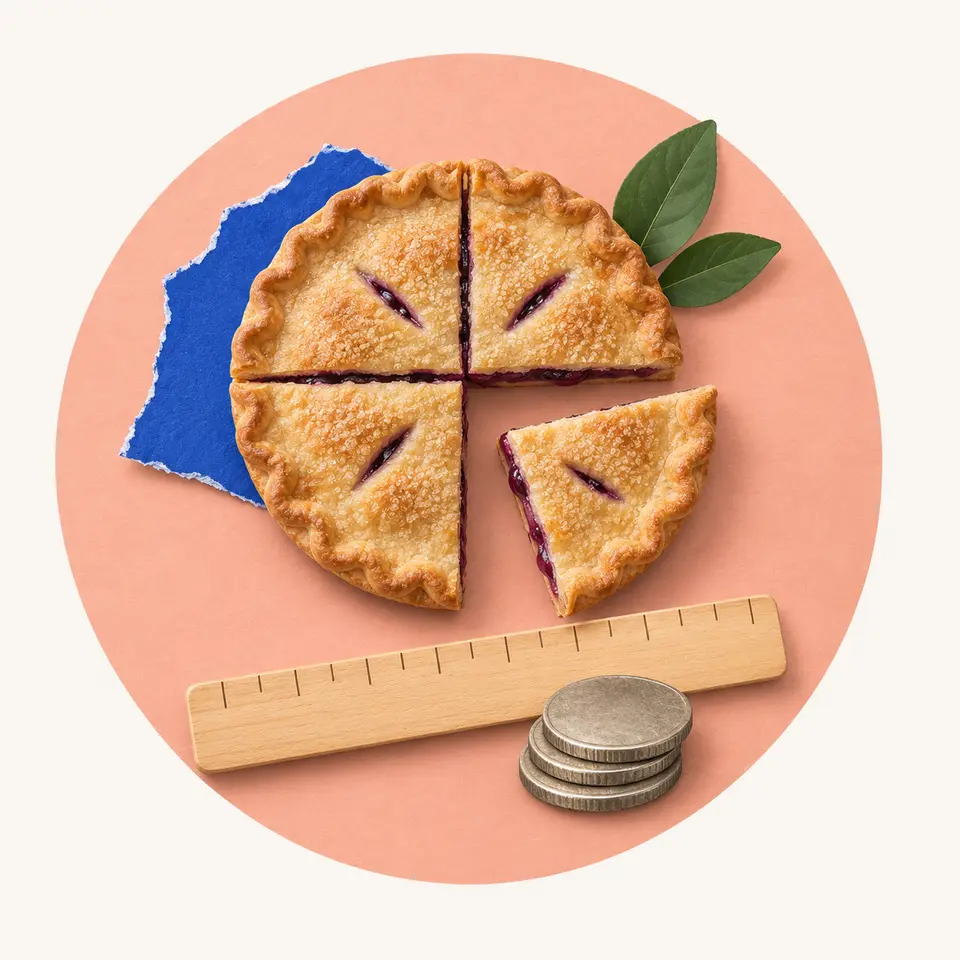
Fractions and decimals
A fraction is a number, a division and a share all at once. See why adding needs a common denominator and multiplying doesn't, and why some fractions become decimals that never end.

Prime numbers
Primes can't be split into smaller factors, and every whole number is built from them in exactly one way. See how to find them, why they never run out, and why online security relies on them.
Algebra & functions
Variables, equations, functions, matrices, linear algebra and symbolic relationships between quantities.

What a function is, and why it can't always run backward
A function is a rule that gives each input exactly one output. See why two inputs can share an output, where a formula stops applying, and why working back from an output can fail.
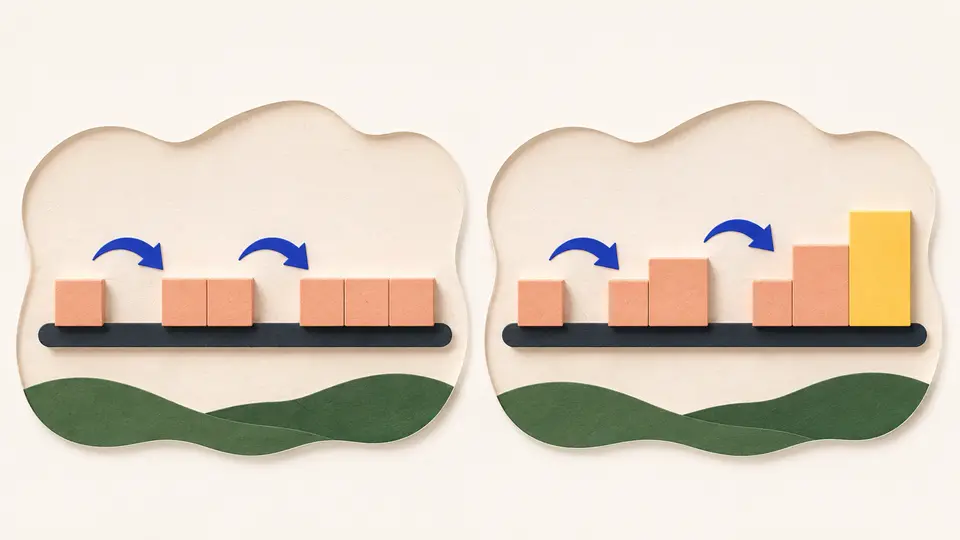
Linear versus exponential growth
Linear growth adds the same amount at each step and exponential growth multiplies by the same factor. See why they look alike at first, how decay and compound interest follow the same rule, and where the number e comes from.
Logarithms, where one step means ten times as much
A logarithm counts how many times you multiplied. See how that makes earthquake magnitudes, orders of magnitude and half-lives work, and why a scale built this way is easy to misread.

Variables and algebraic expressions
Algebra uses letters to talk about numbers you don't know yet, or about all numbers at once. Learn to read an expression, turn a sentence into symbols, and simplify without changing what it says.

Solving equations
An equation is a balance, and solving it means keeping the balance while you isolate the unknown. Learn which moves are allowed, how to check an answer, and how to spot an equation with no solution or with endlessly many.
Geometry & space
Shapes, angles, measurement, coordinates, vectors, transformations and introductory topology.

Scale, area and volume
See why doubling a shape's size can mean four times the covering and eight times the filling, and why the answer changes when only one dimension grows.

The Pythagorean theorem
In a right triangle, the squares on the two short sides add up to the square on the long side. See why that's true, how builders use it, and how Babylon, India and China knew it before Pythagoras.

Angles and triangles
An angle measures turning, and a triangle is the one shape that can't be pushed out of shape. See why its angles always make a half turn, when two triangles match, and how that measured the Earth.
Change & calculus
Limits, rates, derivatives, accumulation, differential equations and numerical approximation.

How calculus finds speed at a single instant
Build a speedometer reading from average speeds over shorter and shorter intervals. See why the method never divides by zero, why a sharp corner breaks it, and how one rate predicts the next moment.
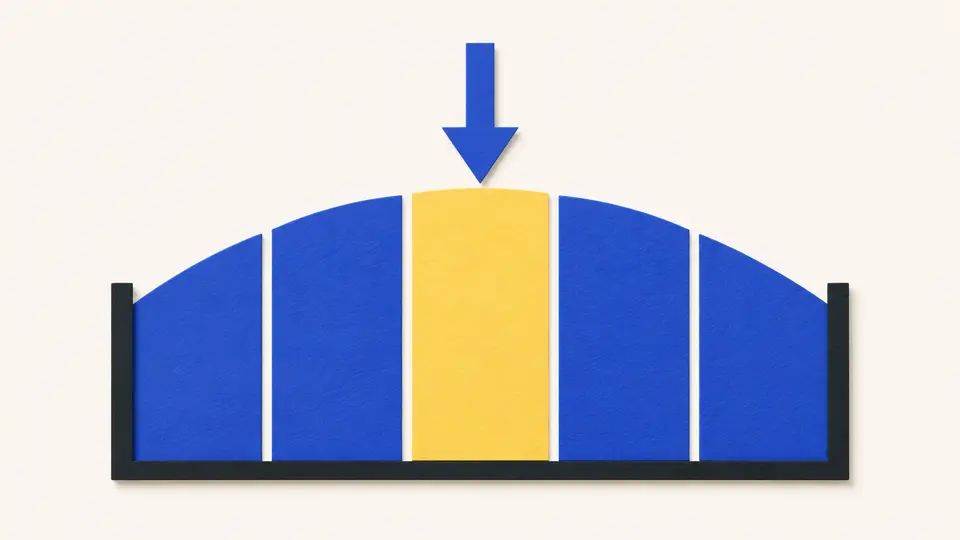
How calculus measures the area under a curve
Fill a curved region with thin rectangles, let them shrink, and you have an integral. Then see the theorem that replaces all that adding with one subtraction, because adding up and finding a rate undo each other.

Limits
A limit is the value something closes in on, whether or not it ever gets there. See how the idea answers Zeno's runner, why 0.999... is exactly 1, and how calculus finally got a solid footing.

Newton, Leibniz and the invention of calculus
Two men built calculus independently in the late 1600s, and their followers fought over the credit for decades. See what each found, what thinkers in Greece and India had done before, and whose notation won.
Probability & statistics
Chance, distributions, sampling, inference, experimental data, uncertainty and evaluating statistical claims.

Base rates and what a test result means
Count true and false alarms in a made-up factory to see why the meaning of a test result depends on how common the problem was before testing.
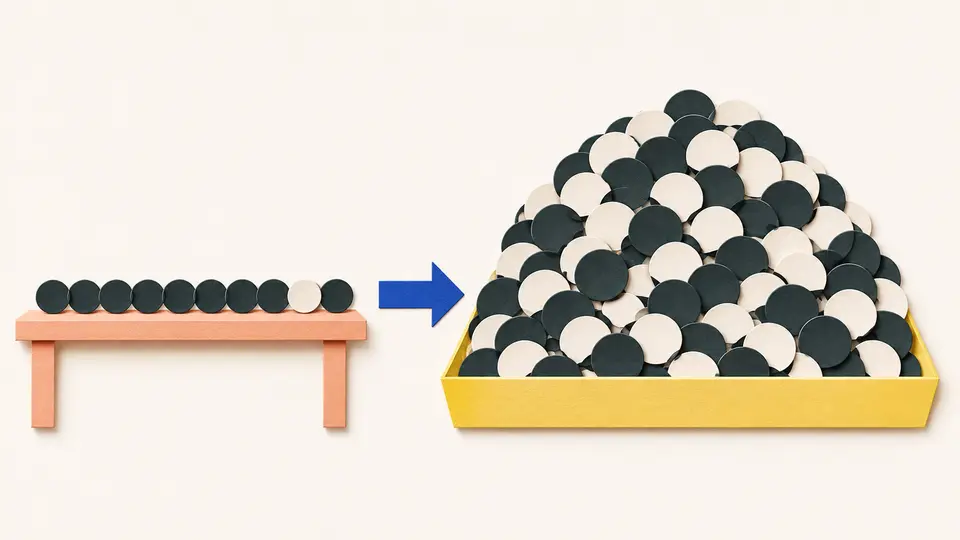
What an expected value promises
An expected value is the average you'd get over many repetitions. See how to calculate one, why it can be a result that never happens, and what it can't tell you about a single try.

The rules of probability
Probability puts a number between 0 and 1 on how likely something is. Learn to count outcomes, when to add chances and when to multiply them, and why 'at least one' is easiest to find by working out 'none'.

The normal distribution and the bell curve
Measurement errors, dice totals and test scores often pile up in the same bell shape. See why many small effects added together produce it, how to read it with the 68-95-99.7 rule, and when assuming it goes wrong.
Logic & proof
Sets, formal statements, deduction, proof techniques, counterexamples and mathematical foundations.

Why examples are not a proof
Watch a formula produce 40 primes in a row and then fail, then learn to prove a claim for every case by direct argument, by induction and by the contrapositive.

If-then statements and the mistake of reversing them
Learn the one way an if-then statement can be false, why reversing it makes a different claim, and what you commit to when you deny one.

Sets and Venn diagrams
A set is a collection with a clear rule for what belongs. Learn union, intersection and complement, draw them as overlapping circles, and use them to count survey answers and build search queries.

Truth tables and the logic of and, or, not
Logic builds complicated statements from simple ones joined by and, or and not. Learn to test any of them with a truth table, spot two that say the same thing, and see how Boole turned reasoning into algebra.
Games, networks & optimization
Counting, combinations, graphs, game theory, scheduling, routing and finding solutions under constraints.

The seven bridges of Königsberg
Turn a famous walking puzzle into points and lines, then count the bridges at each piece of land to prove the walk impossible without trying a single route.
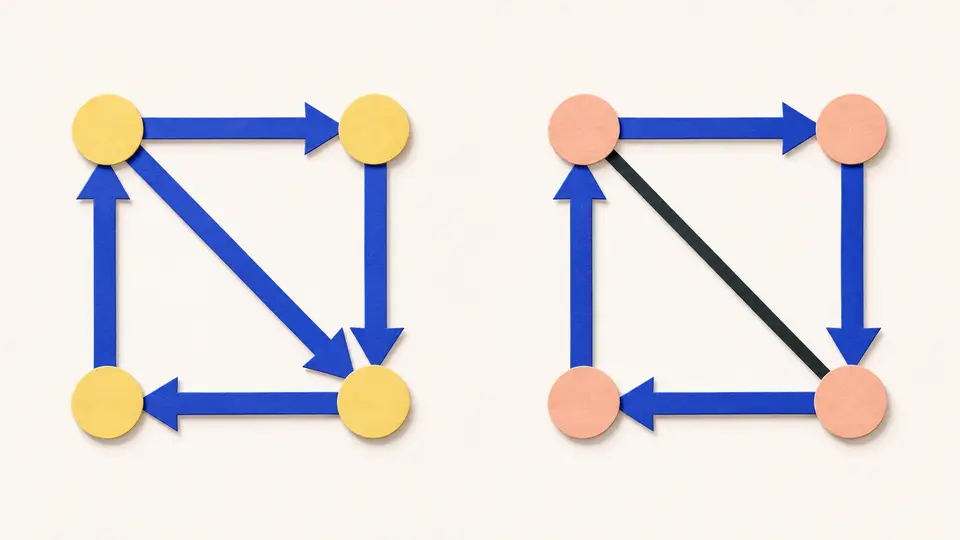
Why the shortest delivery route is so hard to find
Ask for a route that visits every place once, instead of every road once, and the easy test disappears. The number of possible tours outruns any computer, which is why real route planners settle for good enough.

Game theory and the prisoner's dilemma
Game theory studies choices whose results depend on what others choose. See how two prisoners acting sensibly both end up worse off, what a Nash equilibrium is, and why repeating the game can make cooperation pay.

Permutations and combinations
Count possibilities without listing them. Learn when to multiply choices, when order matters and when it doesn't, and work out why a 6-from-49 lottery ticket has about a 1 in 14 million chance.
Guided paths in Mathematics & Logic
- From everyday numbers to proofStart with everyday percentages and rates, weigh a surprising test result, then prove a famous bridge walk impossible. 7 topics.
- Where quick math intuition goes wrongIf an average or a growth curve has ever misled you, start here. In each topic a first guess fails, and the route runs from calculation to logic and a problem with no easy test. 7 topics.