Mathematics & Logic · Change & calculus
How calculus finds speed at a single instant
Build a speedometer reading from average speeds over shorter and shorter intervals. See why the method never divides by zero, why a sharp corner breaks it, and how one rate predicts the next moment.

What you will learn
- Calculate an average rate from a change in position and the time elapsed
- Explain why an average over an interval can differ from the rate at moments inside it
- Explain a derivative as the limit of average rates over shrinking intervals
- Tell a limiting calculation apart from substituting an interval of zero
Lesson 1 of 4 · 4 min
Why an average speed is not a speedometer reading
Say a car covers 60 kilometers in two hours. Its average speed is 30 kilometers per hour. But the driver may have stopped for coffee and then driven at 50 to make up time. The speedometer showed 0 for a while and 50 for a while.
The average sums up the whole trip in one number. A speedometer answers a different question, which is how fast the car is moving right now. Total distance divided by total time can't tell you that.
Take a made-up motion that's easy to compute. An object moves forward along a straight line, and after t seconds it's t squared meters from its start. At 2 seconds it's at 4 meters, and at 3 seconds it's at 9.
Its position changes by 5 meters in one second. So its average velocity over that second is 5 meters per second. Velocity is speed with a direction.
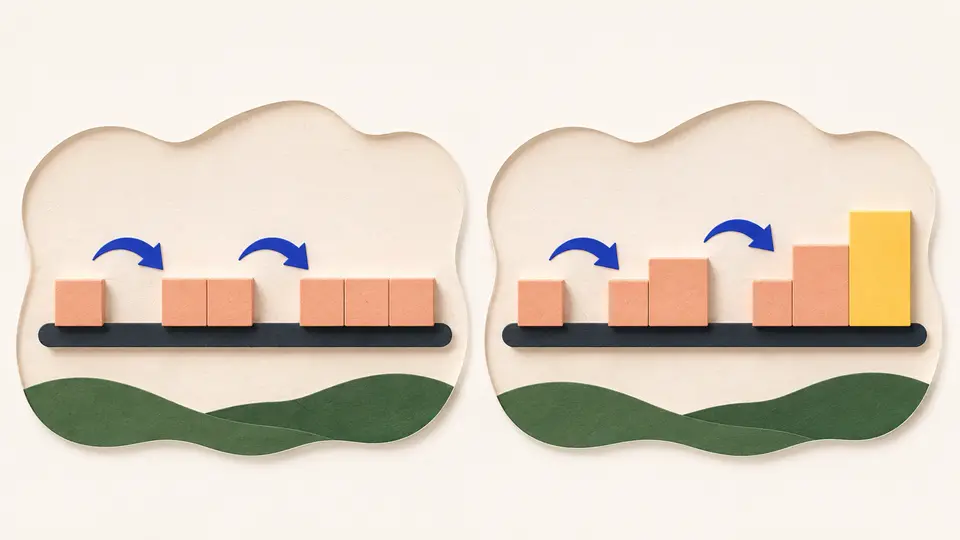
Now shorten the interval. At 2.1 seconds the position is 2.1 squared, or 4.41 meters. So from 2 to 2.1 seconds the object moves 0.41 meters in 0.1 seconds, an average of 4.1 meters per second.
The first average came out at 5 because it covered a whole second, and the object kept getting faster during it. So two intervals that start at the same moment give different averages.
An instantaneous rate describes a single moment, the way a speedometer reading does. You can't get it by dividing, because in a single moment no time passes. So you watch the averages over shrinking intervals instead.
Here they run 5 over a full second, 4.1 over a tenth and 4.01 over a hundredth. If averages like these close in on one value, that value is the instantaneous rate. Mathematicians call it the derivative at that moment.
Try to recallWhy can an object's average velocity from two to three seconds differ from its instantaneous velocity at two seconds?
The average spreads the change in position over a whole second, and the object's velocity changes during that second. The instantaneous velocity is the value the averages close in on as the interval shrinks toward two seconds.
Ignoring air resistance, a ball dropped from 64 feet lands 2 seconds later, so its average speed is 32 feet per second. It hits the ground at 64 feet per second, twice the average.
An average belongs to a whole interval. A speedometer reading belongs to one moment, and you find it by asking where the averages go as the interval shrinks.
Lessons in this topic
Why an average speed is not a speedometer reading
Work out an average speed over an interval, and see why it can't tell you how fast something is moving at any one moment.
How to find a speed at one instant without dividing by zero
Use shrinking intervals and one step of algebra to find the exact rate at a single moment, and see why the method never divides zero by zero.
Why a sharp corner has no single slope
Use a V-shaped graph to see why an unbroken line can still have a point with no slope, and how a common shortcut for estimating slopes hides it.
Using a rate at one moment to predict the next
Use an instantaneous rate to estimate a nearby value, and see why the estimate drifts as you move farther from where you measured.
Three quick stories from this topic
The calculator's false slope
The TI-84 Plus slope formula gives 0 at the tip of a symmetric V, where no slope exists
The calculator estimates a slope from two points the same small distance to the left and right. At the tip of the V-shaped absolute-value graph, those points sit at equal heights, so the answer is 0. The real slopes there are negative 1 and positive 1.
Why the formula is fooled
It divides the height difference between the two points by the distance between them. With the tip of the V midway, the fall on the left cancels the rise on the right.
The guidebook admits it
Texas Instruments warns that the method can return a false derivative value at a nondifferentiable point. On a smooth curve the same formula usually gets more accurate as the distance shrinks.
Landing at twice the average
A ball dropped from 64 feet hits the ground at twice its average speed for the fall
Ignoring air resistance, the fall takes 2 seconds, so the average speed is 32 feet per second. But the ball speeds up the whole way down and lands at 64. An average covers the whole trip, and the landing speed belongs to one instant.
The average is the whole trip
Average speed is total distance divided by total time, here 64 feet over 2 seconds. It says nothing about any single moment of the fall.
Speed at one instant
Calculus finds the landing speed from averages over shorter and shorter intervals that end at the landing. Those averages close in on 64 feet per second.
Negative velocity means backward
A negative velocity means an object is moving backward, not slowing down
Velocity is the rate of change of position, so its sign gives the direction along a line. Speed is the size of the velocity with the sign dropped. An object slows down only when its velocity and its acceleration have opposite signs.
Direction and speed are separate readings
OpenStax defines velocity as the derivative of position and speed as its absolute value. In one of its examples, position = t cubed − 4t + 2 gives velocity −1 and acceleration 6 at t = 1. The particle is moving from right to left, and because velocity and acceleration point in opposite directions, its speed is decreasing.
Slowing down needs two signs
Whether an object is slowing down depends on velocity and acceleration together. Opposite signs mean the speed is falling, and matching signs mean it's rising. A negative velocity on its own only tells you which way the object is going along its line.