Mathematics & Logic · Algebra & functions
Logarithms, where one step means ten times as much
A logarithm counts how many times you multiplied. See how that makes earthquake magnitudes, orders of magnitude and half-lives work, and why a scale built this way is easy to misread.
What you will learn
- Convert a difference on a base-ten scale into the ratio it represents
- Define a logarithm as the exponent that produces a number
- Evaluate a common logarithm in your head and bracket one that isn't a whole number
- Say what ln means and what a logarithm written without a base usually means
Lesson 1 of 4 · 6 min
Why a magnitude 9 quake is 100 times a magnitude 7
In January 2010 an earthquake of magnitude 7.0 struck Haiti. In March 2011 one of magnitude 9.0 struck off Honshu, the largest ever recorded in Japan. The numbers 7 and 9 look close. But the 2011 earthquake's seismic waves had 100 times the amplitude, meaning the swings traced by a seismograph were 100 times as large.
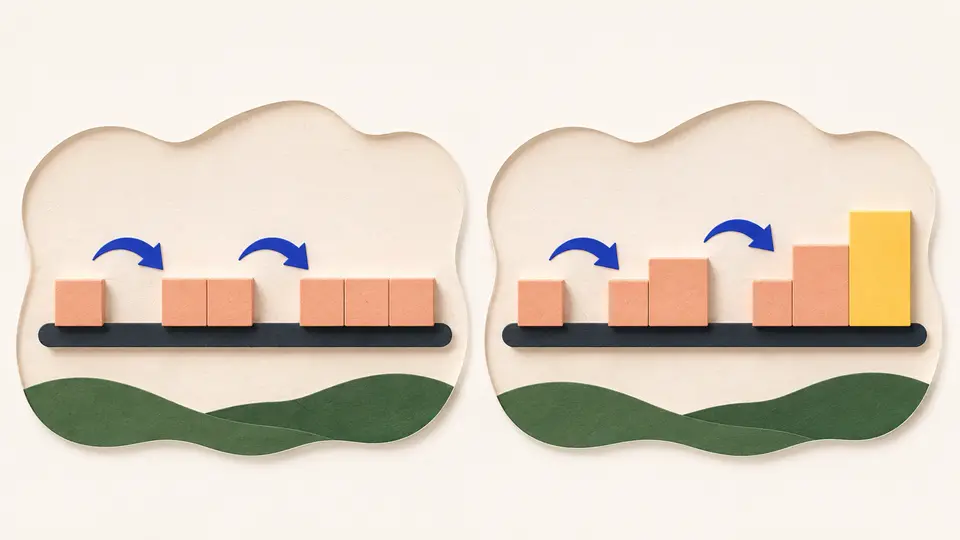
That's because magnitude, which Charles Richter introduced in 1935, is a base-ten logarithmic scale. Each whole step up multiplies the amplitude by ten instead of adding a fixed amount. Two steps are ten times ten.
So to compare two readings, subtract them and raise ten to that difference. A gap of 1 is a factor of 10. A gap of 3 is a factor of 1,000. A gap of 0.3 is a factor of about 2.
The energy gap is wider still. The US Geological Survey puts each whole step at about 32 times the energy released, so two steps come to about 1,000 times.
This is why a magnitude 8 isn't twice a magnitude 4. Its waves have 10 to the power 4, or 10,000 times, the amplitude. On a scale like this, "twice as strong" never means double the number.
The function behind that scale is the logarithm, and it's easiest to learn as a sentence. The base b logarithm of a number is the exponent you raise b to in order to get that number. The base 2 logarithm of 32 is 5, because 2 to the fifth is 32.
The two forms always pair up. Log base b of x equals y says the same thing as b to the power y equals x. One asks what exponent is needed and the other applies it. So every logarithm question is an exponent question turned around, and mathematicians call the two functions inverses.
On the magnitude scale the base is 10. An amplitude 100 times as large is 10 to the power 2, and the logarithm picks out the 2. That's how a hundredfold difference becomes a gap of two units.
One limit follows from the definition. The base is always positive, and a positive number raised to any power stays positive. No exponent can land on zero or below. So the logarithm of zero or of a negative number isn't defined among the real numbers.
Try to recallExplain what log base 3 of 81 means, and why the logarithm of a negative number isn't a real number.
Log base 3 of 81 asks for the exponent that turns 3 into 81. Since 3 to the fourth is 81, the answer is 4. The logarithm is that exponent, not some quantity of 81. The logarithm of a negative number is undefined among the real numbers because the base is always positive, and no power of a positive base is ever negative. The same reasoning rules out zero, so only positive numbers have logarithms.
A logarithm is an exponent, and each step on the magnitude scale is one more power of ten. So read a gap on such a scale as a multiplication. One unit apart means ten times, two units a hundred times, and three units a thousand times.
Lessons in this topic
Why a magnitude 9 quake is 100 times a magnitude 7
On the earthquake magnitude scale, each whole step multiplies the shaking by ten. Learn to turn the gap between two readings into a ratio, and what a logarithm is.
Reading log and ln, the two logarithms you'll meet
Base ten and base e cover almost every logarithm you'll see. Learn to estimate a base-ten logarithm in your head, and how to read a log written with no base at all.
How logarithms turn huge ratios into small gaps
Use a logarithm to solve for an unknown exponent, then use orders of magnitude to compare quantities that differ by factors of thousands or millions.
Why half-life doesn't depend on how much you have
Apply a logarithm to a decay rate and you get the half-life, and the starting amount drops out of the answer. Then see what radiocarbon dating can and can't tell you.
Three quick stories from this topic
Half-life forgets the amount
A gram of carbon-14 and a metric ton of it take the same 5,730 years to decay by half
Radioactive decay removes a fixed share of what's left in each stretch of time, not a fixed amount. So the time to lose half depends only on the substance's decay rate. The starting amount cancels out of the equation.
The consequence
The starting quantity is nowhere in the answer. A gram and a metric ton of the same isotope halve in exactly the same time, which is why half-life is quoted as a property of a substance.
Carbon-14
Carbon-14 has a half-life of 5,730 years, giving a decay constant of about negative 1.2097 times 10 to the power negative 4. Willard Libby discovered radiocarbon dating in 1949.
Magnitude 9 against magnitude 7
Japan's magnitude 9.0 earthquake released about 1,000 times the energy of Haiti's 7.0
Magnitude is a logarithmic scale. Each whole step means 10 times the wave amplitude on a seismograph and about 32 times the energy released. Two steps make that 100 times the amplitude and about 1,000 times the energy.
Two earthquakes, two units apart
The earthquake that struck Haiti in January 2010 had a magnitude of 7.0. The one off Honshu in March 2011 had a magnitude of 9.0, the largest ever recorded in Japan.
How to compare two readings
Subtract the readings and raise ten to the difference to get the ratio of wave amplitudes. A gap of 1 is a factor of 10, and a gap of 3 is a factor of 1,000.
Three meanings of log
Log means three different things on a calculator, in a math paper and in computing
On a calculator, log is the base-ten logarithm. In advanced mathematics it's base e. In computing texts it's often base 2. The international standard avoids the muddle by giving each base its own symbol, lg, ln and lb.
What the base changes
A logarithm is the exponent that turns the base into a number. Log of 1,000 is 3 in base ten, because 10 cubed is 1,000, but about 6.9 in base e and about 10 in base 2.
One answer never changes
The logarithm of 1 is 0 in every base, because any base raised to the power zero gives 1.
Sources
- 6.3 Logarithmic Functions - College Algebra 2e, OpenStax, Rice University
- Earthquake Magnitude, Energy Release, and Shaking Intensity, U.S. Geological Survey
- M 7.0 - 10 km SE of Léogâne, Haiti, U.S. Geological Survey
- Information on the 2011 Great East Japan Earthquake, Japan Meteorological Agency
- 6.7 Exponential and Logarithmic Models - College Algebra 2e, OpenStax, Rice University
- Logarithm, Wolfram MathWorld
- NIST Guide to the SI, Chapter 10: More on Printing and Using Symbols and Numbers in Scientific and Technical Documents, National Institute of Standards and Technology
- Binary logarithm, Wikipedia