Mathematics & Logic · Numbers & patterns
Fractions and decimals
A fraction is a number, a division and a share all at once. See why adding needs a common denominator and multiplying doesn't, and why some fractions become decimals that never end.
What you will learn
- Explain a fraction as a single number with a place on the number line, made of equal parts
- Explain why fractions like 2/4 and 1/2 are equal and how renaming fractions lets you compare them
- Explain why adding fractions requires a common denominator
- Explain why multiplying fractions means taking a part of a part, so it needs no common denominator
Lesson 1 of 4 · 4 min
A fraction is one number with many names
The burger beat its rival in taste tests and cost less by weight. Yet according to the chain's former owner, people passed it over, thinking a third of a pound was smaller than a quarter. A fraction's two numbers can mislead you if you read them as two separate counts.
The bottom number, the denominator, says how many equal parts make a whole. The top number, the numerator, counts how many of those parts you have. So 3/4 means three parts, each a quarter of a whole.
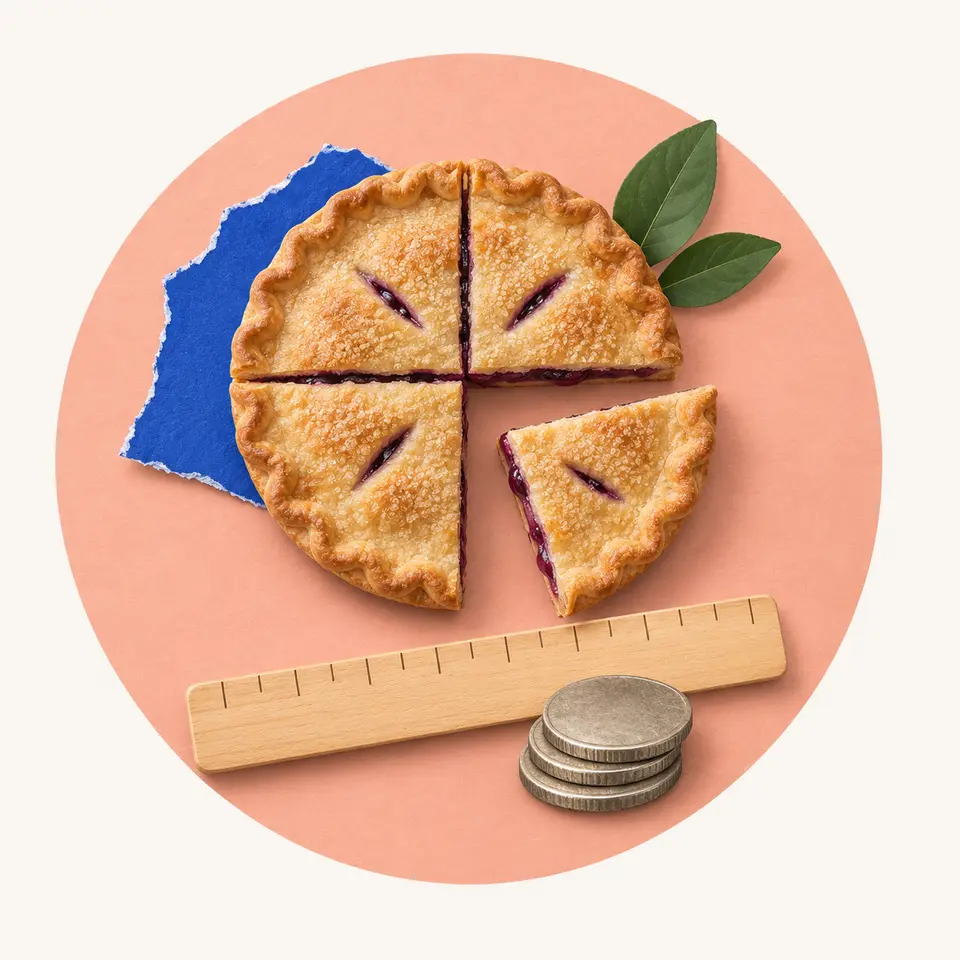
That's why 1/3 beats 1/4. Cut a pie into 3 equal slices and each one is bigger than when you cut it into 4. With the same top number, the smaller denominator gives the bigger fraction.
A fraction is also one number, with its own point on the number line. To find 3/4, split the stretch from 0 to 1 into 4 equal steps and count 3 of them. It sits between 1/2 and 1.
The same fraction is a division too. 3/4 is what you get when you divide 3 by 4, which is why sharing 3 pizzas among 4 people gives each person 3/4 of a pizza.
Cut a pie into 4 slices and take 2, or cut it into 2 halves and take 1. You've got the same amount of pie, so 2/4 and 1/2 are the same number. They land on the same point of the number line.
Here's the rule behind it. Multiplying top and bottom by 2 is the same as multiplying by 2/2, and 2/2 equals 1. Multiplying by 1 changes nothing. So every fraction has endless equivalent fractions. You can also divide top and bottom by a shared factor, turning 3/9 into 1/3. That's called lowest terms.
Renaming is how you compare awkward pairs. Is 3/5 bigger than 2/3? Rename both as fifteenths. 3/5 is 9/15 and 2/3 is 10/15, so 2/3 wins.
Try to recallWhy does multiplying the top and bottom of a fraction by the same number leave its value unchanged?
Multiplying top and bottom by, say, 3 is the same as multiplying the fraction by 3/3. And 3/3 is equal to 1. Multiplying any number by 1 leaves it as it was, so the new fraction names the same number.
A fraction is one point on the number line, and a bigger denominator means smaller parts. Multiplying top and bottom by the same number gives another name for the same point.
Lessons in this topic
A fraction is one number with many names
See where a fraction sits on the number line, why a bigger bottom number means a smaller piece, and why 2/4 and 1/2 are the same number.
Why adding fractions needs equal pieces
Learn why you must rename fractions before adding them, and why multiplying works straight across with no common denominator.
Why you flip and multiply to divide fractions
See division as asking how many times one amount fits in another, and why that turns dividing by a fraction into multiplying by its flip.
Why some fractions become decimals that never end
Find out why 1/4 stops at 0.25 while 1/3 repeats forever, and how to turn a repeating decimal, even 0.999..., back into a fraction.
Three quick stories from this topic
Egypt's one-on-top fractions
Egyptian scribes wrote nearly every fraction as a sum of fractions with 1 on top
Five-sevenths became one half plus one sixth plus one twenty-first. The Rhind papyrus, copied by a scribe named Ahmes, even holds a table for splitting 2/n into such sums.
It adds up
Rename 1/2, 1/6 and 1/21 as 42nds and you get 21, 7 and 2, which make 30/42, or 5/7.
A few exceptions
Only a few fractions, such as 2/3 and 3/4, were left out of the system and written as they were.
0.999... is exactly 1
The decimal 0.999..., with nines that never end, is exactly equal to 1
It isn't a number creeping toward 1 and never quite arriving. If it were smaller, some number would have to fit between it and 1, and none does.
A two-line proof
1/3 is 0.333.... Multiply both by 3 and you get 1 = 0.999....
Why it feels wrong
People picture nines piling up forever. But the symbol names a fixed number, the same way 2/4 names one half.
The burger fractions sank
A third-pound burger reportedly flopped because diners thought 1/3 was less than 1/4
Launched in 1985 against a rival's quarter-pounder, it won taste tests and cost less by weight. The chain's former owner later wrote that research blamed confusion over 1/3 and 1/4.
Why the mix-up happens
People read the 3 and the 4 as counts. But the bottom number names the piece size, and fewer pieces means bigger ones.
The quick check
Cut a pie into 3 and into 4. Each third is plainly bigger than each quarter.
Sources
- A&W Restaurants, Wikipedia
- Fraction, Wikipedia
- Number line, Wikipedia
- Rational number, Wikipedia
- Egyptian fraction, Wikipedia
- 0.999..., Wikipedia