Religion & Worldviews · Rituals, festivals & sacred places
The Sikh langar, a free kitchen open to all
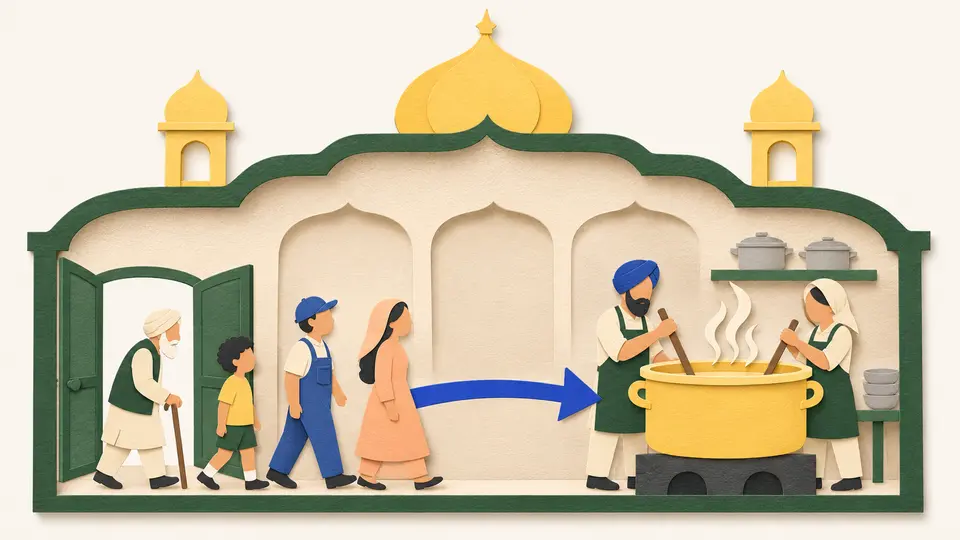
Anyone who comes to a gurdwara can eat a free meal there, sitting side by side with other diners, and Sikh service and giving keep the kitchen running.
What you will learn
- Describe what a langar is and who may eat there
- Explain why a langar serves simple vegetarian food
- Explain what pangat means and why langar diners sit together in rows
- Explain why Guru Amar Das asked every visitor to eat in the langar before meeting him
Lesson 1 of 4 · 5 min
A free meal for everyone who comes
Walk into almost any gurdwara, a Sikh place of worship, and you'll be offered a meal. It's free, whatever your religion, caste, gender, income or ethnicity. The kitchen that serves it is the langar, and Sikhs use the same word for the meal.
The word came into Punjabi from Persian, where it meant an almshouse or a public kitchen. Guru Nanak, the founder of Sikhism, made the langar part of the faith around 1500 CE in Punjab, as a charity and a symbol of equality. He worked his own farm and gave a share to the common kitchen.
His successor, Guru Angad, organized it as an institution where visitors from near and far could eat a simple free meal and sit as equals. He set rules and training for the volunteers. His wife, Mata Khivi, looked after visitors with such care that the kitchen came to be known by her name.
The Sikh code of conduct spells out who may eat. All human beings, high or low and of any caste or color, may sit and eat in the Guru's kitchen. When people are seated in rows for the meal, nobody may be treated differently because of their country of origin, color, caste or religion.
A langar meal may include chapati, dal made from pulses, vegetables and rice pudding. It's plain on purpose. The BBC's guide to Sikhism says the food must be simple "so as to prevent wealthy congregations turning it into a feast that shows off their superiority."
It's also vegetarian, even though Sikhs aren't required to be. Serving only vegetarian food means that any visitor, "whatever the dietary restrictions of their faith," can eat it. Dairy is allowed, so rice pudding is fine. Fish and eggs count as meat and are left out.
Both rules do the same job. They keep the meal open to everyone, whatever their faith and whatever their means.
Try to recallWhy does a Sikh langar serve simple vegetarian food?
The food is kept simple so that wealthy congregations can't turn the meal into a feast that shows off their superiority. It's vegetarian so that any visitor can eat there whatever the dietary rules of their own faith. Fish and eggs count as meat and are left out. Both choices keep the meal open to everyone on equal terms.
Almost every gurdwara runs a langar, and some feed hundreds or thousands of people. Many also draw homeless people, who are fed alongside the Sikh congregation without any discrimination. The langar at the Golden Temple in Amritsar serves over 100,000 meals a day.
The Gurus meant it to stay that way. "Keep the langar ever open" are reported to have been the last words of a later Guru, Gobind Singh.
Lessons in this topic
A free meal for everyone who comes
Almost every gurdwara runs a langar that feeds anyone who walks in. See where it came from and why the food is kept plain and vegetarian.
Why even an emperor ate on the langar floor
Langar diners sit side by side on the floor, a practice called pangat. See what it's for, and why Guru Amar Das made every visitor eat that way before meeting him.
Why kitchen work counts as worship for Sikhs
Sikhs call the work of the langar seva, service that is also worship. See why, and why their tradition ranks work done with the hands above giving money.
How a tenth of Sikh earnings pays for the langar
Sikhs fund langars with dasvandh, a tenth of their earnings given to the community. See where the practice came from and why the gifts are pooled instead of passing from person to person.
Three quick stories from this topic
The Golden Temple's kitchen
The free kitchen at the Golden Temple in Amritsar serves over 100,000 meals a day
Anyone who wants a meal gets one, whatever their faith, gender or means. Everyone sits on the floor in rows and eats the same vegetarian food, served by volunteers who count the work as worship.
Served by volunteers
Volunteers serve the meal as part of their ethos of kar seva, or community service. More than 150,000 people visit the shrine every day to worship, which makes it one of the most visited religious sites in the world. Its kitchen and dining hall stand on the east side of the courtyard.
Open on all four sides
The Shiromani Gurdwara Parbandhak Committee, which oversees major Sikh shrines, says Guru Arjan designed the Harmandir Sahib, as the temple is also known, to open on all four sides. He made it accessible to every person without any distinction of caste, creed, sex or religion.
An emperor on the floor
Sikh tradition says the emperor Akbar had to eat on the floor before meeting the Guru
Guru Amar Das asked every visitor to eat in the free kitchen first, seated in a row with people of every caste and class. The rule became a saying, that eating together comes before meeting together.
The rule of the row
Diners in a Sikh free kitchen sit side by side on the ground, a practice called pangat. No one gets a better seat, whatever their caste, creed or status.
Barefoot to the Guru
One Sikh account adds that Akbar refused to walk on the silks his servants spread for him. He turned them aside and went to the Guru barefoot.
Hands above money
Sikh tradition ranks service done with your hands above service done with your money
Sikhs name three kinds of service, with the body, the mind and material means. Bodily work such as cooking and serving in the free kitchen ranks highest and is required of every Sikh. Traditional Indian society had left that labor to the humblest castes.
Service as worship
Sikhs call this service seva and count it as worship. Sikh teaching holds that God pervades all creation, so serving a person is serving God.
Why money is pooled
Giving money counts too, as a tenth of earnings called dasvandh. It goes into a common fund, because the tradition holds that personal charity can debase the receiver and feed the giver's ego.
Sources
- Langar (Sikhism) - Wikipedia, Wikimedia Foundation
- BBC - Religions - Sikhism: The Gurdwara, BBC
- BBC - Religions - Sikhism: Guru Angad Dev, BBC
- The Code of Sikh Conduct and Conventions, English version of the Sikh Reht Maryada, Dharam Parchar Committee, Shiromani Gurdwara Parbandhak Committee
- Sri Guru Angad Dev Ji, Shiromani Gurdwara Parbandhak Committee
- Gurū kā Laṅgar (lit., laṅgar or refectory of the Gurū), Punjabi University
- Jhaṭkā, Punjabi University
- Sikh Reht Maryada, Section Six, Shiromani Gurdwara Parbandhak Committee
- Golden Temple - Wikipedia, Wikimedia Foundation
- Sri Harmandir Sahib - SGPC official, Amritsar, Shiromani Gurdwara Parbandhak Committee
- Sevā - The Encyclopaedia of Sikhism, Punjabi University
- Paṅgat - The Encyclopaedia of Sikhism, Punjabi University
- Guru Amar Das - Wikipedia, Wikimedia Foundation