Religion & Worldviews · Rituals, festivals & sacred places
Ramadan and Eid al-Fitr
For one lunar month Muslims fast from dawn to sunset. See what the fast involves, why Muslims keep it, who is excused, why its dates move through the seasons and how it ends in a festival.

What you will learn
- Describe what a day of the Ramadan fast involves from dawn to sunset
- Describe how Muslims spend Ramadan evenings and nights, from the meal at sunset to the night prayers
- Explain why Muslims fast in Ramadan, linking the month to the Qur'an and the aims of fasting
- Identify who is excused from fasting and how missed days are made up
Lesson 1 of 4 · 4 min
A Ramadan day, from the meal before dawn to sunset
Before dawn in old Damascus, a drummer walks the streets calling people to wake. Inside, families eat suhur, the meal before dawn. Then they say the first prayer of the day, and the fast begins.
The Qur'an marks the moment with an image. Believers may eat and drink until "the white thread of dawn becomes distinct" from the black thread of night. From then they fast until sunset.
During those hours a fasting Muslim takes no food or drink, not even water, and no sex. Each fast starts with an intention, a resolve made the night before. Muslims also try to avoid lies and quarrels, because a fast without that effort is seen as mere hunger.
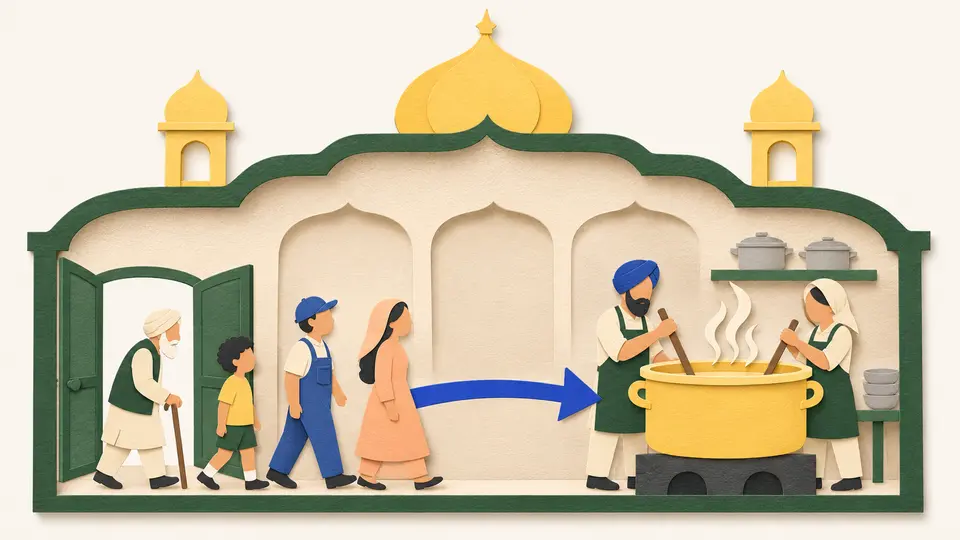
At sunset the fast ends with iftar, the meal that breaks it. Many families start with dates and water, following Muhammad, who broke his fast with three dates. They say the sunset prayer, then sit down to the main meal.
Iftar is often shared. Mosques lay on huge meals, and the Sheikh Zayed Grand Mosque in Abu Dhabi feeds up to 30,000 people a night. Giving rises too, because many Muslims believe good deeds earn a greater reward in Ramadan.
Later, many Sunni Muslims stay at the mosque for tarawih, extra night prayers with long readings. Many mosques aim to recite the whole Qur'an over the month, about one of its 30 parts a night. Tarawih is recommended, not required. Shia Muslims don't hold it in congregation and favor other night prayers.
Try to recallWhat happens on a Ramadan evening after the sun sets?
The fast ends with iftar, often beginning with dates and water, then the sunset prayer and a main meal that's frequently shared. Later many Sunni Muslims pray tarawih, extra night prayers that work through the Qur'an over the month.
A Ramadan day runs from suhur before dawn to iftar at sunset, with no food or drink between. The nights are for shared meals and, for many, extra prayers.
Lessons in this topic
A Ramadan day, from the meal before dawn to sunset
Walk through one day of the Ramadan fast, from the meal before dawn to the meal at sunset, and see how the nights fill with shared food and extra prayers.
Why Muslims fast, and who doesn't have to
See why Ramadan is the month of the fast, what Muslims hope it does for them, and how the rules excuse the sick, travelers, children and others.
Why Ramadan moves through the seasons
See why Ramadan starts about 11 days earlier every year, why Muslims argue over sighting the moon or calculating it, and how they fast where summer days barely end.
Eid al-Fitr, and how it differs from Eid al-Adha
See how the new moon ends Ramadan, why every household gives food to the poor before the festival prayer, and how Islam's other great festival differs.
Three quick stories from this topic
A fast that changes season
Ramadan moves through every season of the year, coming back around in about 33 years
The Islamic calendar follows the moon, so its year is about 11 days shorter than the solar one. It never adds an extra month to catch up, so the fast slips earlier every year.
Winter fasts, summer fasts
A Muslim who fasts for decades will keep Ramadan in short winter days and in long summer ones.
Started by the moon
Each Islamic month begins with the new crescent, so even the start date can differ by a day between countries.
The Night of Power
Muslims hold that one night near the end of Ramadan is better than a thousand months
The Qur'an says so of Laylat al-Qadr, the night Muslims believe its first verses were revealed. Nobody knows the exact date, so many spend all the odd-numbered nights of the last ten in prayer.
Why Ramadan
The Qur'an calls Ramadan the month in which it was revealed, which is why Muslims fast in it.
Ten days apart
Some Muslims spend the whole final ten days in the mosque, fasting by day and praying by night.
The two threads at dawn
The Qur'an times the start of each fast day by telling a white thread from a black one
Believers may eat and drink until "the white thread of dawn becomes distinct" from the black thread of night. From that first light until sunset, they take no food and not even water.
Before the light
Families wake in the dark for suhur, the meal before dawn, then pray as the fast begins.
At sunset
The fast ends with iftar, often with dates and water, following Muhammad's practice.
Sources
- Ramadan, Wikipedia
- Fasting in Islam, Wikipedia
- Suhur, Wikipedia
- Quran 2:187, Sahih International translation, Quran.com
- Iftar, Wikipedia
- Tarawih, Wikipedia
- Islamic calendar, Wikipedia
- Quran 97:3, Sahih International translation, Quran.com
- Laylat al-Qadr, Wikipedia