Religion & Worldviews · Beliefs & teachings
Covenant in Jewish traditions
The idea of a binding agreement between God and Israel shapes Jewish law, rabbinic teaching about non-Jews and the differences among Jewish movements.
What you will learn
- Explain how the Hebrew Bible presents the covenant at Sinai as a binding agreement between God and Israel
- Distinguish the Hebrew Bible's covenants with Noah and with Abraham from the covenant at Sinai
- Explain where the traditional count of 613 commandments comes from
- Explain why no one today can keep all 613 commandments
Lesson 1 of 4 · 6 min
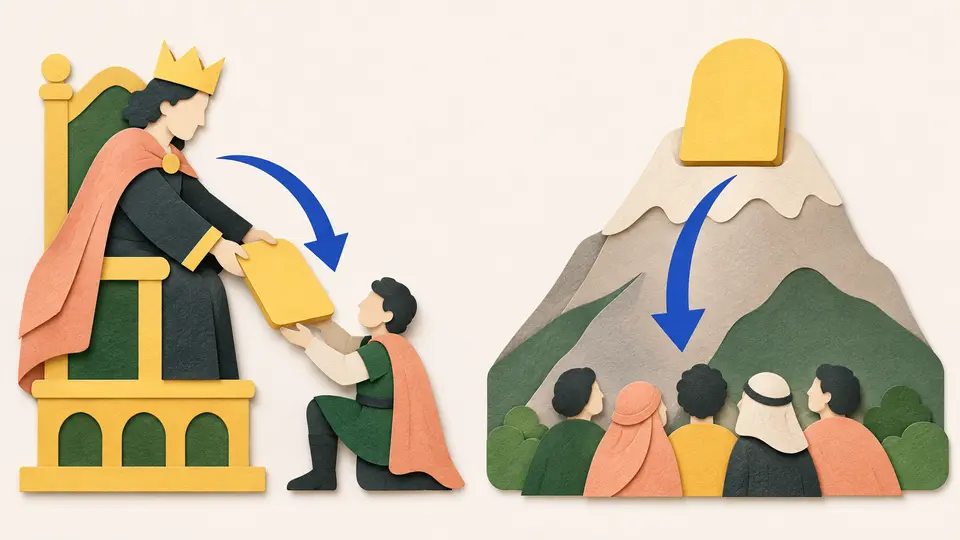
The covenant at Sinai reads like an ancient treaty
In the ancient Near East, two parties could seal a pact by passing between the cut pieces of a sacrificed animal. The Bible still speaks of "cutting" a covenant, and the Hebrew word for covenant, brit, may come from a root with the sense of cutting.
The Bible's central covenant is the one at Sinai, told in Exodus 19 to 24 and again in Deuteronomy. By biblical tradition it's how Israel became a community. It's also laid out like a treaty.
Hittite rulers of the 14th and 13th centuries BCE made treaties with their vassals, the rulers of their client states. The treaties were lopsided. The king set the terms and spelled out the misfortunes that would follow rebellion. The vassal swore an oath that called punishment down on himself if he broke them.
Sinai follows the pattern. God opens by recounting past help. "I the Lord am your God who brought you out of the land of Egypt, out of the house of bondage." Then God forbids loyalty to any rival power and sets the terms. The Ten Commandments are among them, and Israel is to be "a kingdom of priests and a holy nation" if it keeps them.
The people answer, "All the things that the Lord has commanded we will do." Blood from sacrificed oxen is sprinkled on the altar and on the people to seal the agreement. Later, at Shechem, all the tribes pledge themselves to it again under Joshua.
Sinai isn't the first covenant in the Hebrew Bible. After the flood, in Genesis 9, God makes one with Noah that takes in all of humanity and every living creature. God promises never again to destroy all life on earth by flood and sets the rainbow in the sky as its sign.
The covenant with Abraham is narrower, made with one man and his family line. In Genesis 15 Abraham cuts a heifer, a goat and a ram in two and lays the halves opposite each other. After dark, a smoking oven and a flaming torch pass between the pieces, and God promises his descendants the land from the river of Egypt to the Euphrates.
In Genesis 17 God promises to make Abraham the father of many nations. Abraham circumcises himself and his household and commits to circumcision in every generation.
Two more covenants follow. One is with Aaron and his descendants, the priests. The other, in 2 Samuel 7, promises David that his dynasty will last forever. Jewish hope for a messiah draws on that promise, since the messiah is expected to be a future king from David's line.
Try to recallHow do the Hebrew Bible's covenants with Noah and with Abraham differ from the covenant at Sinai?
The covenant with Noah takes in all of humanity and every living creature, with God's promise never again to destroy all life by flood and the rainbow as its sign. The covenant with Abraham concerns him and his family line, promising land and many descendants, with circumcision as its sign. The covenant at Sinai is made with the whole people of Israel, who agree to keep God's commandments, including the Ten Commandments.
So the Bible's covenants narrow as they go. Noah's takes in every living creature, Abraham's one family line, and Sinai's the people that family became.
Three of them come with a sign. The rainbow marks the covenant with Noah, and circumcision marks the covenant with Abraham. God gives Israel the Sabbath as the permanent sign of the covenant at Sinai.
Lessons in this topic
The covenant at Sinai reads like an ancient treaty
The Hebrew Bible pictures Israel's bond with God as a treaty with terms and penalties, and sets it beside earlier covenants with Noah and with Abraham.
Where the 613 commandments come from
Jewish tradition counts 613 commandments in the Torah. See where the number comes from, why some rabbis doubted it, and why fewer than half can be kept today.
Seven laws for all humanity
Rabbinic tradition asks Jews to keep the whole Torah and everyone else to keep seven laws named after Noah, with no need to convert.
Why Orthodox, Conservative and Reform Jews differ on law
All three movements speak of a covenant with God. They part over where the authority of Jewish law comes from, and Reform's own answer changed between 1885 and 1999.
Three quick stories from this topic
A commandment for every day
The Talmud counts 613 commandments, with 365 prohibitions to match the days of the year
The count is Rabbi Simlai's. The other 248 are positive commands, one for each limb of the body. By one standard reckoning only 271 of the 613 can be observed today, because many depend on the Temple in Jerusalem, which no longer stands.
No single definitive list
The Talmud gives the number, and later scholars drew up lists that differ in how they interpret the Torah's passages. The most famous, by Maimonides, uses fourteen rules to decide what counts as a commandment.
Most can't be kept today
Many commandments can only be observed at the Temple in Jerusalem, which no longer stands. By one standard reckoning, 77 positive and 194 negative commandments can be observed today.
Why a covenant is cut
In the Bible a covenant is "cut," and Genesis shows one sealed between halved animals
Abraham cuts a heifer, a goat and a ram in two and lays the halves opposite each other. After dark a smoking oven and a flaming torch pass between the pieces, and God makes a covenant with him. The word for covenant, brit, may come from a root for cutting.
A pact sealed by sacrifice
In Genesis 15, the covenant of the pieces, Abraham offers animal sacrifices and God promises his descendants the land from the river of Egypt to the Euphrates. At Sinai, blood from sacrificed oxen is sprinkled on the altar and the people.
A cut in every generation
In Genesis 17, Abraham circumcises himself and his household and commits to doing so forever. Jewish scholars take circumcision, brit milah, as a symbol of the sealing of the covenant.
Seven laws for everyone
Rabbinic Judaism doesn't ask non-Jews to convert, only to keep seven laws named after Noah
Six are prohibitions, on idolatry, blasphemy, murder, sexual immorality, theft and eating flesh torn from a living animal. The seventh requires courts of justice. A non-Jew who keeps them counts as righteous, with a share in the World to Come.
A share in the World to Come
Maimonides equated the righteous of the nations, who have a share in the World to Come without becoming Jews, with the non-Jews who keep these laws. He held that they must accept the laws as revealed by God.
Who counts as a Noahide
Because of Islam's strict monotheism, Muslims were considered Noahides. The status of Christians was debated, but since the later Middle Ages many authorities have come to regard Christianity as Noahide too, though some still disagree.
Sources
- Covenant (biblical) - Wikipedia, Wikimedia Foundation
- The Covenant: A Relationship with Consequences | My Jewish Learning, My Jewish Learning
- Covenant, Jewish Encyclopedia (1906)
- Genesis 15:7-18 (JPS Tanakh, Gender-Sensitive Edition), Sefaria
- Makkot 23b (William Davidson Edition, English), Sefaria
- 613 commandments - Wikipedia, Wikimedia Foundation
- Noachide Laws, Jewish Virtual Library
- Seven Laws of Noah - Wikipedia, Wikimedia Foundation
- Shituf, Wikimedia Foundation