Religion & Worldviews · Religious traditions & communities
Hinduism
What Hindus share when there's no single founder, creed or church. Meet the main ideas, the gods, the scriptures and the daily worship of about 1.2 billion people.
What you will learn
- Explain where the words Hindu and Hinduism came from and why the name is recent
- Describe how Hinduism grew from the Vedas and later texts without a single founder
- Explain dharma, rebirth and moksha and the four goals of a Hindu life
- Describe what happens in puja at a home shrine or temple
Lesson 1 of 4 · 4 min
A religion with no founder and a name from a river
In the 6th century BCE the Persian king Darius I carved a list of his provinces into stone. One of them was Hindush, the land along the Indus River. That's the earliest form of the word Hindu.
The Sanskrit name of the river was Sindhu. Persians said it as Hindu and used it for anyone who lived beyond the Indus. For centuries the word named a place and its people, not a faith.
From the 14th century, texts in India used Hindu to set people apart from Muslims. The English word Hinduism first shows up in a letter of 1787. Ram Mohan Roy may have been the first Indian to use it, around 1816.
Before British rule sorted people by religion, most Indians described themselves by region, language, caste or sect. Many Hindus prefer an older-sounding name for their tradition, Sanatana Dharma, the eternal dharma.
Hinduism has no single founder, no single scripture and no agreed set of teachings. So how did it hold together?
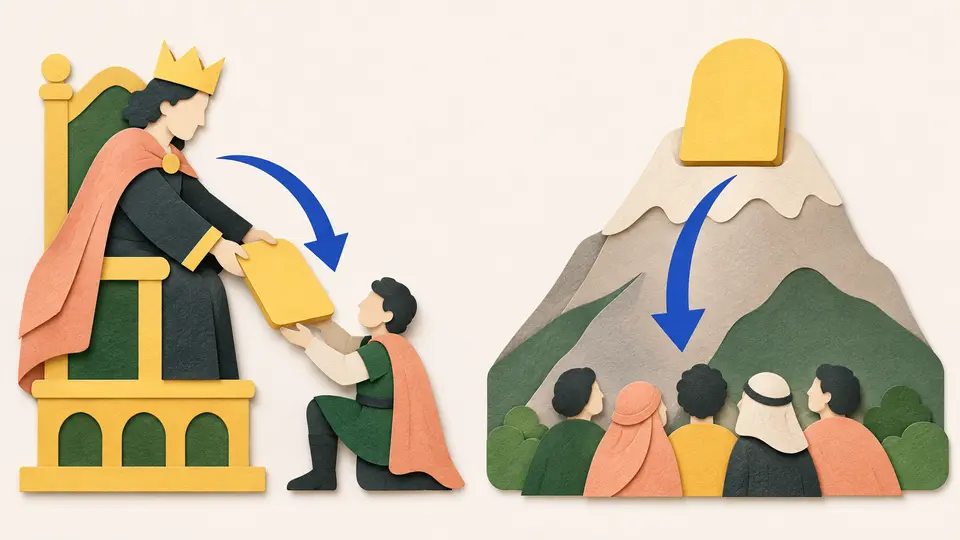
Its oldest layer is the Vedas, hymns and ritual texts in Sanskrit. The oldest, the Rigveda, was composed about 1500 to 1200 BCE and passed on by memory for centuries. Hindus call the Vedas shruti, what was heard. They see them as revelation that no human wrote.
Later texts are called smriti, what was remembered. They include the great epics, the Mahabharata and the Ramayana, and the Puranas, books of stories about the gods. These spread the ideas of the Vedas through stories anyone could follow.
Scholars describe a synthesis. Between about 500 BCE and 300 CE, the priests' Vedic tradition merged with many local cults and customs. The result is often called a family of religions, with relatives that share texts and ideas.
Try to recallHow did Hinduism come together without a single founder?
It grew in layers. The Vedas, composed from about 1500 BCE and passed on by memory, form the oldest layer. Later epics and Puranas retold their ideas as stories, and between about 500 BCE and 300 CE this Vedic tradition merged with many local cults and customs.
Hindu began as a Persian word for the people of the Indus, and Hinduism as a name is barely 250 years old. You can now explain how the Vedas, the epics and local worship grew into one family of traditions.
Lessons in this topic
A religion with no founder and a name from a river
Find out where the words Hindu and Hinduism came from, and how one family of traditions grew from many sources without a founder.
What Hindus aim for and how puja puts it into practice
Learn the four goals of life, from duty to final release from rebirth, and see how a daily offering at a home shrine fits them together.
Vishnu, Shiva, the Goddess and the one behind them
Meet the large devotional traditions centered on Vishnu, Shiva and the Goddess, and see why many Hindus treat many gods as faces of one reality.
Hinduism beyond India and the fight over who defines it
Follow Hinduism to Bali and the Caribbean, meet the reformers who reshaped it, and see why Hindus still argue over what makes someone Hindu.
Three quick stories from this topic
Custom over creed
72% of Hindus in India say a person who eats beef can't be a Hindu
Only 49% said the same about someone who rejects belief in God. For many Hindus, being Hindu is about what you do and eat as much as what you believe. Cows have long been seen as sacred.
North and south differ
Southern Indian Hindus were much less likely to rule out beef eaters, 50% against 83% in the north and center.
Who decides?
The question of what makes someone Hindu, belief, custom or homeland, is argued over in Indian politics today.
A word from a river
The word Hindu began as a Persian name for the people living beyond the Indus River
The Sanskrit name of the river was Sindhu, and Persians said it as Hindu. For centuries the word named a place and its people, and the English word Hinduism first appeared only in 1787.
Carved in stone
A 6th-century BCE inscription of the Persian king Darius I lists Hindush, the land along the Indus, among his provinces.
An older name
Many Hindus call their tradition Sanatana Dharma, the eternal dharma, rather than Hinduism.
One God, many faces
In a survey of nearly 30,000 people in India, only 7% of Hindus said there are many gods
The most common answer, from 61% of Hindus, was one God with many manifestations. Many Hindus see Vishnu, Shiva, the Goddess and the rest as faces of one ultimate reality.
Favorites still matter
Most Hindus feel close to more than one god. Shiva was chosen most often, by 44%, then Hanuman and Ganesha.
A personal god
Seeing gods as forms of one reality lets a Hindu love one deity without denying the others.
Sources
- Hinduism, Wikipedia
- Hinduism at a glance, BBC Religions
- Vedas - Wikipedia, Wikimedia Foundation
- Hinduism Basics, Hindu American Foundation
- Religion in India: Tolerance and Segregation, Pew Research Center