Religion & Worldviews · Religion, history & society
Buddhism on the Silk Road
How monks, translators and pilgrims carried Buddhism from India to China along the Silk Road, and what the caves at Dunhuang reveal about the faiths that met on the route.
What you will learn
- Describe how Buddhism reached China along the Silk Road
- Explain why oasis monasteries mattered to monks traveling the Silk Road
- Explain why early Chinese translations of Buddhist texts were hard to get right
- Describe how Kumarajiva's translation team worked at Chang'an
Lesson 1 of 4 · 6 min
How Buddhism crossed the desert to China
Around the year 400, a Chinese monk named Faxian left Dunhuang, a frontier town in China's far west, and walked into the desert. The crossing took 17 days. He wrote that the only marks showing the way were "the dry bones of the dead."
Faxian was heading for India. Buddhism had long since made the same trip in the other direction. How does a religion cross a desert like that?
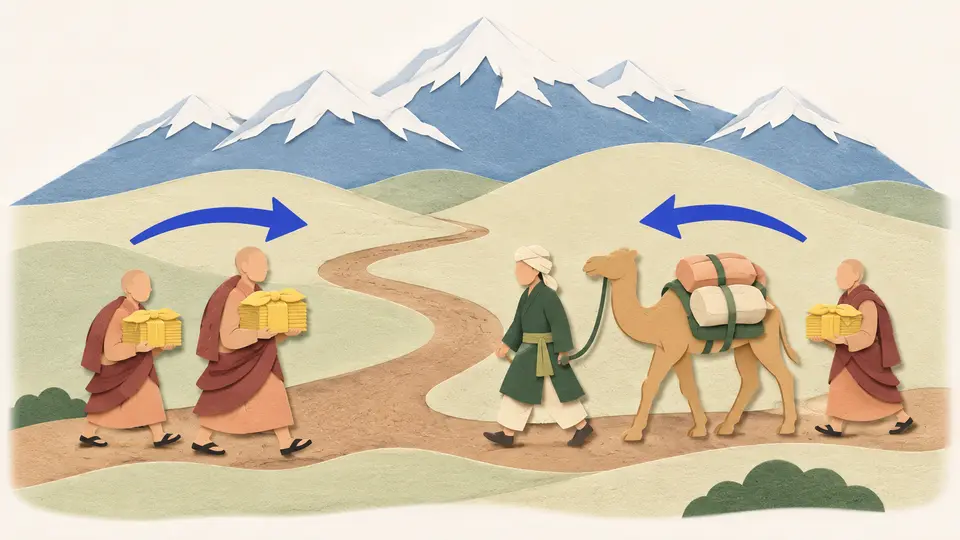
It went with the traffic. Networks of land and sea routes linked India with Central Asia and China, and the overland ones are now called the Silk Road. Merchants, monks and lay believers shared them. Indian monks traveled to China, and Chinese monks traveled to India.
By the second century CE a Buddhist community had formed at Luoyang, then the Chinese capital. The first people to translate Buddhist texts into Chinese there were foreigners. They were Parthians, Sogdians and Indians who had come in along those routes.
Most of the carriers left no names. Foreign monks traveling between India and China took Buddhism beyond courts and scholars to ordinary people.
People along the way remembered it like that. Near the Indus River, locals told Faxian a story handed down from their fathers. Long ago, monks from India had crossed the river heading east, carrying sutras, the Buddhist scriptures, and books of monastic rules.
Between India and China lay deserts and mountains, so travelers moved from one water source to the next. Buddhist monasteries grew up at the irrigated oases along the way, places such as Khotan, Kucha, Turfan and Dunhuang.
Faxian's travel record shows what an oasis monastery offered. Khotan, he wrote, was a pleasant and prosperous kingdom with tens of thousands of monks, all fed from a common store. Its monasteries kept rooms for monks arriving from anywhere and gave them whatever else they needed.
The ruler lodged Faxian's party in a monastery of 3,000 monks. A bell called them to meals, which they ate in complete silence. A monk who wanted more food wasn't allowed to call out. He signaled with his hand.
Hospitality had limits. In Udyana, monasteries fed a visiting monk for three days and then told him to find his own lodging. In another kingdom the locals were so stingy that three of Faxian's companions had to go back to an earlier town for supplies.
The oases were also schools. In the kingdoms Faxian passed through, the monks all studied Indian books and the Indian language. More than two centuries later another Chinese pilgrim, Xuanzang, found the monks of Kucha still following teachings and rules like India's.
And they were trading towns. Xuanzang described one where merchants from the surrounding countries gathered and lived.
Try to recallWhy did oasis monasteries matter to Buddhist monks traveling the Silk Road?
Monasteries grew up at irrigated oases such as Khotan, Kucha and Dunhuang, and they gave traveling monks food and shelter between the deserts and mountains. In Khotan, Faxian found rooms kept for monks arriving from anywhere. The monasteries also kept their learning close to India's, since their monks studied Indian books and the Indian language. Hospitality had limits, though. In Udyana a visiting monk was fed for only three days.
So Buddhism reached China one oasis at a time. Foreign monks carried the texts, and the monasteries along the way fed them and kept Indian learning within reach.
The gate at the Chinese end was Dunhuang. "Everybody coming into and out of China had to pass through Dunhuang," says the art historian Mimi Gardner Gates. Caravans took on food and water there for the desert, and its prefect supplied Faxian's party for the 17-day crossing.
Lessons in this topic
How Buddhism crossed the desert to China
Buddhism reached China on foot, carried by foreign monks along the Silk Road. See who brought it and why the monasteries at desert oases kept them going.
The captive monk who gave Chinese Buddhism its words
Buddhist ideas had no ready words in Chinese, and early translations misled their readers. See how Kumarajiva, brought to Chang'an by force, led a team whose versions are still in use.
The monks who went to India for the missing texts
Faxian set out for India on foot at about 60, and Xuanzang defied a travel ban two centuries later. See what each was looking for and what he brought home.
The thousand caves of Dunhuang and their sealed library
Monks cut hundreds of painted shrines into a cliff near Dunhuang with donors' money. A walled-up room found there in 1900 held about 50,000 documents in many languages and from many faiths.
Three quick stories from this topic
The monk two rulers fought over
Two rulers in China sent armies to seize one Buddhist monk, who became a great translator
Kumarajiva was born in 344 in the oasis kingdom of Kucha. The general sent to fetch him turned warlord and held him captive for years, which is probably when he learned Chinese. A second army brought him to Chang'an in 401, and Chinese Buddhists still use his translations.
How his team worked
He read a text aloud and explained it in Chinese. Monks and students debated it until a Chinese version emerged, and he checked it before it was written down. Over a thousand monks attended the daily sessions.
Why his versions lasted
The team put meaning ahead of word-for-word accuracy, so the texts read smoothly. Where a later, more literal translation exists, his has often stayed the more popular one.
The real monk behind the novel
The monk in Journey to the West was a real man who defied a travel ban to reach India
Xuanzang left China around 629, when travel abroad was banned, and came back in 645 with hundreds of Buddhist texts. Legends grew around the trip. About nine centuries after his death they became the novel, which gives the monk four protectors, one of them a monkey.
A monk and his monkey
In the novel, the monk Tang Sanzang, Xuanzang's fictional counterpart, is protected on his journey by four powerful disciples. One of them, the monkey, became a popular favorite. He's had a deep influence on Chinese culture and on contemporary Japanese manga and anime, and Arthur Waley's translation made him well known in the West.
The account behind the story
Emperor Taizong asked Xuanzang to describe the lands he'd crossed, and the monk composed the first book of his Records of the Western Regions in 646. After his death, his travels became fantastic legends that were retold in plays and novels.
The oldest dated printed book
The oldest known dated printed book is a Buddhist scroll printed in China in 868
It's a copy of the Diamond Sutra, printed from woodblocks, and a note at the end says it was made for free distribution. It lay in a walled-up cave at Dunhuang from the 11th century until 1900, among some 50,000 other documents.
How it was found
A Daoist priest, Wang Yuanlu, was clearing sand from the caves in 1900. By one account he followed a drift of cigarette smoke to a walled-up room packed with manuscripts.
Whose words it carries
The Chinese text on the scroll is the translation Kumarajiva made around 401. The archaeologist Aurel Stein bought the scroll from Wang in 1907.
Sources
- Buddhism on the Silk Routes, University of Washington
- The Global, Multicultural Past of Dunhuang | Getty News, J. Paul Getty Trust
- The Journey of Faxian to India, University of Washington
- Faxian - Wikipedia, Wikimedia Foundation
- Xuanzang's Record of the Western Regions, University of Washington
- Kumārajīva - Wikipedia, Wikimedia Foundation
- Xuanzang - Wikipedia, Wikimedia Foundation
- Mogao Caves - Wikipedia, Wikimedia Foundation
- Diamond Sutra - Wikipedia, Wikimedia Foundation