Religion & Worldviews · Secular worldviews
Atheists, agnostics and the nones
What atheist and agnostic mean, who counts as a religious none and how people with no religion grew to nearly a quarter of the world's population.
What you will learn
- Distinguish the two main senses of the word atheism
- Explain what Thomas Henry Huxley meant by the word agnostic
- Identify the three answers Pew combines into the religious nones
- Explain why having no religious affiliation doesn't always mean having no beliefs
Lesson 1 of 4 · 5 min
Can you be an atheist and an agnostic at once?
Say three people are asked, "Does God exist?" One says yes. One says no. One says, "I haven't made up my mind." How many atheists are in the room? Either one or two, because the word has two meanings in use.
Start with the believer. A theist is someone who believes that God exists, or that there are gods. In the broad sense, an atheist is anyone who isn't a theist. Atheism is then just lacking the belief that God exists, so the undecided person counts too.
Philosophers of religion usually mean something narrower. For them, atheism is the claim that God doesn't exist, or more broadly that there are no gods. Suspending judgment isn't enough. An atheist in this sense denies that God exists, so only one person in the room qualifies.
The narrow sense has one clear advantage. It makes atheism a direct answer to the question. Theism answers yes, and atheism answers no.
The broad sense has serious defenders. The philosopher Antony Flew proposed it, and some scholars use it as an umbrella term that they divide into "strong" and "weak" atheism. Both senses are legitimate, because each reports how many people use the word. So when someone says they're an atheist, it's fair to ask which one they mean.
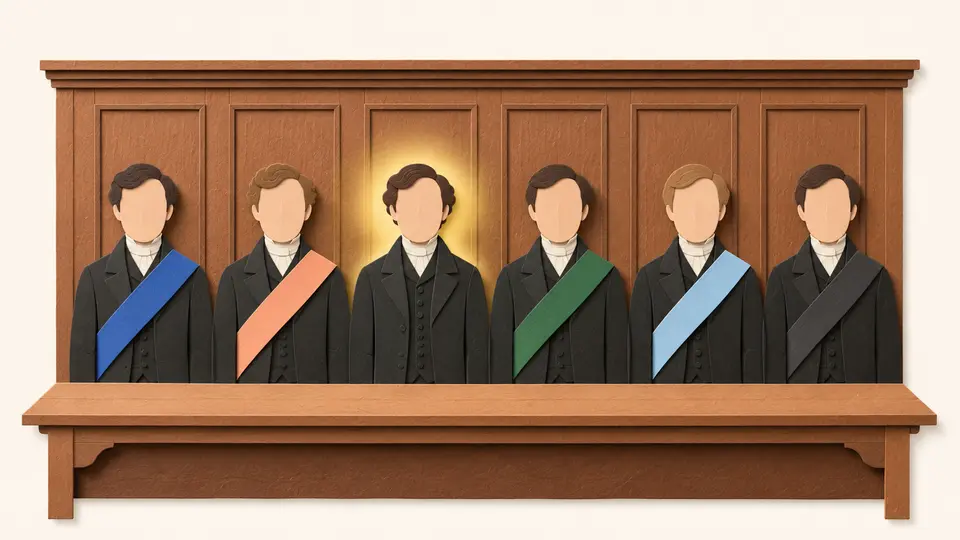
The word agnostic has a known inventor and a known year. In 1869 the English biologist Thomas Henry Huxley joined the Metaphysical Society, a club formed to debate questions of philosophy and religion. Its members included a cardinal.
Huxley recalled that most of his colleagues were "-ists of one sort or another" and that every variety of opinion was represented. He called himself "the man without a rag of a label to cover himself with" among them. He felt like the fox in the fable who loses his tail in a trap and has to face the other foxes.
So he invented a label. He took gnostic, the church-history name for people who claimed to know a great deal about the very things he felt ignorant of, and put the Greek a-, meaning without, in front of it. He paraded the word at the society "to show that I, too, had a tail." To his great satisfaction, it caught on.
For Huxley, agnosticism was a method, and it came down to one rule. "In matters of the intellect do not pretend that conclusions are certain which are not demonstrated or demonstrable."
Applied to God, the rule led him to say that neither belief nor disbelief had enough evidence behind it, so people ought to suspend judgment. That's the usual meaning today. An agnostic has considered whether God exists and believes neither that God does nor that God doesn't.
Try to recallWhat did Thomas Henry Huxley mean by the word agnostic when he coined it?
Huxley coined agnostic in 1869 at the Metaphysical Society, where most members identified with some school of thought and he had no label. He meant it as the opposite of the gnostic of church history, who claimed to know a great deal about things Huxley felt ignorant of. For him, agnosticism was a method built on one rule, which was never to call a conclusion certain unless it's demonstrated or demonstrable. Applied to God, that rule meant suspending judgment.
The two words can describe the same person. Philosophers also use agnosticism for a claim about knowledge, that nobody knows whether God exists. In that sense it combines with either belief. Some atheists call themselves agnostic atheists. Agnostic theists believe in God while denying that anyone can truly know the divine.
Atheist and theist describe what you believe. Agnostic, in this second sense, describes what you think can be known. They answer two different questions.
Lessons in this topic
Can you be an atheist and an agnostic at once?
Atheist has two meanings in use, and agnostic was coined in 1869 by a biologist who felt he had no label. See what each word claims and why one person can be both.
Who America's nones are and what they still believe
About 28% of U.S. adults tell pollsters they have no religion. See the three groups inside that number and why most of them still believe in God or a higher power.
How the nonreligious grew to nearly a quarter of the world
About 1.9 billion people had no religious affiliation in 2020. See where they live, and how their share grew although they're older and have fewer children than the major religious groups.
Has the rise of the nones stalled?
The share of Americans with no religion climbed from 16% in 2007 to 29% in 2023-24. See what drove the rise and why Pew thinks it has paused, at least for now.
Three quick stories from this topic
Nones who believe
Most Americans who say they have no religion still believe in God or a higher power
Pew Research Center calls them the nones, and in 2023 they were about 28% of U.S. adults. Only 29% of them reject any higher power or spiritual force. What most have left is organized religion, since 90% seldom or never go to services.
Three answers, one label
Nones are people who answer atheist, agnostic or nothing in particular when asked their religion. 63% choose nothing in particular, and atheists are the smallest group at 17%.
Why they left
Two-thirds say they question religious teachings or don't believe in God. And 47% call a dislike of religious organizations an extremely or very important reason.
Two-thirds are in China
Two of every three people in the world with no religion live in China
A 2025 Pew study counted 1.9 billion people with no religious affiliation in 2020, and about 1.3 billion were in China. Chinese surveys ask about formal religious identity, so the count includes people who keep spiritual beliefs and practices without claiming a religion.
What the measure leaves out
The measure is called zongjiao identity. People who hold religious or spiritual beliefs but don't consider themselves affiliated with any religion are counted as having none.
Counts and shares
The United States has the second-largest number, about 101 million. Japan has fewer, 73 million, but they're 57% of its population.
The man without a label
The word agnostic was coined in 1869 by a biologist who had no label for his own views
Thomas Henry Huxley had joined a debating society where most members were "-ists of one sort or another." He felt like the fox in the fable who has lost his tail. So he made up a name, the opposite of the gnostics who claimed to know about divine things.
What he meant
For Huxley agnosticism was a rule about evidence. Don't pretend a conclusion is certain unless it's demonstrated or demonstrable.
What it means now
Applied to God, the rule led Huxley to suspend judgment. Today an agnostic usually means someone who believes neither that God exists nor that God doesn't.
Sources
- Atheism and Agnosticism, Stanford Encyclopedia of Philosophy
- Agnosticism (1889), Clark University
- Agnosticism - Wikipedia, Wikimedia Foundation
- The Huxley File: Agnosticism, Clark University
- Religious 'Nones' in America: Who They Are and What They Believe | Pew Research Center, Pew Research Center
- The World's Religious Groups: How Their Sizes Changed from 2010 to 2020 | Pew Research Center, Pew Research Center