Everyday Systems · Energy, waste & recycling
Keeping the electricity grid in balance
Electricity is used the instant it is made. See who keeps supply matched to demand, why power travels at high voltage and why the United States runs on three grids that barely share.
What you will learn
- State the balance condition the grid has to satisfy at every moment
- Say who does that balancing and what they control
- Explain why long-distance transmission uses high voltage while delivery uses low voltage
- Identify where in the journey the voltage changes and what equipment changes it
Lesson 1 of 4 · 5 min
Why the grid has to match supply to demand every second
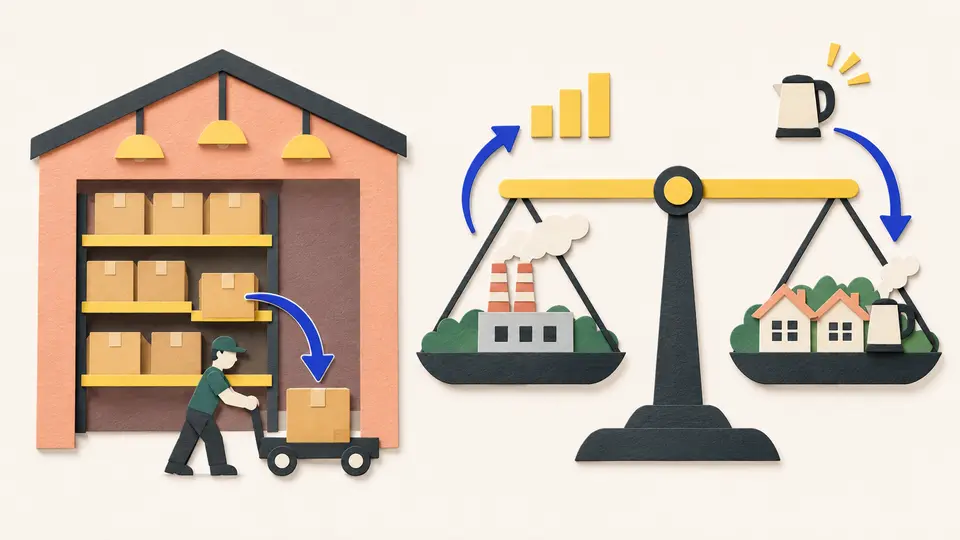
On July 4, 1990, the penalty shootout ended in England's World Cup semi-final against West Germany. As it did, Britain's demand for electricity jumped by 2,800 megawatts, the largest surge of its kind on record. Viewers across the country had gotten up to switch on a kettle, and the jump equaled about a million kettles boiling at once.
A warehouse could meet a rush like that from its shelves. The grid can't, because it has almost no shelves. Grids can't store electricity in large quantities, so the power for those kettles had to be generated as they were switched on.
That's the rule the whole system runs on. For the grid to stay stable, the electricity supplied has to match demand, continuously. If the two fall out of balance, local or even widespread blackouts can follow.
The first sign of a mismatch is the grid's frequency. Generators across a US grid turn in step, producing current that cycles 60 times a second. When demand runs ahead of supply, the extra load drags on the generators and the frequency falls.
A small dip is normal. A large one makes protective equipment cut off customers or disconnect lines, to save the rest of the network.
Preventing that is somebody's job. In the United States, organizations called balancing authorities run the system day to day, each in its own region. Most are electric utilities. They have two levers. They make sure enough electricity is available for expected demand, and they manage transfers of power with neighboring authorities.
It helps to see the grid as two layers. The bottom layer is physical. The power lines of the lower 48 states are joined into three giant networks, called interconnections, in the East, the West and Texas.
The top layer is operational. Balancing authorities decide, minute by minute, what flows through those wires. The Eastern and Western networks each contain dozens of them.
Texas is the exception. There a single organization, the Electric Reliability Council of Texas or ERCOT, is the balancing authority for the whole network.
Balancing isn't only about making more power. Operators also watch demand. British grid staff study TV schedules, because the end of a popular show sends viewers to their kettles.
The smart grid goes a step further. It adds digital communication to the traditional system, so information can travel between utilities and customers. Smart devices in homes and factories can tell customers when prices are higher, or when there's an incentive to use less.
Say you set the dishwasher to run overnight instead of at dinnertime, when everything else is on. That demand has moved to a quieter hour, and nobody has to find supply for it at the peak.
Electricity is made the moment it's used. So every switch you flip is answered by a generator somewhere on your network, and a balancing authority is making sure the two stay matched. The grid's frequency, 60 cycles a second, shows how well they're doing.
Lessons in this topic
Why the grid has to match supply to demand every second
Electricity is used the instant it's made, so someone has to keep generation matched to demand all day. See what happens when they drift apart and who does the matching.
Why electricity travels at high voltage and arrives low
Electricity is stepped up for the long haul and stepped down before it reaches you. See what transformers do and why higher voltage wastes far less energy.
The US has three power grids, and Texas has its own
The lower 48 states run on three networks that rarely share power. See what that structure protects against, where it stops helping and why Texas stands alone.
How 4,000 separate power companies became three grids
See what utilities gained by connecting their wires, why sharing spare capacity works and why the next long line is mostly an argument about who pays.
Three quick stories from this topic
The World Cup kettle surge
The end of a 1990 World Cup shootout added 2,800 megawatts to Britain's power demand
As the match ended, viewers got up together and switched on their kettles. The jump equaled about a million kettles boiling at once. A grid can't store electricity in large quantities, so that power had to be generated at that very moment.
Supply has to match demand
For a grid to stay stable, the electricity supplied has to match demand continuously. If they fall out of balance, blackouts can follow.
Who keeps the match
British grid operators study TV schedules to see such surges coming. In the United States, organizations called balancing authorities keep the match, each in its own region.
Ten times the voltage
The same power sent down a wire at ten times the voltage loses a hundred times less heat
A wire's heat loss rises with the square of the current, and higher voltage delivers the same power with less current. That's why long-distance lines run at 115,000 volts or more, and why transformers step the voltage down before it reaches your street.
Up for the journey
Transformers at substations step the voltage up after the power plant, for the long-distance transmission lines.
Down for safety
Near towns, transformers step the voltage down again, because lower voltage is safer to use in homes and businesses.
Three grids, one for Texas
The lower 48 states run on three separate power grids, and most of Texas has its own
The Eastern and Western grids divide at the Rocky Mountains and rarely exchange power. Texas keeps its grid inside the state, which leaves it mostly outside federal regulation. In a February 2021 winter storm, that grid came within minutes of shutting down completely.
Where the lines fall
The Eastern Interconnection covers everything east of the Rocky Mountains plus part of the Texas panhandle. The Western Interconnection covers everything from the Rockies west, and ERCOT covers most of Texas.
In Texas, one system plays every role
ERCOT is unique because its balancing authority, its interconnection and its regional transmission organization are all the same entity and physical system.
Sources
- Electricity explained: How electricity is delivered to consumers, US Energy Information Administration
- TV pickup, Wikimedia Foundation
- Utility frequency, Wikimedia Foundation
- Texas Interconnection, Wikimedia Foundation
- U.S. electric system is made up of interconnections and balancing authorities, US Energy Information Administration, Today in Energy
- Electric power transmission, Wikimedia Foundation
- 2021 Texas power crisis, Wikimedia Foundation