Everyday Systems · Transport & delivery
Why traffic jams form
See what a road's capacity measures, why a single slowdown travels backward as a wave and why merging does more damage to traffic than almost anything else.
What you will learn
- State what traffic engineers mean by the capacity of a road section
- Explain why exceeding capacity produces a queue that grows backward
- Describe how a single slowdown can propagate backward as a shock wave
- Identify the visual cues that can trigger a sudden slowdown
Lesson 1 of 4 · 5 min
What a road's capacity actually measures
A stretch of highway can carry more traffic when the people driving on it know it well. Nothing about the road changes. To see why, you need the traffic engineer's idea of capacity.
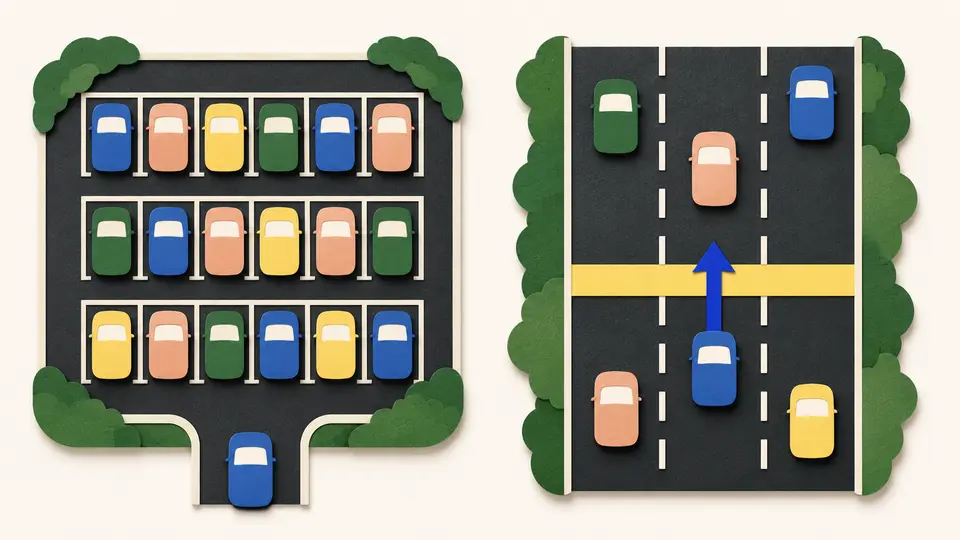
Ask why traffic is bad and most people say too many cars are using the road at once. Engineers agree, and they make it precise. Capacity is a road's ability to move vehicles past a point in a given span of time.
So capacity is a rate, counted at one spot. A road doesn't fill up the way a parking lot does. What matters is how many vehicles can cross a line each minute, and whether more than that are arriving.
The road sets most of that rate. The number and width of lanes and shoulders matter. So do merge areas at interchanges, and the grades and curves of the route. A toll booth is a special case, a squeeze built in on purpose.
Then there's the wild card, driver behavior. Research has found that drivers who know a routinely congested road space themselves closer together than drivers on quieter roads. Smaller gaps mean more vehicles cross the line each minute.
Weather pushes the other way. In rain, fog or low sun, drivers slow down and leave longer gaps, so the same road passes fewer vehicles.
Once capacity is a rate, you can predict what happens when more vehicles arrive than can get through. Flow breaks down. Speeds drop, vehicles crowd together and traffic backs up behind the tight spot.
Why behind? Vehicles that have passed the tight spot are through and moving. Those still arriving have nowhere to go, so the line grows back toward where traffic comes from. That's why you meet the tail of a jam long before you see what caused it.
The delay also snowballs. Each vehicle that joins the back has to wait, and it makes the line longer for everyone who arrives after it.
So a jam is a mismatch between two rates. Capacity is how many vehicles can pass a point each minute. Demand is how many arrive. When demand is higher, the extra vehicles wait in a queue upstream, and the queue keeps growing until the mismatch ends.
Lessons in this topic
What a road's capacity actually measures
A road's capacity is a rate, vehicles past one point per minute. See what sets it, and why a jam grows backward when more vehicles arrive than can get through.
Why a traffic jam can have nothing at the front
One driver braking in dense traffic can start a slowdown that travels backward as a wave. See what sets it off, and what 22 cars on a circular track showed.
Seven causes of congestion and what they share
Crashes, road work, weather, busy days, special events, signals and bottlenecks all cut how many vehicles a road can pass. See why that changes what counts as a fix.
Why merging does the most damage to traffic flow
Short of snow, ice or dense fog, nothing disrupts traffic more than merging. See why the damage depends on how many vehicles merge in a given space and time.
Three quick stories from this topic
Merging does the most damage
Short of snow, ice or dense fog, nothing disrupts highway traffic more than merging
When a lane closes, the trouble comes from vehicles squeezing into the next lane while the drivers there slow down to let them in. How bad it gets depends on how many must merge in a given space and time, which is why ramp signals release cars one by one.
What decides the severity
How badly a merge disrupts flow is related to how many vehicles must merge in a given space over a given time, so the space and time available matter as well as the count.
The worst case
Freeway-to-freeway interchanges are a special case of on-ramps and are typically the most severe form of physical bottleneck because of the high traffic volumes involved.
Regular drivers raise capacity
A highway carries more traffic when its drivers are used to congestion
Drivers who know a routinely jammed road space themselves closer together than drivers elsewhere. A road's capacity is the number of vehicles that can pass a point each minute, so smaller gaps let more through. In rain or fog, drivers spread out and it falls.
Capacity is a rate
Engineers measure a road by how many vehicles it can move past a point in a given time. How many fit on it is a different number.
The wild card
Lanes, shoulders, curves and grades set most of a road's capacity. The US Federal Highway Administration calls driver behavior the wild card.
The 22-car traffic jam
Twenty-two cars circling a track jammed themselves with no obstacle in the way
In a 2008 experiment in Japan, drivers on a 230-meter circle were asked to hold a steady speed. Small differences in spacing grew until several cars stopped dead. The jam then crept backward around the track at about 12 miles per hour.
The jam moves, the cars pass through
Every car in a jam like this moves forward while the jam itself travels backward. Traffic engineers call it a shock wave.
Why the road ahead is empty
The wave moves away from whatever set it off, so drivers can crawl for minutes and then find nothing at the front.
Sources
- Traffic Congestion and Reliability, Chapter 2: The Nature of Traffic Congestion and Reliability, US Federal Highway Administration
- Ramp Metering: A Proven, Cost-Effective Operational Strategy. A Primer, section 1, US Federal Highway Administration
- Traffic jams without bottlenecks: experimental evidence for the physical mechanism of the formation of a jam, New Journal of Physics (IOP Publishing), Sugiyama and others, 2008