Everyday Systems · Objects & appliances
Inside a microwave oven
Follow microwaves from a radar tube into your dinner, see why the middle stays cold, and find out why the leftovers aren't radioactive but a calm cup of water can still erupt.
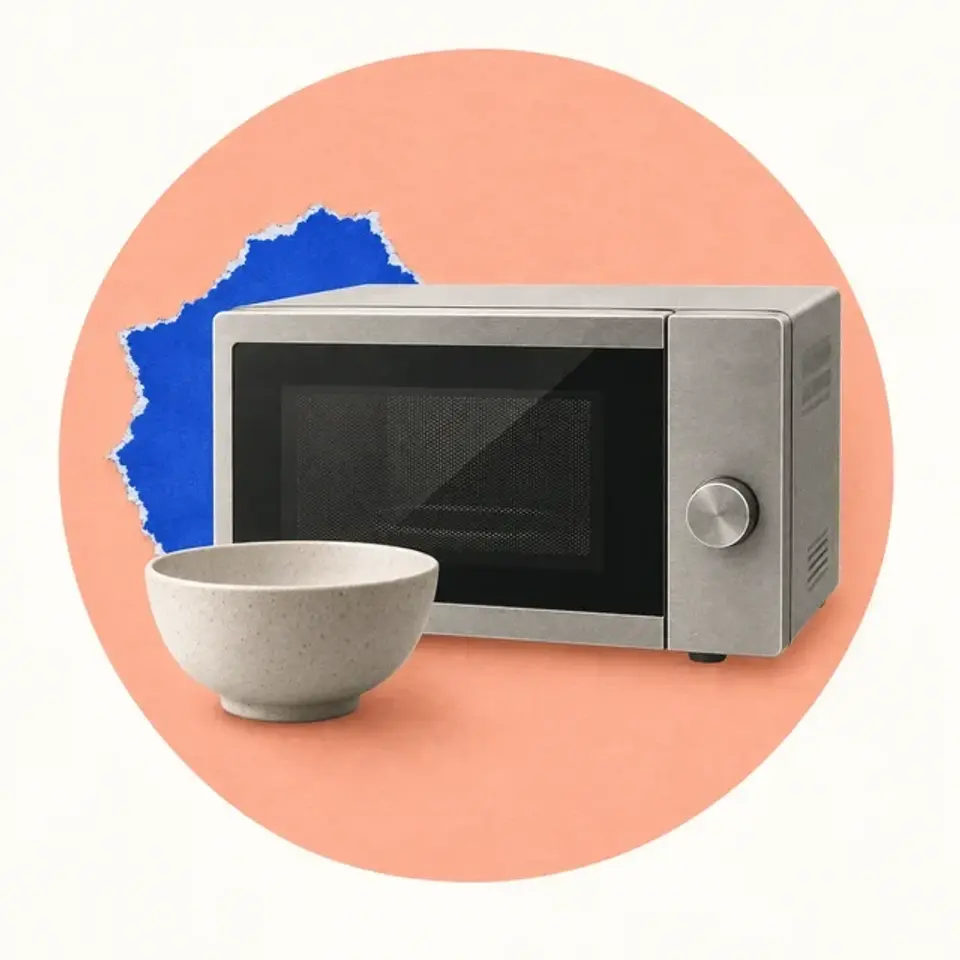
What you will learn
- Explain how microwave energy becomes heat in food.
- Explain why a dish can get hot even when microwaves pass through it.
- Explain why a microwave doesn't simply heat food from the inside out.
- Explain why knowing how food heats is no substitute for a reliable food-safety procedure.
Lesson 1 of 4 · 3 min
Where the heat in a microwave oven comes from
In 1945 Percy Spencer, an engineer at Raytheon, was working beside a live radar set when the candy bar in his pocket started to melt. The first food he cooked on purpose was popcorn. The second was an egg, which exploded in an experimenter's face.
To test the idea, he fed microwaves from a magnetron, the tube that makes a radar's waves, into a metal box. Your oven is that box. Microwaves are electromagnetic waves, like radio waves and light. The metal walls reflect them until food absorbs them.
Raytheon's first oven, sold in 1947, stood almost 1.8 meters tall and weighed 340 kilograms.
What absorbs the waves is mostly water. Microwaves make the water molecules in food vibrate, and that vibration is heat. So the heat is made in the food itself. Nothing hot has to touch it first.
That's why watery foods, like fresh vegetables, cook faster than dry ones. It's also why a microwave can use less energy than a conventional oven, which has to heat its whole compartment as well as the food.
Three behaviors make microwaves useful for cooking. Food absorbs them. Metal reflects them. Glass, paper, ceramic and many plastics let them pass straight through.
So the waves reach your soup as if the glass bowl weren't there. Metal does the opposite. A metal pan or foil bounces the waves away from the food, which cooks it unevenly and can damage the oven.
Then why is the bowl too hot to hold? The waves didn't heat it. The soup did. Heat flows from hot soup into whatever it touches, and the bowl is touching a lot of soup.
That's a second route for the energy. It's also why some plastic containers don't belong in a microwave. The waves pass through them, and then the hot food melts them.
Try to recallWhy can a microwave-safe bowl get too hot to hold even though microwaves pass straight through it?
The waves pass through the bowl and heat the food. Heat then flows from the hot food into the bowl it's touching, so the bowl gets hot secondhand.
Lessons in this topic
Where the heat in a microwave oven comes from
Follow the waves from a radar tube into your soup, and see why the bowl comes out hot even though the waves pass straight through it.
Why the middle of microwaved food stays cold
A microwave doesn't cook from the inside out. See where the waves put their heat, why frozen patches resist them and what standing time is for.
Why microwaved leftovers aren't radioactive
See why microwaved food doesn't become radioactive, what the oven's door is doing, and why heat is the hazard that's left.
Why calm water from the microwave can erupt
See how water in a microwave can pass its boiling point without a single bubble, and why the FDA says the coffee goes in first.
Three quick stories from this topic
Not from the inside out
A microwave oven doesn't cook food from the inside out
The waves reach the outer layers first. The FDA says the inside of thick food is cooked mainly by heat conducted inward from those hot outer layers. That's why a thick dish can be bubbling at the edges and still cold in the middle.
A hot edge proves less than you think
Different parts of the same dish can be at different temperatures. A warm surface or one hot bite doesn't tell you how thoroughly the center has heated.
Heat still moves the ordinary way
Conduction carries heat from warmer parts of the food into cooler ones. A microwave changes how energy gets into the meal, but many of the rules for what happens next stay the same.
The 340-kilogram microwave
The first microwave oven on sale was almost 1.8 meters tall and weighed 340 kilograms
Raytheon's Radarange of 1947 was water-cooled and drew 3 kilowatts. It grew out of radar work. Two years earlier a Raytheon engineer, Percy Spencer, had noticed a candy bar melting in his pocket while he worked beside a live radar set.
Popcorn first, then an egg
The first food Spencer cooked on purpose was popcorn. The second was an egg, which exploded in the face of one of the experimenters.
Still a radar tube in a box
Spencer fed microwaves from a magnetron into a metal box. A modern oven does the same. The walls reflect the waves until the water in the food absorbs them as heat.
Hotter than boiling, and calm
Water microwaved in a clean cup can be hotter than boiling and still look calm
Bubbles need a scratch or a speck to start on, and a smooth cup of plain water may offer none. The FDA has had reports of serious burns from cups that erupted when someone picked them up or stirred in instant coffee.
Boiling needs a starting point
Bubbles form at scratches, particles or grains. A clean, smooth cup of plain water that nobody disturbs has few of those sites, so the water keeps heating past its boiling temperature until a movement or an added spoonful sets off sudden boiling.
Add the coffee first
The FDA says adding instant coffee or sugar before heating greatly reduces the risk, because the grains give bubbles somewhere to begin. Adding them afterward can be the disturbance that sets off the eruption.
Sources
- Microwave Ovens, U.S. Food and Drug Administration
- Microwave oven, Wikimedia Foundation
- Microwave-Assisted Superheating and/or Microwave-Specific Superboiling (Nucleation-Limited Boiling) of Liquids Occurs under Certain Conditions but is Mitigated by Stirring, Molecules, via PubMed Central