Everyday Systems · Energy, waste & recycling
Where household trash goes
After the truck leaves, trash is buried, burned or dumped. See how a modern landfill is built, what an incinerator does with its heat and ash and why the mix differs so much between countries.
What you will learn
- Explain why household waste is split into separate streams before collection
- Describe what a transfer station does and why it saves money
- Describe how a landfill's liner, drains and daily cover protect groundwater
- Explain why buried trash decays slowly and gives off methane
Lesson 1 of 4 · 4 min
The trip from your bin to the transfer station
Put a bag out on collection day and it's gone by lunch. In 2018, people in the United States threw away about 4.9 pounds each every day. Where it goes depends on which bin it went into.
Most towns collect waste in separate streams. Recycling goes to a sorting plant. Food and garden scraps go to composting or digestion. Everything else is residual waste, and it goes to a landfill or an incinerator. Each stream gets its own truck run because each has a different destination.
Towns push hard for that split. The European Union required its member states to collect food and garden waste separately, or have it composted at home, by the end of 2023. Some Japanese towns ask households to sort trash into as many as 30 categories.
A garbage truck is a compactor on wheels. A hydraulic blade squeezes each load so more fits inside. When a compactor was first built into a truck, in 1938, it could double what the truck held.
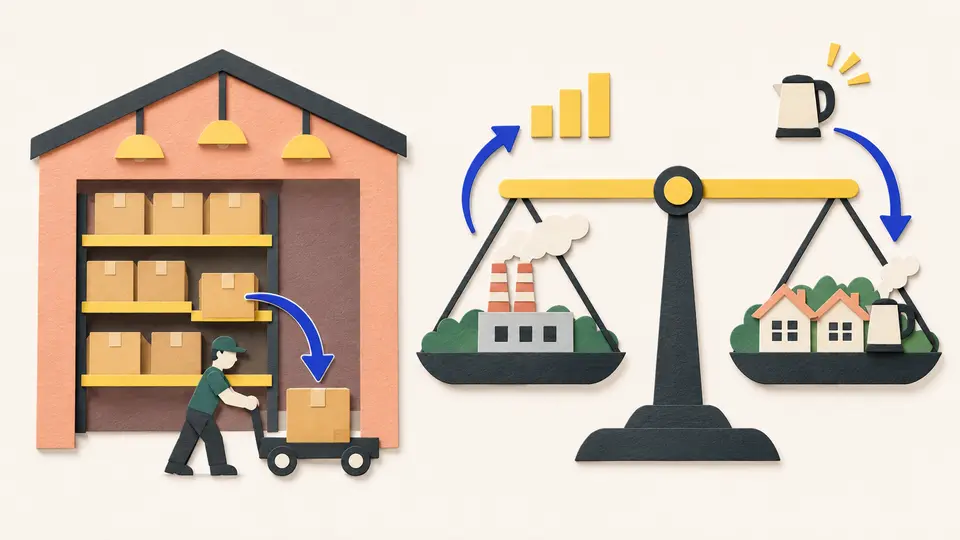
Even packed tight, a city truck carries only a few tons, and landfills are often far from town. So many trucks unload at a transfer station instead. There, waste from several trucks is loaded into big trailers, railcars or barges. Nothing is stored for long. The waste usually leaves within hours.
The reason is cost per ton per mile. In a US EPA example, a collection truck carries 7 tons and a transfer trailer 21, both at $3 a mile. The station adds about $10 a ton. Past about 35 miles round trip, the bigger load wins. Below that, driving straight to the landfill is cheaper.
Japanese cities use the same idea. Small compacting trucks fit down narrow streets and feed central stations, where larger trucks take over.
Try to recallWhy does a transfer station save money when the landfill is far from town?
A city garbage truck carries only a few tons, so driving it a long way costs a lot per ton. A transfer station moves the loads of several trucks into one big trailer. The trailer costs about the same per mile but carries three times the waste, so the cost per ton falls once the trip is long enough.
Your trash is sorted by destination. The residual bag rides in a compacting truck, often to a transfer station, then on in a big trailer to a landfill or an incinerator.
Lessons in this topic
The trip from your bin to the transfer station
Learn why trash is split into separate bins and why most of it stops at a transfer station before it reaches a landfill or incinerator.
How a modern landfill keeps trash sealed in
See how liners, drains and daily cover keep a landfill's liquid out of groundwater, and why buried trash makes methane instead of rotting away.
Burning trash for heat and power
Find out how a waste-to-energy plant turns trash into electricity and heat, what's left in its ash and smoke, and why some countries burn most of what they throw away.
Where no garbage truck comes
See how much of the world's trash is never collected, why open dumps and fires harm health, and who makes a living sorting the waste by hand.
Three quick stories from this topic
Readable buried newspapers
Newspapers buried in landfills for decades can still be read
Archaeologist William Rathje's Garbage Project dug into landfills and kept finding newsprint you could still read. Under the soil, buried trash runs out of oxygen, and the microbes left behind work very slowly.
Why it doesn't rot
A compost heap gets air, and fast-working microbes need oxygen. A covered landfill uses up its oxygen in less than a year.
What happens instead
Microbes that live without oxygen break waste down slowly into gas that's about half methane, which many landfills capture.
The ski-slope incinerator
Copenhagen's trash-burning power plant has a ski slope on its roof
Amager Bakke opened in 2017 and burns the city's waste to make electricity and heat for homes. In 2018 a dry ski run, a hiking trail and a climbing wall opened on its 85-meter building.
Heat from trash
Denmark has used heat from burning waste for more than a century, piping hot water to homes through district heating.
Cleaner smoke
Modern plants hold their exhaust hot enough to break down dioxins, then filter it before it leaves the stack.
The uncollected third
A third of the world's trash is never collected or is dumped in the open
The World Bank counted 2.56 billion tonnes of household and city waste in 2022. In low-income countries, just 3% of waste is treated in any way, and the rest is left in heaps or burned.
Less trash, less collection
People in the US and Canada make 2.2 kg or more a day, against 0.2 kg or less in Niger, yet poorer places collect far less.
Who fills the gap
Waste pickers collect and sell much of what cities miss, facing smoke, injuries and trash slides as they work.
Sources
- National Overview: Facts and Figures on Materials, Wastes and Recycling, US Environmental Protection Agency
- Directive (EU) 2018/851 amending Directive 2008/98/EC on waste, EUR-Lex, European Union
- Waste management in Japan, Wikipedia
- Waste Transfer Stations: A Manual for Decision-Making (EPA530-R-02-002, 2002), US Environmental Protection Agency
- Garbage truck, Wikipedia
- Tucson Garbage Project, Wikipedia
- Basic Information about Landfill Gas, US Environmental Protection Agency, Landfill Methane Outreach Program
- Compost, Wikipedia
- Amager Bakke, Wikipedia
- Incineration, Wikipedia
- What a Waste 3.0, World Bank Group
- Ten charts that explain the global waste crisis, World Bank Blogs