Everyday Systems · Energy, waste & recycling
What happens after you put something in recycling
Follow an item from the bin through sorting to a new product. See why a buyer decides whether anything gets recycled, what labels really claim and why a hopeful guess at the bin does harm.
What you will learn
- Describe the main stages that turn collected material into a new product
- Explain why collection totals alone don't prove that material became a new product
- Explain why local collection guidance matters when you decide where an item belongs
- Tell "recyclable" apart from "recycled content"
Lesson 1 of 4 · 3 min
What happens between the bin and a new product
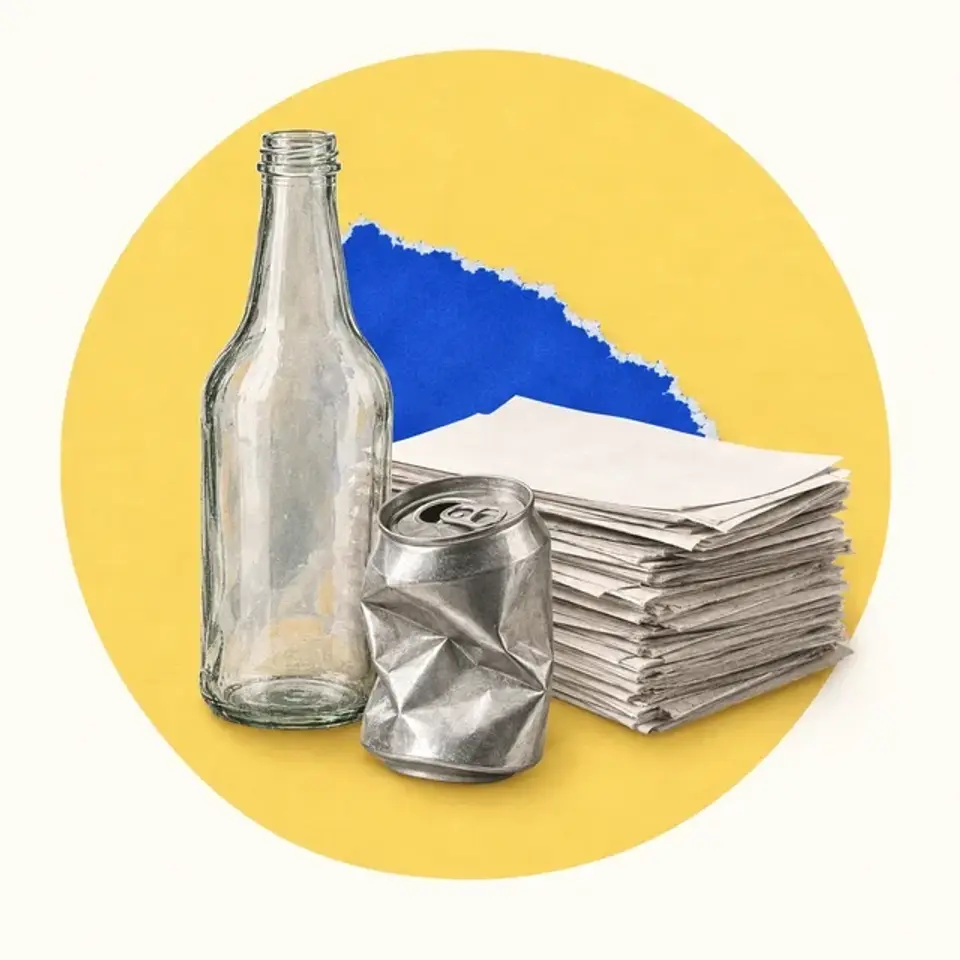
In 2018, Americans recycled about 69 million tons of everyday trash. Two thirds of it was paper and cardboard. Glass, plastic and wood each made up only 4% to 5%.
Every ton began the same way, with someone dropping an item in a bin. That's collection, the first of three steps. A hauler takes the material away, and nothing has been recycled yet. It still has to be processed and then made into something new.
The hauler's truck unloads at a materials recovery facility. There the mix is sorted into separate materials, cleaned of what doesn't belong and prepared for shipping.
Some materials need a second stop. Glass and plastic often go on to specialist plants that make them ready for a mill or factory.
Sorting matters because factories are particular. A paper mill needs paper, and a bottle plant needs glass. Sorting connects a mixed truckload to one manufacturing process.
The last step is remanufacturing, making something new from the recovered material at a paper mill, a bottle plant or another factory. The new product is often not the old one. Recovered glass goes into asphalt for roads, and recovered plastic into carpeting and park benches.
It saves energy either way. The US Environmental Protection Agency, the EPA, says recycling just 10 plastic bottles saves enough energy to power a laptop for more than 25 hours.
So "how much was recycled" can mean three different numbers. There's the tonnage collected. There's the usable material that left the sorting plant. And there's the amount manufacturers made into new products.
The numbers can shrink at each step, because sorting throws out what doesn't belong. So a collection total can't tell you the outcome. The EPA lists inconsistent measurement among the system's own problems.
Try to recallA report says a community collected a thousand tons of material for recycling. What else would you want to know before claiming all of it became new products?
I'd want to know how much usable material was left after sorting and processing, and how much of it manufacturers actually used in new products.
Lessons in this topic
What happens between the bin and a new product
Follow an item through collection, sorting and remanufacturing, and see why a collection total doesn't tell you how much became something new.
Why your town's recycling rules beat the label
See why a package can be recyclable in one town and trash in the next, and what "recyclable", "recycled content" and "post-consumer" each claim.
Recycling only works when someone buys the material
See why sorted material still needs a buyer, what happened when the biggest buyer of plastic waste stopped buying, and why reducing and reusing rank above recycling.
Why guessing at the recycling bin backfires
See what a wrong item costs a sorting facility, then use the EPA's check-first rule on bags, cans, caps and greasy boxes.
Three quick stories from this topic
Don't crush the can
In one-bin recycling, a crushed can is harder for the sorting plant to detect
The US Environmental Protection Agency says aluminum cans generally should not be crushed before recycling. Where every material goes in the same bin, the plant has to pick cans out of the mix, and flattened ones are harder to detect. Where materials are collected separately, crushing is fine.
One bin or several
Single-stream programs take all recyclables in one bin and sort them later. Multi-stream programs ask households to keep materials apart.
Check before you toss
Local programs differ, so the EPA's rule is to put nothing in the bin unless you know your provider accepts it.
Batteries beat plastic
In 2018 the US recycled 99% of its lead-acid batteries but under 9% of its plastic
By the US Environmental Protection Agency's count for that year, paper and cardboard came in at 68% and glass at 25%. Recovered materials are bought and sold like raw materials, so whether something gets recycled depends heavily on whether a manufacturer wants it back.
Paper carries the total
Paper and cardboard made up about 67% of everything recycled in the US in 2018. Glass, plastic and wood each made up 4% to 5%.
The bin is only the start
Collected material still has to be sorted, cleaned and sold to a manufacturer before it becomes a new product.
A contaminated load
Putting the wrong item in a recycling bin can get the whole load thrown out
The US Environmental Protection Agency warns that non-recyclable items contaminate the load around them. At the sorting facility they can damage equipment and must be picked out and sent to landfill. Plastic bags, electronics and textiles generally don't belong in a curbside bin.
What contamination costs
At a recycling facility, wrong items can damage sorting equipment. They have to be picked out and then sent to landfill. Each step adds cost, and a load that's too costly to clean is thrown out along with the good material in it.
Check before you toss
The EPA's rule is to put nothing in the bin unless your local provider accepts it. Plastic bags and film usually belong at store drop-off points rather than in curbside bins, and containers should be empty and rinsed.
Sources
- The U.S. recycling system, US Environmental Protection Agency
- Recycling basics and benefits, US Environmental Protection Agency
- National Overview: Facts and Figures on Materials, Wastes and Recycling, US Environmental Protection Agency
- How Do I Recycle Common Recyclables, US Environmental Protection Agency
- Frequent Questions on Recycling, US Environmental Protection Agency