Everyday Systems · Energy, waste & recycling
Energy bills, meters and tariffs
An energy bill charges for the units you used and for being connected at all. See how a meter counts, what the fixed charge pays for, why a unit can cost more at six in the evening and where the money goes.
What you will learn
- Work out a bill from its unit rate and standing charge
- Explain what the standing charge pays for and what happens if it's removed
- Explain how a meter counts energy and why estimated bills can go wrong
- Describe how prepayment and smart meters work and what each one risks
Lesson 1 of 4 · 4 min
Why an empty home still gets an energy bill
Open an electricity bill and you'll find two prices. One is the unit rate, the price of each kilowatt-hour you use. A kilowatt-hour is the energy a 1,000-watt heater uses in one hour. The other is the standing charge, a fee for every day you're connected, even a day you use nothing.
Your tariff is the deal that sets both prices. Britain's regulator, Ofgem, lists three main kinds. A fixed tariff locks the prices for a period. A variable tariff moves with the cost of energy. A multi-rate tariff charges more at some hours than others. Britain's price cap limits the unit rate and standing charge on variable tariffs, but not the total bill, so using more still costs more.
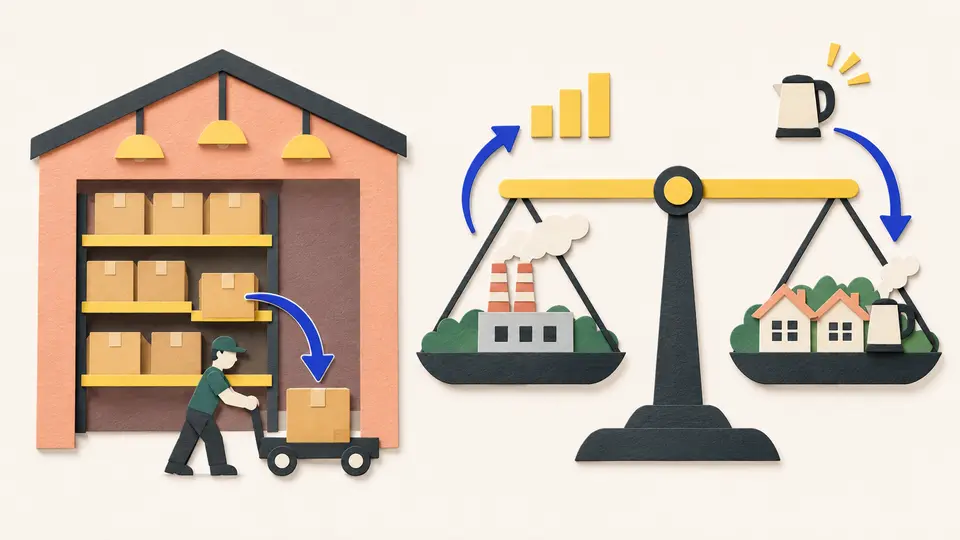
Why pay for a day with no use? Some costs don't shrink when you switch things off. The standing charge recovers those fixed costs. In Britain, Ofgem says it depends on the cost of building and improving the local network and on how much energy people in the region use on average.
So it varies by place. Under Britain's price cap for late 2026, a home paying by direct debit and using no electricity would pay about £157 a year in London and about £247 in Merseyside and North Wales. Same country, same zero use, about £90 apart.
Standing charges are unpopular. When Ofgem reviewed them, tens of thousands of people wrote in to complain. In 2025 it consulted on a tariff with no standing charge, with the fixed costs moved into the unit rate. The costs don't vanish, so a tariff like that helps people who use little and costs more for people who use a lot.
Try to recallWhy does a home that uses no electricity still pay a standing charge, and what changes if that charge is folded into the unit rate?
The standing charge pays for fixed costs, such as building and improving the local network, that don't fall when you use less. Folding it into the unit rate doesn't remove those costs. It spreads them over each kWh, so people who use little pay less and heavy users pay more.
A bill is units times the unit rate plus days times the standing charge. The daily part pays for fixed costs like the local network, which is why it varies by region and never drops to zero.
Lessons in this topic
Why an empty home still gets an energy bill
Learn the two prices on every energy bill, how to work out a bill from them and why you pay a daily charge even when you use nothing.
How your meter counts, and what happens when it doesn't
See how a meter turns flowing power into a number on a bill, why estimated bills go wrong and how prepayment and smart meters change the deal.
Why power can cost more at six in the evening
Find out why electricity costs more to supply at busy times, how tariffs try to move demand and how much households really shift.
Where the money from your energy bill goes
Break a bill into energy, wires, running costs, policies and tax, then see why the same kilowatt-hour costs several times more in some places than others.
Three quick stories from this topic
Thermostats beat willpower
Letting thermostats react to prices on their own cut homes' peak use by up to 44%
A 2008 survey of 15 pricing pilots found plain time-of-use rates trimmed peak demand by just 3 to 6%. Very high prices on a few days did better, and adding automatic controls pushed the cut to 27 to 44%.
Why peaks matter
The grid is built for the busiest hour, and the costliest plant running sets the wholesale price.
Machines don't forget
Shifting use works best when a timer or thermostat does it, not a person watching the clock.
The Dutch negative tax
Taxes on Dutch household electricity added up to less than zero in early 2026
Eurostat put taxes at minus 9.9% of the typical Dutch household price. Every household connection gets a fixed yearly tax discount whatever it uses, and for a typical home that discount outweighed the taxes charged.
The EU picture
Across the EU, taxes and levies were about 28% of household electricity prices, and 47% in Poland.
Why prices differ
With taxes and fuel costs added in, Irish households paid more than three times what Hungarian households did per kWh.
Edison's weighed meter
Thomas Edison's early meters billed customers by weighing metal plates
His system ran current through a chemical cell. At intervals, workers took out its plates and weighed them, and the change set the bill. It was hard work to read and customers disliked it.
The disc that replaced it
Later meters spun an aluminum disc at a speed matching the power, so each turn stood for a fixed amount of energy.
Reading without a visit
Smart meters now send their readings to the supplier on their own, so bills no longer rely on estimates.
Sources
- How your electricity or gas bill is calculated, Ofgem (Great Britain)
- Energy price cap, Ofgem (Great Britain)
- Kilowatt-hour, Wikipedia
- Energy price cap unit rates and standing charges, Ofgem (Great Britain)
- Benchmark maximum charges for charge restriction period 17a (1 October to 31 December 2026), Ofgem (Great Britain)
- Lower standing charge tariffs: next steps, Ofgem (Great Britain)
- Household Response to Dynamic Pricing of Electricity: A Survey of the Empirical Evidence (Faruqui and Sergici, 2008), SSRN, via Crossref
- Electricity price statistics, Eurostat
- Electricity meter, Wikipedia