Everyday Systems · Food & cooking
How bread is made
Flour, water, yeast and salt become a loaf through kneading, rising and baking. See what gluten does, what yeast eats, how the oven sets the crumb and browns the crust, and how flatbreads manage without a rise.
What you will learn
- Explain how glutenin and gliadin form gluten when wet flour is worked
- Explain why gluten lets dough hold gas and what kneading does to it
- Explain where yeast's food comes from and what yeast makes from it
- Explain how temperature and time change the rise and the flavor
Lesson 1 of 4 · 4 min
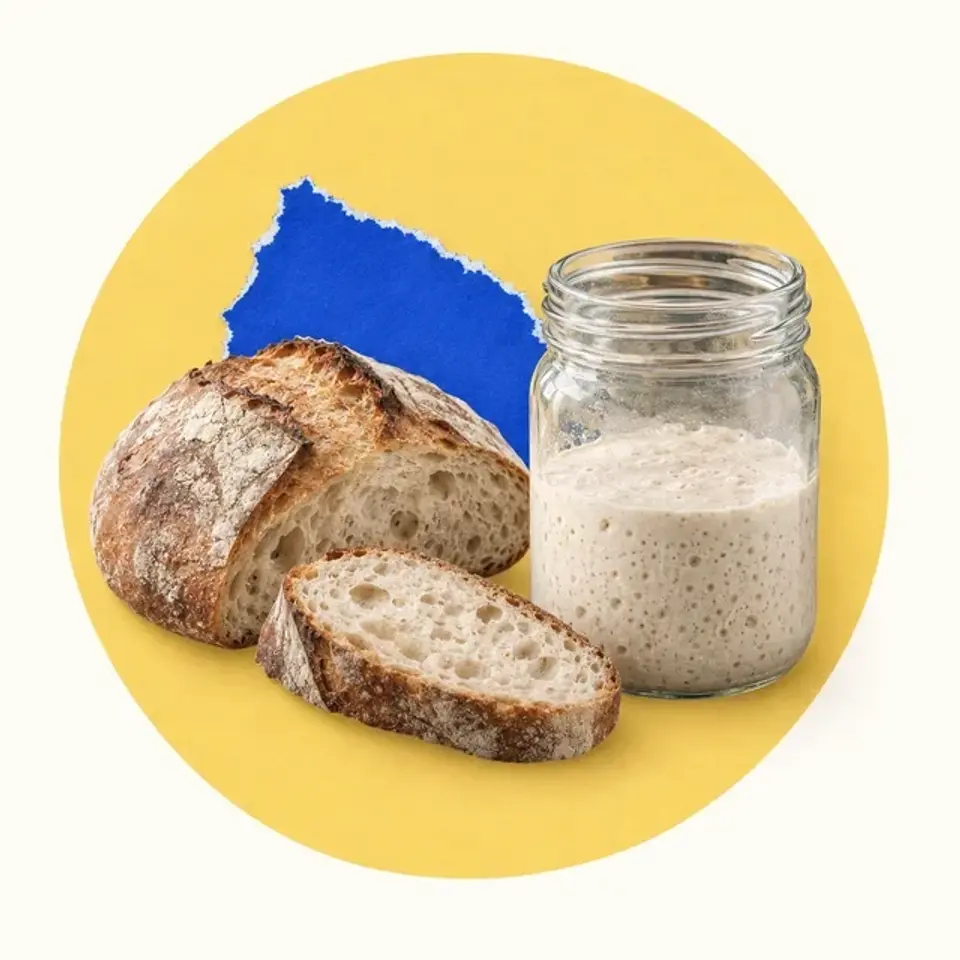
The stretchy net that holds bread up
Stir flour into water and you get a sticky paste. Work it for a while and it turns smooth, stretchy and springy. Nothing new went in. So what changed inside the dough?
Starch makes up about 70% of flour, but the change comes from two wheat proteins, glutenin and gliadin. Dry, they sit separately. With water and working, they join into one continuous network called gluten.
The two proteins do different jobs. Glutenin molecules link end to end through chemical bridges into long chains, which act as an elastic backbone. That's why stretched dough springs back. Gliadin clings to those chains and lets the dough stretch without tearing.
Bread flour has more of these proteins, about 12 to 14%, than softer flours. More protein means a stronger net and a chewier loaf.
Gluten matters because of gas. Yeast makes bubbles of carbon dioxide throughout the dough. The gluten net stretches around each bubble and traps the gas, so thousands of small balloons swell together and the dough rises.
Without strong strands, the bubbles escape and the dough collapses into a heavy, dense loaf. That's why kneading matters. Pressing, stretching and folding the dough lines up the proteins and builds more links between them.
Longer kneading gives a chewier bread. Time can do the same work, since a wet, low-yeast dough left for over 12 hours builds gluten with no kneading at all. Salt helps too, because it strengthens the net.
Bakers avoid kneading pastry, muffins and scones for the same reason. There, a strong net would make them tough and rubbery.
Try to recallWhy does a well-kneaded wheat dough rise into a light loaf when the same dough barely mixed may come out dense?
Kneading builds strong gluten strands by lining up and linking the proteins. That net stretches around each bubble of yeast gas and holds it in. With weak strands the gas escapes and the dough collapses into a dense loaf.
Wet, worked wheat flour links two proteins into gluten, a springy, stretchy net. Kneading or long resting strengthens it, and that net is what traps yeast gas and lifts the loaf.
Lessons in this topic
The stretchy net that holds bread up
See how two wheat proteins link into gluten when you wet and work flour, and why that net is what lets dough trap gas and rise.
What yeast eats and why slow dough tastes better
Follow the sugar from flour starch into yeast, see what the yeast makes from it, and learn how warmth, cold and time change the rise and the flavor.
What the oven does to a loaf
See why dough jumps in size in the oven, what sets it into crumb, how the crust browns and why bakers fill the oven with steam.
Breads without a yeast rise or without wheat
See how chapati and corn tortillas work without a rise, why rye bread is dense and how Ethiopian injera gets its holes from teff and days of fermenting.
Three quick stories from this topic
The three-minute loaf
By 2011, over 80% of British loaves came from a 1961 method with 3 minutes of mixing
Researchers at Chorleywood in England found that extra yeast, additives and intense mixing develop dough quickly. It let bakers skip the long rise and use cheaper low-protein wheat.
Softer and longer-lasting
The BBC reported in 2011 that the method made the average British loaf 40% softer.
What it skips
A long, slow rise builds flavor in dough. The fast method trades that time for speed and price.
A bread with 68 yeasts
Ethiopian injera batter ferments for up to three days and hosts at least 68 kinds of yeast
Teff batter sits for 24 to 72 hours with a starter saved from the last batch. Researchers have also found at least 107 species of lactic acid bacteria in it, which give injera its sour taste.
Where the holes come from
Bubbles from the fermenting batter rise as it cooks under a lid, leaving the spongy eyes.
A different grain
Teff has no strong wheat gluten, so the bread relies on fermentation and a boiled-batter binder.
Steam lifts the loaf
When bread jumps up in the oven, steam does more of the lifting than yeast gas
Heat turns water in the bubble walls into steam, which swells every bubble. By one calculation steam gives about 60% of this oven spring, and heat soon kills the yeast anyway.
Then it sets
The gluten firms and the starch swells and sets, fixing the bubbles into crumb.
Why bakers add steam
Steam in the oven keeps the skin soft, so the loaf can spring further before the crust sets.
Sources
- Gluten, Wikipedia
- The structure and properties of gluten: an elastic protein from wheat grain (Shewry et al., Philosophical Transactions of the Royal Society B, 2002), Royal Society, via Europe PMC
- Science of Bread: Bread Science 101 (archived copy), Exploratorium
- Bread, Wikipedia
- Kneading, Wikipedia
- Chorleywood bread process, Wikipedia
- Chorleywood: The bread that changed Britain (7 June 2011), BBC News
- Injera, Wikipedia