Everyday Systems · Food & cooking
Why food spoils and how to slow it
See food going bad as microbes growing, at a pace set by conditions you can change. Find out which foods carry which hazards, why milk sours in a working fridge, and why canning needs more than boiling water.
What you will learn
- Describe spoilage and foodborne illness as microbial growth rather than as food changing on its own
- Use minimum, optimum and maximum growth temperatures to predict how a storage choice changes growth
- State how the burden of foodborne illness is distributed across the population
- Match a named bacterial hazard to the foods it's most often linked with
Lesson 1 of 4 · 5 min
Food goes bad because something is growing in it
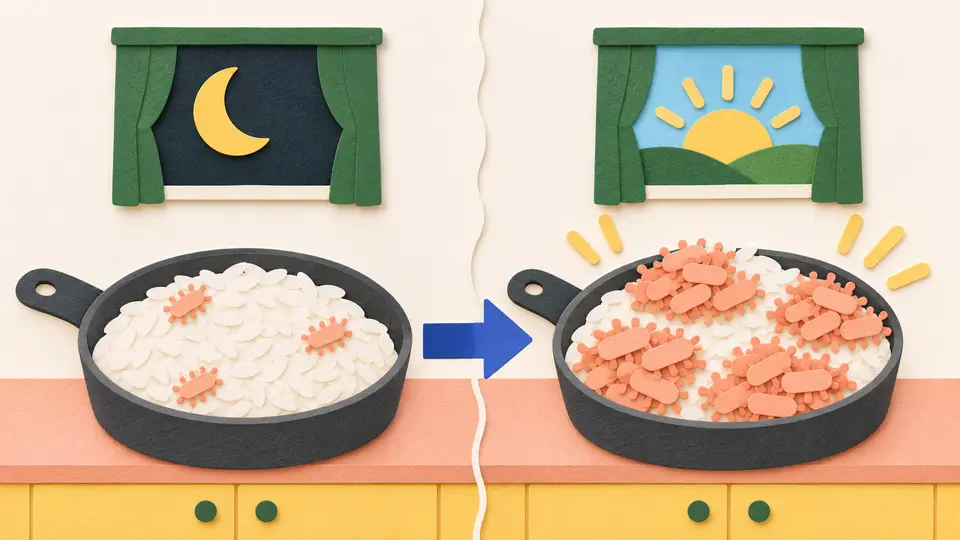
A pan of rice left on the counter overnight isn't the same pan of rice in the morning. Something grew in it. That's the most useful way to think about food going bad, because a growing population needs certain conditions, and you can change those conditions.
Two different things can go wrong, and everyday speech lumps them together. Spoilage is food turning unpleasant, whether sour, slimy or just off. Foodborne illness is food making someone sick.
The two often arrive together, but not always, and neither is sure to announce itself. So a dish that looks and smells fine isn't proven safe.
Microbes are picky about temperature. Each kind has a minimum growth temperature, the coldest at which it can survive and multiply, and a maximum, the hottest at which it still grows. In between is its optimum growth temperature, where it grows fastest.
Cold slows a microbe's chemistry and stiffens its proteins. Heat past the optimum starts to destroy those proteins, so growth falls away fast on the hot side.
So every organism comes with three numbers. Asking whether food is cold enough only makes sense once you know which organism you mean.
This happens on a scale that's hard to picture. The World Health Organization estimates that contaminated food makes 866 million people ill each year, almost one in nine people on Earth, and that 1.52 million die.
Unsafe food, in the organization's definition, is food carrying harmful bacteria, viruses, parasites or chemicals. It's behind more than 200 diseases, from diarrhea to cancers. At that scale, foodborne illness isn't something that only happens to careless people.
So when food goes bad, ask what grew and what let it grow. Temperature is the condition you usually control. A warm room sits inside the band where the microbes that live on people grow best.
It isn't the only condition. Acidity, salt and moisture shift an organism's growth range too, so treat the numbers here as approximate.
Lessons in this topic
Food goes bad because something is growing in it
See spoiled food as microbes multiplying, and use their growth temperatures to predict what leaving a dish on the counter does.
Why the salad can be as risky as the chicken
See who is hit hardest by unsafe food, and which foods the World Health Organization links to which microbes.
Why a fridge isn't a pause button
Cold slows most microbes and favors a few, which is why milk still sours in a working fridge and why Listeria is a refrigerator problem.
The two questions behind every kitchen hygiene rule
Two questions decide how clean something has to be. Apply them to a cutting board, and see why canning low-acid food takes a pressure canner.
Three quick stories from this topic
Why canning needs pressure
Making low-acid food safe to can in boiling water would take 7 to 11 hours
Botulism spores sit on most fresh food and are very hard to destroy at boiling point. Sealed in an airless jar of low-acid food, they can grow and make a deadly toxin. A pressure canner gets hotter, about 116 degrees Celsius, and takes 20 to 100 minutes.
What makes it hard to remove
The bacterium can produce endospores that survive harsh conditions. Ordinary heating isn't enough, so extreme temperatures and pressures must be used to eliminate them.
The general rule underneath
How clean an item has to get depends on what it will be used for and how resistant the likely organisms are. Less resistant organisms can be controlled by something as ordinary as a laundry machine.
Unsafe food sickens one in nine
Contaminated food makes almost one in nine people ill every year
The World Health Organization puts it at 866 million illnesses and 1.52 million deaths a year. Children under five carry 29% of the harm. Unsafe food leads to a vicious cycle of disease and malnutrition, and the very young are among the hardest hit.
Where the burden falls
Children under five years of age bear 29% of the health burden from unsafe food, with 143,000 deaths in 2021. That's a far larger share than their share of the population.
How far the harm reaches
Unsafe food is linked to more than 200 different diseases, from diarrhea to cancers. Foodborne disease also strains health systems and harms economies, tourism and trade.
Listeria grows in the fridge
Listeria, a food-poisoning bacterium, keeps multiplying inside a working refrigerator
Most germs that make people ill grow best near body temperature and stall at 4 degrees Celsius. Listeria can multiply at 4 to 10 degrees, which is why it turns up in chilled ready-to-eat foods and unpasteurized dairy.
The fridge picks winners
Cold slows the microbes that like warmth and leaves the field to psychrotrophs, which grow from about 25 degrees Celsius down to about 4. They're why refrigerated food still spoils.
Cold buys time
A refrigerator slows growth without stopping it. Each storage temperature favors some microbes over others, so chilled food keeps longer but not forever.
Sources
- 9.4 Temperature and Microbial Growth - Microbiology, OpenStax, Rice University
- Food safety, World Health Organization
- 13.1 Controlling Microbial Growth - Microbiology, OpenStax, Rice University
- Ensuring Safe Canned Foods, National Center for Home Food Preservation
- About Botulism, Centers for Disease Control and Prevention