Everyday Systems · Food & cooking
How heat cooks food
Pans, pots, ovens and grills move heat into food in different ways. See why water heats faster than hotter air, why boiled food never browns, and why a mountain or a sealed lid changes the cooking time.
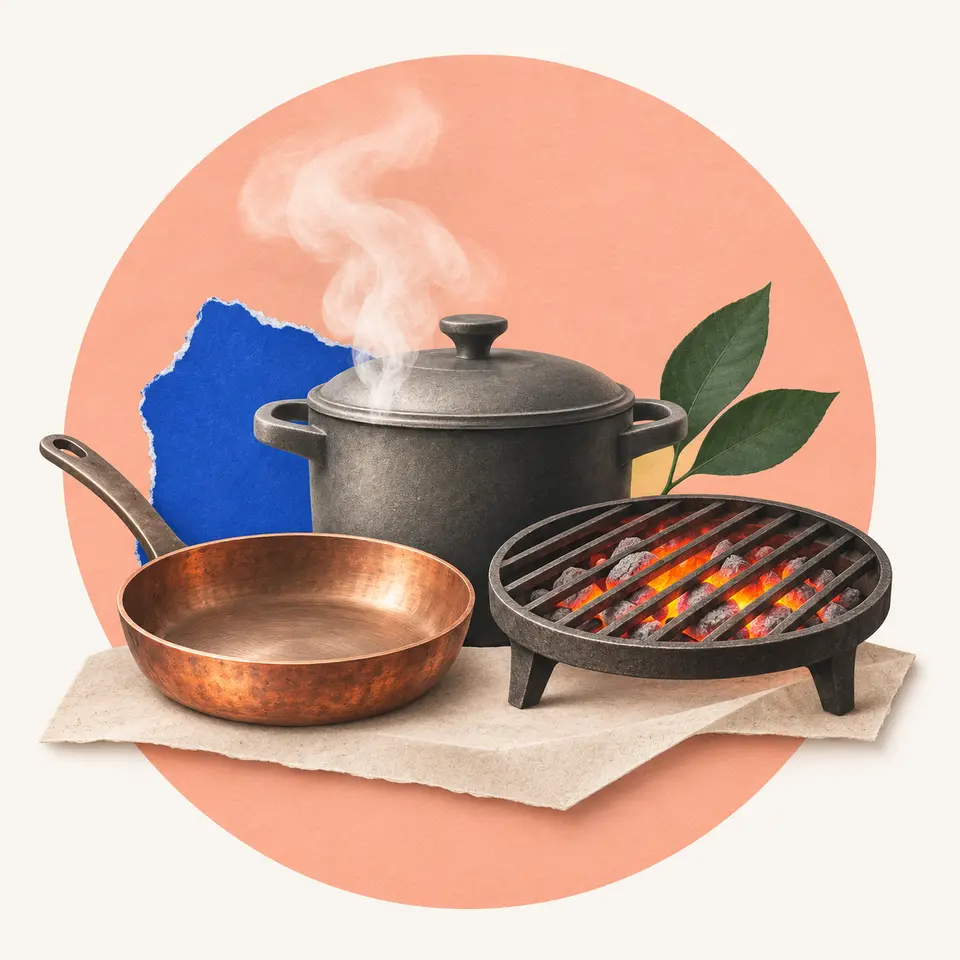
What you will learn
- Tell conduction, convection and radiation apart in a pan, a pot and on a grill
- Explain why hot water heats food much faster than hotter air
- Explain why water caps the temperature of boiled and steamed food
- Explain how frying and roasting brown the outside while the inside stays moist
Lesson 1 of 4 · 4 min
Three ways heat gets into your dinner
Hold your hand over a glowing grill and you feel the heat without touching anything. Lay a steak in a hot pan and it sizzles on contact. Heat reaches food by three routes, the same three that warm or chill a house, and each cooks differently.
Conduction is heat passing through direct contact, from the burner to the pan and from the pan into the steak. Metals differ a lot. Copper conducts heat about 25 times better than stainless steel, which is why good pans often hide a copper or aluminum core.
Convection is heat carried by a moving liquid or gas. Water circulates in a pot, and hot air swirls in an oven. A fan oven blows away the blanket of cooler air that clings to cold food, so it cooks faster and is usually set about 20°C lower.
Radiation is heat traveling as infrared light, with no contact and no moving air needed. It's how the Sun warms the Earth. Food on a grill grate over coals gets its heat mostly by radiation, and so does food under an overhead broiler.
A Finnish sauna keeps its air between about 75 and 100°C, and people sit in it for many minutes. Yet water at 68°C scalds skin in one second. The heat source matters as much as the number on the thermometer.
Two things make water the faster carrier. Water conducts heat about 23 times better than still air. Water also holds a lot of heat, with one of the highest heat capacities of any common substance. So water touching food keeps delivering heat, while a thin layer of air next to the food barely passes any on.
That's why an oven at 200°C warms food more slowly than its setting suggests. The air is very hot, but it hands its heat over reluctantly. A pot of water at 100°C presses heat into every surface at once.
Try to recallWhy can people sit in sauna air near 100°C for minutes when water at 68°C scalds skin in a second?
Water conducts heat about 23 times better than still air and holds far more heat. So water pours heat into skin or food quickly, while hot dry air hands its heat over slowly. Temperature alone doesn't set how fast something heats.
Heat reaches food by contact, by moving water or air, and by infrared light. You can now explain why water at 100°C outpaces oven air at 200°C. Water passes heat on far better than air does.
Lessons in this topic
Three ways heat gets into your dinner
Learn how a pan, a pot and a grill each move heat into food, and why water at 100°C cooks faster than oven air at twice that.
Why boiled food never turns brown
See why water puts a ceiling on cooking temperature, what steam adds, and how oil and oven air get hot enough to brown a crust.
Why the outside cooks before the middle
Find out why thick food needs gentler heat, why a roast keeps cooking after it leaves the oven and why a thermometer beats a timer.
Why beans cook slowly on a mountain
See how air pressure sets water's boiling point, why food takes longer to boil at altitude and how a sealed pressure cooker turns that around.
Three quick stories from this topic
Darwin's stubborn potatoes
In 1835, Charles Darwin's potatoes boiled all night high in the Andes and stayed hard
He was camped at no less than 11,000 feet, where thin air lets water boil well below 100°C. His companions blamed the new pot. The real cause was the lower boiling point.
How cool mountain water boils
At 3,000 meters water boils at about 90°C, and near Everest's summit at about 70°C.
The fix existed already
Darwin called his pot the converse of Papin's digester, a sealed steam cooker from 1679 that raises the boiling point.
Hot air, hotter water
People sit in sauna air near 100°C, yet 68°C water scalds skin in one second
Finnish saunas keep the air dry and between about 75 and 100°C for long sessions. Water conducts heat about 23 times better than still air, so it pours heat into skin far faster at a lower temperature.
Why steam rooms run cooler
Steam baths near full humidity are set to about 50°C. Wet heat at sauna temperatures would scald.
Same reason pots beat ovens
That's why boiling water at 100°C can heat food faster than oven air at 200°C.
The heat hidden in steam
Condensing steam gives off five times the heat it took to warm the water from 0 to 100°C
Turning a kilogram of water into steam takes 2,257 kilojoules, and steam gives it all back when it condenses on cooler food. Warming the same water from freezing to boiling takes only about 419 kilojoules.
Why steaming is fast
Steam wraps food and condenses on it, so a small amount of water cooks quickly.
Still no browning
Steam tops out near 100°C, too cool for the browning reactions that start around 140°C.
Sources
- Thermal conductivity and resistivity, Wikipedia
- Cookware and bakeware, Wikipedia
- Grilling, Wikipedia
- Thermal radiation, Wikipedia
- Convection oven, Wikipedia
- Sauna, Wikipedia
- Scalding, Wikipedia
- Specific heat capacity, Wikipedia
- The Voyage of the Beagle, by Charles Darwin, Project Gutenberg
- Boiling point, Wikipedia
- High-altitude cooking, Wikipedia
- Enthalpy of vaporization, Wikipedia
- Steaming, Wikipedia