Everyday Systems · Food & cooking
Sourdough starters and fermentation
A jar of flour and water becomes a living community. Meet the microbes that make the gas and the acid, see why dough can hold their bubbles, and find out what 500 starters showed about where a starter comes from.
What you will learn
- Explain how microbial activity produces gas and acidity in a sourdough starter.
- Tell a starter community apart from a single isolated microbe.
- Trace what a starter eats and produces, and explain why it needs feeding.
- Explain why producing gas is only part of making wheat dough rise.
- Separate the causes of a loaf's rise from the causes of its sour flavor.
- When a loaf disappoints, separate the flour's gas-holding structure from the starter's gas production.
Lesson 1 of 4 · 6 min
What's alive in a jar of sourdough starter
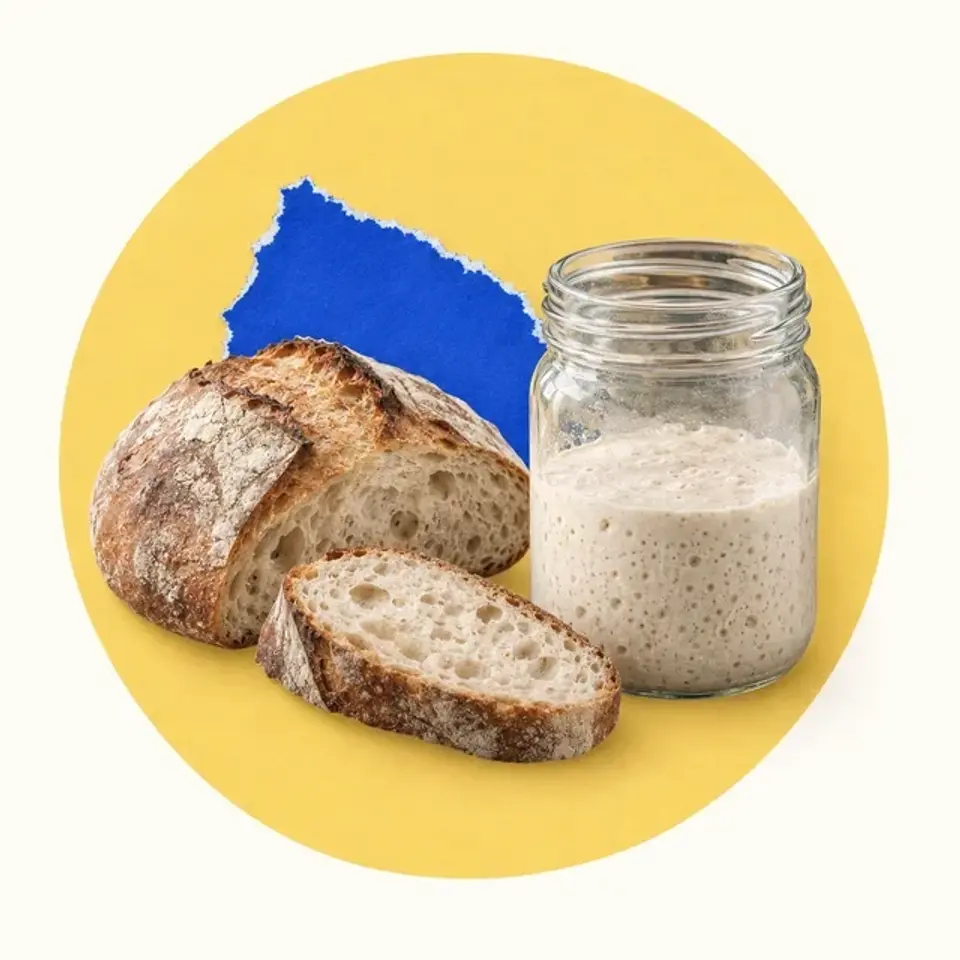
Stir flour into water and leave the jar on the counter. Nobody adds yeast. Come back later and the paste is full of bubbles and smells sour. The jar has come alive.
It now holds yeasts and bacteria, living off the flour. A group of microbes living together like this is a microbial community, and bakers call the jar a starter.
The microbes take in sugars and give off gas, acids and a little alcohol. That process is fermentation.
Yeasts make the carbon dioxide that fills the bubbles. A group called lactic acid bacteria makes lactic acid and acetic acid, the acid in vinegar, and those give sourdough its tang.
The acids also protect the loaf. They make the dough more acidic, which holds back the microbes that cause food poisoning.
That split is only a first sketch, because the jobs overlap. Some bacteria make gas too, and many microbes shape the smell. No single organism makes sourdough.
Where did the microbes come from? A common guess is the kitchen air. Researchers tested the idea by sending the same flour and the same recipe to 18 professional bakers in 14 countries. Each baker made a starter.
The team then read the DNA of the microbes in the starters, in the flour and on the bakers' hands. The starter communities looked most like the flour's. So most of the yeasts and bacteria arrive in the bag.
Not all of them, though. Some matched microbes on the bakers' hands. And the 18 starters differed from one another, even though the ingredients were identical.
The hands held a surprise of their own. On average, about a third of the bacterial DNA found on them came from Lactobacillus, the main group of sourdough bacteria.
On most people's hands that group is scarce. An earlier study found its family made up 2% of the bacteria on men's hands and 6% on women's. The researchers suspect starters shape their bakers too, though the study wasn't built to prove it.
It's also why a spoonful of a friend's starter is more than a flavoring. It moves a living community into fresh flour and water.
Try to recallSomeone says, "My sourdough starter is one special yeast that came entirely from the air." Which two parts of that explanation need correcting?
A starter holds a community of yeasts and bacteria, so it isn't one yeast. And most of its microbes arrive in the flour, with some from the baker's hands, so they didn't all come from the air.
Follow the food and the jar stops being a mystery. Flour is about 70% starch by weight. Enzymes already in the flour break some of that starch into sugars, and the yeasts and bacteria live on those sugars.
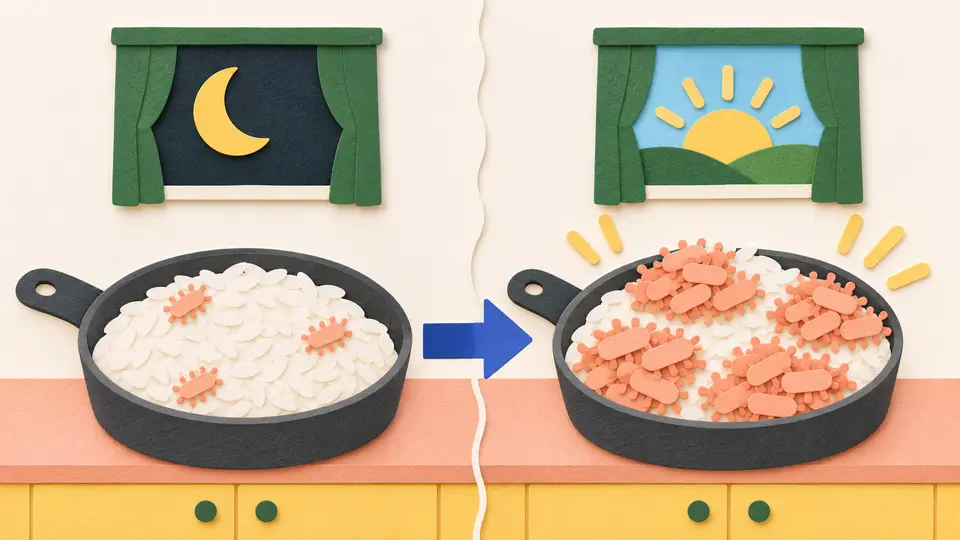
What they eat comes back out as carbon dioxide, acids and alcohol. A baker feeds a starter by adding fresh flour and water, and between feedings nothing new goes in. So a starter is like a pantry with a fixed stock of food and a population that keeps eating.
That's why a starter's activity rises and then falls. Soon after a feeding there's plenty to eat, and the bubbling is vigorous. As the sugars run down, the gas slows.
Here the pantry picture stops working, because a pantry doesn't fill with waste. The acids the microbes release stay in the jar and make it a harsher place to live.
Feeding fixes both problems at once. Fresh flour restocks the food, and the added flour and water dilute the acids.
Now read a neglected jar. A starter left unfed for a week is often quiet and sharp-smelling, and it may have a layer of liquid on top. Bakers call the liquid hooch. It smells of alcohol because it's a by-product of the fermenting yeast.
By the pantry model, food is low and acids are high. It doesn't mean the microbes are gone.
What the jar can't tell you is who's in it. Naming its members takes a lab.
Lessons in this topic
What's alive in a jar of sourdough starter
Meet the yeasts and bacteria that turn flour and water into a starter, find out where they come from, and see why the jar needs feeding.
Why bubbles can lift a loaf
See how gluten traps the gas a starter makes, why rye loaves stay dense, and why a sourer starter doesn't mean a taller loaf.
Does a sourdough starter have a hometown?
See what a study of 500 starters found about geography, where its sample runs out, and what evidence a claim about an old starter would need.
Why a young sourdough starter keeps changing
Follow how a new starter's community shifts over time, and see why a vinegar smell often goes with a slower rise.
Three quick stories from this topic
Vinegar smell, slower rise
Sourdough starters that smell of vinegar tend to raise dough more slowly
Bacteria that make acetic acid, the acid in vinegar, live in many starters. In a 2021 study, researchers regrew 40 starters in the same flour, and the ones with more of these bacteria rose more slowly. Their acid may hold back the yeast.
A long-overlooked group
The main reviews of sourdough microbes had barely mentioned acetic acid bacteria. Reading the DNA of 500 starters showed they made up more than 1% of the bacteria in 147 of them.
A clue about a jar
The link was a correlation across 40 starters, and it didn't appear in all of them. A sharp smell can't say why one particular jar is slow.
Sourdough on bakers' hands
On bakers' hands, a third of the bacterial DNA came from the main sourdough bacteria
Researchers sampled the hands of 18 professional bakers from 14 countries. On average, 33% of the bacterial DNA belonged to Lactobacillus, and on one baker 88%. An earlier study of ordinary hands found that family at 2% to 6%.
Same flour, different starters
All 18 bakers were sent the same flour and recipe. Their starters still differed. Each most resembled the flour, and shared some microbes with its baker's skin.
Microbes may move both ways
Flour supplies most of a starter's microbes and hands add some. The researchers think starters also shape the skin of the people who work with them, though the study wasn't designed to test that.
No hometown in the microbes
Across 500 sourdough starters, where a starter lived said little about its microbes
Home bakers on four continents mailed their starters to one lab in 2021. Across the United States, starters far apart were no more different than starters close together. Even the bacterium named for San Francisco isn't confined to that city.
Why geography washes out
Bakers share starters, and flour is shipped everywhere. The study suggests how a starter is made matters more than where it lives.
Where the sample runs out
429 of the 500 starters came from the United States, and the method couldn't tell every strain of a species apart. Finer patterns could still exist.
Sources
- The sourdough microbiome, American Society for Microbiology
- The diversity and function of sourdough starter microbiomes, eLife
- Influences of Ingredients and Bakers on the Bacteria and Fungi in Sourdough Starters and Bread, mSphere, American Society for Microbiology (via PubMed Central)
- Bread science 101, Exploratorium
- Sourdough Starter Best Practices, Colorado State University Extension
- Sourdough, Wikimedia Foundation