Everyday Systems · Sports & games
Why a spinning ball curves
Spin drags air around a ball, the air pushes back and the ball's path bends. See which way it goes, what sets the size of the push and why a real ball never quite matches the formula.
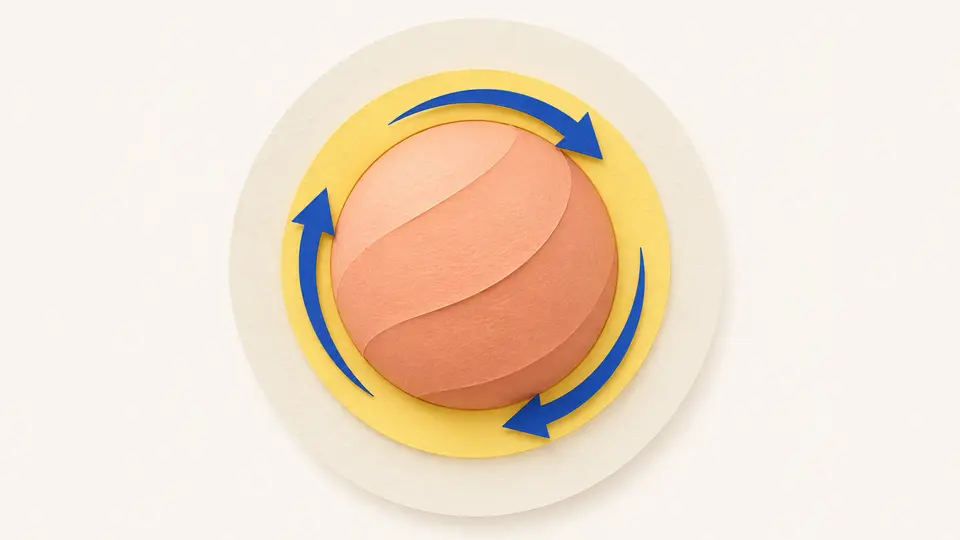
What you will learn
- Explain how a spinning surface sets the surrounding air moving
- Describe why a spinning ball moving through the air has different flow speeds on its two sides
- Name the quantities the ideal lift of a spinning ball depends on
- Predict how the force changes when one of those quantities changes
Lesson 1 of 4 · 5 min
How a spinning ball gets pushed sideways
In June 1997, Roberto Carlos took a free kick for Brazil against France from about 40 yards. The ball set off so wide that a ball boy standing ten yards to the side ducked. Then it bent back and went in. The goalkeeper never moved.
He did it with spin, and the explanation starts with one plain fact about air. Right next to any surface, air molecules stick to it. That thin stuck layer pulls the neighboring air along with it.
So a spinning ball doesn't slip cleanly through the air. It carries a skin of air around with it, turning the same way as the ball.
Now send the ball through the air. Seen from the ball, air is streaming past it. That oncoming flow is called the free stream.
On one side of the ball, the surface is turning the same way the free stream is going. The dragged air and the stream add up, so the air on that side moves faster. On the other side, the surface turns against the stream. The two partly cancel, and the air there is slower.
A ball that isn't spinning has matching flow on its two sides. A spinning one doesn't, and that lopsided flow is where the curve comes from.
The spinning ball turns the flow to one side. When a ball pushes air one way, the air pushes the ball the other way. The change in the air's speed also changes the pressure around the ball, which is the same push described another way.
The force always points at right angles to the ball's flight and to the axis it spins around. A simple rule gives the direction. The ball swerves the way its front face is turning.
Topspin turns the front face downward, so the ball dips. Backspin turns it upward, so the ball stays in the air longer. Sidespin, like Roberto Carlos's, sends it left or right.
This is the Magnus effect, named for Heinrich Magnus, who showed it in 1852 with a spinning brass cylinder. Isaac Newton had described it in 1672, after watching tennis players at Cambridge.
Air sticks to the ball, the spin drags it around, the flow goes lopsided and the air pushes the ball sideways. To call a swerve before it happens, watch the front of the ball. Whichever way it's turning is the way the ball will go.
Lessons in this topic
How a spinning ball gets pushed sideways
Follow the air around a spinning ball, see why its two sides end up different, and learn to predict which way the ball will swerve.
The four things that decide how hard a ball swerves
The sideways force on a spinning ball depends on just four quantities. See what each one does, including why pitches curve less in Denver's thin air.
A formula that leaves out its own cause
The ideal formula for a spinning ball has no air friction in it, yet friction is what makes the air circulate. See what such a model can still tell you, and what it can't.
What stitches and rough air do to a real ball
A real ball has seams, a turbulent skin of air and drag. See what each does to its flight, and how one measured number brings the theory back into line.
Three quick stories from this topic
The ship with spinning sails
A ship crossed the Atlantic in 1926 using two tall spinning cylinders as its sails
Each cylinder was about 15 meters tall. Wind blowing past a spinning cylinder pushes it sideways, the same force that bends a free kick. The engineer Anton Flettner fitted the pair to a converted schooner, which reached New York on 9 May 1926.
A ball is a stack of cylinders
NASA's formula for a spinning ball starts from the force on a spinning cylinder. It treats the ball as a stack of thin disks and adds up the force on each.
Why it works
The spinning surface drags air around with it. The passing air is turned to one side, and the cylinder or ball is pushed to the other.
The swerve that goes the wrong way
Under some conditions a spinning ball swerves the opposite way from normal
It's called the inverse Magnus effect. It happens when the thin layer of air on the ball turns turbulent on one side and stays smooth on the other. In wind tunnel studies, rough baseballs show the ordinary swerve and smooth spheres don't.
The formula assumes a smooth ball
NASA's ideal formula for the force on a spinning ball leaves out air friction and the thin layer of air it creates on the ball's surface.
So the force is measured
Engineers measure a lift coefficient for a real ball in experiments and multiply the ideal force by it. Seams and roughness are part of how a ball curves.
Flat curveballs in Denver
Curveballs bend less in Denver, where the ballpark sits 5,200 feet above sea level
The sideways force on a spinning ball rises and falls with the density of the air. Thin mountain air gives the same spin less to push against, so the pitch breaks less. The same thin air lets batted balls fly farther.
Four things set the force
In NASA's ideal formula the sideways force depends on air density, spin rate, speed and the ball's radius cubed. Halve the density and the force halves.
Size counts most
Because the radius is cubed, a ball twice as wide feels eight times the force at the same spin and speed.
Sources
- Ideal Lift of a Spinning Ball, NASA Glenn Research Center
- Roberto Carlos, Wikimedia Foundation
- Magnus effect, Wikimedia Foundation
- Rotor ship, Wikimedia Foundation
- Coors Field, Wikimedia Foundation