Everyday Systems · Homes & utilities
Electricity in the home
Follow electricity from the street through the meter and breaker panel to a socket. See why a home is split into circuits, which device catches which fault and why plugs and voltages differ between countries.
What you will learn
- Trace electricity from the street through the meter and main switch to the panel
- Explain why the panel splits a home into separate circuits
- Tell apart an overload, a short circuit, a ground fault and an arc fault
- Match each fault to the device that cuts it off
Lesson 1 of 4 · 4 min
From the street cable to your wall socket
Flip the main switch in a home and every light goes out at once. That one switch sits on the single path every bit of the home's power takes. Here's how that path runs, using a typical North American house.
It starts at a transformer on a pole or in a green box, which often serves just one or two homes. It steps the street's higher voltage down. Three wires run to the house, two live lines and a neutral, giving 120 volts from either line to neutral and 240 volts between the lines.
The wires enter through a weatherproof cap and reach the meter, which records energy for the bill in kilowatt-hours. One kilowatt-hour is a one-kilowatt heater running for an hour. Past the meter, the wiring is yours.
Next comes the service panel with its main breaker, which controls all the current entering at once. Europe works much the same, though homes there often get a three-phase supply at about 230 volts. In Britain the panel is called a consumer unit.
The panel's job is to split one supply into many circuits. Each circuit is a separate loop of cable to a group of lights or sockets, and each has its own breaker or fuse. A fault on the bathroom circuit then cuts the bathroom only.
Splitting also lets each circuit's cable match its load. Under the US electrical code, big users like electric stoves, dryers, water heaters and central air get dedicated circuits of their own. Many of those run at 240 volts by using both live lines at once.
Britain took a different route after the war. Its ring circuit loops from the consumer unit past every socket and back again, protected at 30 or 32 amps. That's more than a lamp cord can take, so every British plug carries its own small fuse to protect its cord.
Try to recallWhy is a home's wiring split into several circuits instead of running everything from one?
Each circuit has its own breaker or fuse, so a fault cuts off only that part of the home. Splitting also lets each cable be sized for its load, and big appliances like stoves and dryers get dedicated circuits.
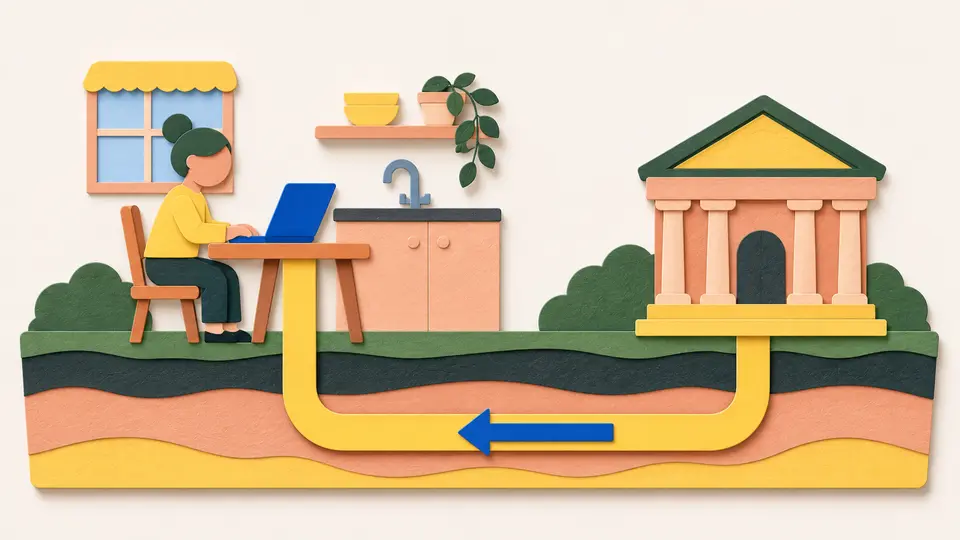
Power runs from a nearby transformer through the meter and the main switch into the panel. The panel splits it into separate circuits, each with its own breaker, so one fault doesn't darken the house.
Lessons in this topic
From the street cable to your wall socket
Trace electricity from the transformer outside through the meter and the main switch into the panel, and see why the panel splits your home into separate circuits.
Four faults and the devices that catch them
Tell an overload from a short circuit, a leak to ground and an arcing wire, and learn which device in the panel watches for each one.
How much one socket or extension lead can take
Add up the watts on an extension lead, see why a wound-up cable reel can catch fire and find out what a surge protector does and doesn't do.
Why plugs and voltages differ around the world
Find out how Edison's 110 volts and a Berlin utility's 220 volts split the world, why plug shapes never merged and what a travel adapter can't do.
Three quick stories from this topic
The hot cable reel
A 13-amp cable reel may be safe for only 3 or 4 amps while it's still wound up
Current warms every cable a little. Wound on a reel, each turn is wrapped in the others and the heat can't escape, so the insulation can melt and catch fire.
The rating's small print
A reel's printed rating applies only when the cable is fully unwound.
The safety net
Reels should have a thermal cut-out that switches off when the cable gets too hot.
The wartime plug
Britain's fused plug came from a wartime plan to wire homes with about 25% less material
A committee set up in 1942 to plan postwar housing chose a ring of cable looping past every socket. The ring is protected at 30 or 32 amps, more than a lamp cord can take, so each plug got its own fuse.
What the fuse protects
The plug's fuse is there to protect the flexible cord. It doesn't protect the appliance and isn't there for overloads.
One plug for everything
By the 1960s the 13-amp fused plug was the single British standard for new homes.
Japan's split grid
Japan runs eastern homes on 50-cycle power and western homes on 60
Tokyo and the north use 50 cycles a second, while Osaka and the west use 60. Four converter stations link the two halves so they can trade power.
An old split
Around 1893 Westinghouse settled on 60 cycles and AEG on 50, and most of the world followed one or the other.
Appliances adapt
Frequency-sensitive appliances sold in Japan can often be switched between the two.
Sources
- Service drop, Wikipedia
- Electricity meter, Wikipedia
- Distribution board, Wikipedia
- Electrical wiring in North America, Wikipedia
- Overloading sockets, Electrical Safety First (UK)
- Extension cord, Wikipedia
- Extension leads, cable reels and block adaptors, Electrical Safety First (UK)
- Ring circuit, Wikipedia
- BS 1363, Wikipedia
- Mains electricity, Wikimedia Foundation