Everyday Systems · Homes & utilities
How homes are heated
Boilers, furnaces, heat pumps, radiators, heated floors and city-wide heat pipes all warm rooms in different ways. See how each makes and moves heat, and what a thermostat really controls.
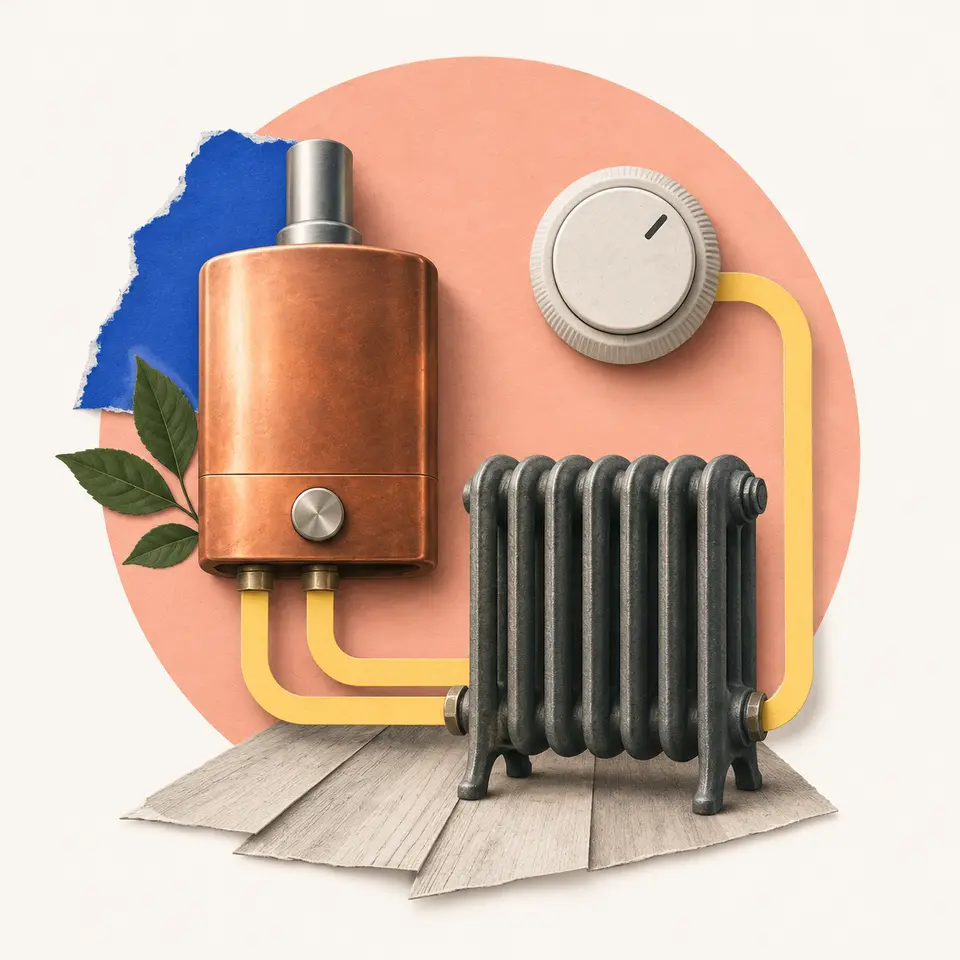
What you will learn
- Explain how burning fuel and passing current through a wire each make heat
- Explain why a heat pump delivers more heat than the electricity it uses
- Compare how hot water systems and warm air systems carry heat to rooms
- Explain why a standard thermostat switches heat on and off instead of setting its speed
Lesson 1 of 4 · 5 min
Where the heat in a heated home comes from
On a cold morning, something in your home turns energy into warmth. In most heated homes that something either burns a fuel or runs electricity through a wire. Which one you have decides what you pay for and whether anything goes up a chimney.
A furnace burns gas, oil or wood and warms air. A boiler does the same job for water. In both, the flame heats a metal wall called a heat exchanger, and the air or water picks up heat from the other side.
So the smoke never mixes with the air you breathe or the water in your pipes. The exhaust gases leave through a flue or chimney, and they carry some heat away with them.
An electric heater has no flame. Current is pushed through a coil of wire that resists it, often an alloy called nichrome, and that resistance turns the electrical energy into heat.
Every bit of electricity the heater draws ends up as heat in the room. By that measure it's 100% efficient, which no flame can match.
That measure stops at your wall socket. Much electricity comes from power stations burning coal, gas or oil, and the US Department of Energy says those turn only about 30% of the fuel's energy into electricity. That's why resistance heating often costs more than burning gas at home.
A heat pump breaks the pattern. It doesn't turn its electricity into heat. It uses the electricity to run a machine that moves heat from the outdoor air or the ground into the house. It's the same machinery as an air conditioner, run the other way.
Because it moves heat instead of making it, a heat pump can deliver more heat than the electricity it uses. Each kilowatt-hour of electricity can bring 1 to 4.5 kilowatt-hours of heat indoors. Even cold outdoor air still holds heat that a heat pump can collect.
The US Department of Energy says heat pumps can easily cut electricity use by half compared with resistance heating. The heat pump topic follows how the machine pulls warmth out of freezing air.
Try to recallA heat pump can deliver more heat to a house than the electricity it uses. How is that possible?
A heat pump doesn't turn its electricity into heat. It uses the electricity to move heat that already exists in the outdoor air or the ground into the house. Since that heat isn't made from the electricity, the heat delivered can be several times the energy used.
Furnaces and boilers burn fuel and lose some heat up the flue. Resistance heaters turn all their electricity into heat. Heat pumps move heat that's already outside, so they can deliver several times the energy they use.
Lessons in this topic
Where the heat in a heated home comes from
Learn how furnaces, boilers and electric heaters make heat, and why a heat pump gets more heat out than the electricity you pay for.
How heat reaches each room, and what turns it off
Follow hot water through radiators and warm air through ducts, and see why a thermostat is an on and off switch.
Heat piped across a city and floors that warm a room
See how district heating sends hot water from one plant to whole neighborhoods, and how Roman and Korean builders heated rooms through the floor.
What a heating efficiency rating really tells you
Read a furnace or boiler efficiency number, see how a condensing boiler squeezes heat from its own exhaust, and compare gas, electric and heat pump heating fairly.
Three quick stories from this topic
Boilers that make water
A modern gas boiler needs a drain pipe because it turns its own exhaust into water
Burning gas makes water vapor that carries heat. A condensing boiler cools its exhaust until that vapor turns back into liquid, keeping the heat and sending the slightly acidic water to a drain.
What it gains
Typical condensing boilers reach about 90% efficiency, against 70% to 80% for older designs.
The catch
It only condenses when water returns from the radiators at about 55°C or cooler, so it suits larger radiators.
China's heating line
China gave free winter heating to cities north of the Huai River and not south of it
The heat came from burning coal, which filled northern air with smoke. A 2013 study compared places on either side of the line and estimated people in the north lived about 5.5 fewer years, mostly from heart and lung disease.
An accidental experiment
The line was a policy choice, so it let researchers compare otherwise similar cities on each side. A 2017 study with newer data also found shorter lives in the north.
Warmth still helped
A 2023 study of older adults near the river found winter heating lowered deaths from cold. The harm came from the coal smoke, which offset that benefit.
The thermostat is a switch
Turning a thermostat way up won't warm a cold room any faster
A standard thermostat only switches the furnace or boiler on or off. Once it's on, the heater runs at full output whatever number you set, so a higher setting just keeps it running until the room overshoots.
Full power or none
Below the setting, the heat runs flat out. Above it, the heat stops.
Why there's a gap
A thermostat waits for a small gap before switching again, which stops the heater flicking on and off over and over.
Sources
- Central heating, Wikipedia
- Furnaces and boilers (archived 2024), US Department of Energy, Energy Saver
- Furnace (central heating), Wikipedia
- Condensing boiler, Wikipedia
- Electric heating, Wikipedia
- Electric resistance heating (archived), US Department of Energy, Energy Saver
- Heat pump, Wikipedia
- Evidence on the impact of sustained exposure to air pollution on life expectancy from China's Huai River policy, Proceedings of the National Academy of Sciences (Chen et al., 2013)
- New evidence on the impact of sustained exposure to air pollution on life expectancy from China's Huai River Policy, Proceedings of the National Academy of Sciences (Ebenstein et al., 2017)
- District heating, Wikipedia
- Trade-offs between cold protection and air pollution-induced mortality of China's heating policy, PNAS Nexus (2023)
- Thermostat, Wikipedia