Everyday Systems · Homes & utilities
How a home gains and loses heat
Tell conduction, convection and radiation apart, then use them to explain a cold floor, a drafty room, a leaky house and a glowing stove element.
What you will learn
- Tell conduction, convection and radiation apart by what each one needs to work
- Match an everyday observation about a warm or cold room to the mechanism behind it
- Explain why two surfaces at the same temperature can feel different
- Use conductivity, temperature difference and contact area to compare two situations
Lesson 1 of 4 · 5 min
Three ways heat moves, and what each one needs
Press your palm on a cold wall. Hold your hands above a heater. Stand in the sun. Each time, heat moves from somewhere warmer to somewhere cooler, and each time it takes a different route. There are three, and the easiest way to tell them apart is by what each one needs.
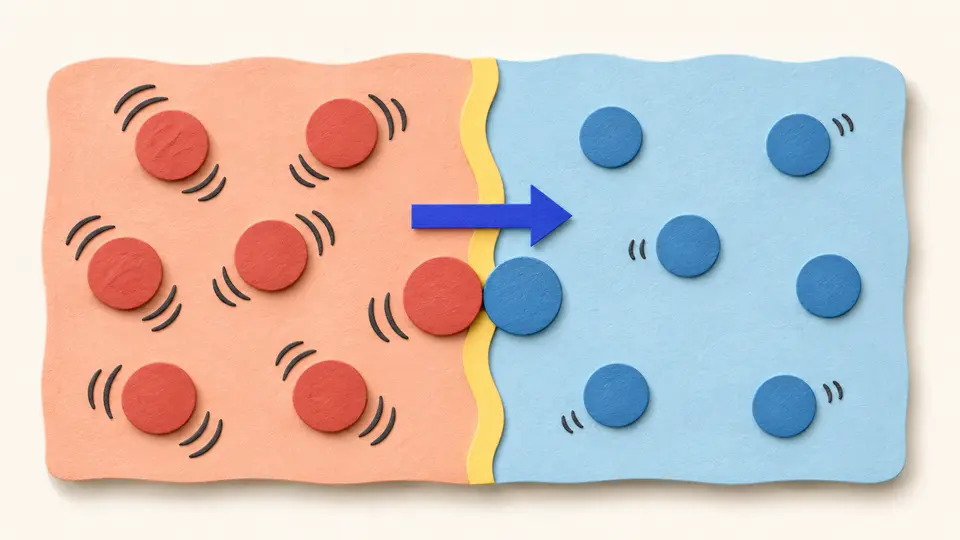
Conduction needs contact. The molecules in a warm object move faster than those in a cool one. Where the two objects touch, fast molecules collide with slow ones and hand over some of their energy. Add up all those collisions and you get a flow of heat from hot to cold.
Convection needs matter that can move, a liquid or a gas. Here the warm material itself travels and carries its energy along.
Air gets less dense as it warms, so warm air floats up through cooler air. That lift is called buoyancy, and it's why the air near a ceiling is warmer than the air at your ankles.
The same thing happens in a pot of water on a stove. It happens on a planetary scale in the atmosphere, where hot air flows from the tropics toward the poles and cold air flows back.
Radiation needs nothing in between. A hot object gives off electromagnetic waves, and whatever they land on absorbs their energy. The waves don't need a medium, which is how the Sun's heat crosses the largely empty space to the Earth.
Much of the heat you feel this way is infrared, which your eyes can't see but your skin picks up easily. That's how you can sense a fire behind you without looking at it.
Conduction needs contact, convection needs matter that can move, and radiation needs nothing at all. A home loses heat by all three at once. So when a room feels cold, the first question is which route the heat is taking.
Lessons in this topic
Three ways heat moves, and what each one needs
Tell conduction, convection and radiation apart by what each one needs, then spot each one at a fire and in a heated room.
Why a tiled floor feels colder than carpet
Two surfaces at the same temperature can feel different. Work out what your skin is really reporting and what that says about insulation.
Where the warm air in your home goes
One rule explains a warm ceiling, a cold floor and a draft. See the same loop in a pot, in the atmosphere and in your bloodstream, and what a leaky house pays for it.
What the color of a glow tells you about heat
Radiation carries heat with no medium at all. See why dark surfaces run hot by day and cold by night, and how a glow's color shows roughly how hot an object is.
Three quick stories from this topic
A house swaps its air hourly
The air in a typical house is completely replaced in less than an hour
It leaks in and out around doors and windows and through cracks. In a textbook example of a mid-sized house, warming the incoming cold air by 10 degrees Celsius takes 4.64 kilowatts, the power of about forty-six 100-watt bulbs.
Why builders seal the gaps
Newly built homes are designed so the air takes two hours or more to turn over. Weather stripping, caulking and better window seals slow the leaks.
A house can be too tight
People need a minimum of fresh air, for oxygen and to dilute household pollutants. So the aim is slower leaks, not none.
Why tile feels colder
A tile floor feels colder than carpet even when both are at the same temperature
Tile takes heat out of your foot faster than carpet does, so your skin cools more in the same moment. What you feel is your own skin cooling. It's why a metal railing feels colder than a wooden one in the same air.
What your skin is reporting
In the same stretch of time, skin on tile loses more heat than skin on carpet, so it cools more. What you feel is a rate of heat loss, not the temperature of the floor.
Why the rates differ
Some materials conduct heat faster than others. Metals conduct well, while wood, plastic and rubber conduct poorly, and that's the same property insulation is chosen for.
Asphalt, hot by day, cold by night
Black asphalt runs hotter than the sidewalk by day and colder on a clear summer night
Black absorbs radiation better than gray, so asphalt heats up more in the sun. Black also gives radiation off better. After dark the same asphalt sheds its heat faster and ends up colder than the gray sidewalk next to it.
A good absorber is a good radiator
Any surface that soaks up radiation well also gives it off well. A white or silvery surface does both poorly.
Why the night has to be clear
At night the ground radiates heat toward the cold of space. Clouds send some of that radiation back down, so far less heat is lost on a cloudy night.
Sources
- 14.5 Conduction - College Physics 2e, OpenStax, Rice University
- 14.6 Convection - College Physics 2e, OpenStax, Rice University
- 14.7 Radiation - College Physics 2e, OpenStax, Rice University