Everyday Systems · Objects & appliances
How a refrigerator moves heat
A fridge doesn't make cold. It pumps heat out of your food and into your kitchen, and the same machine turned around can heat a house. See how the loop works, how it's scored and when it pays.
What you will learn
- Describe a refrigerator as a device that moves heat instead of making cold
- Trace the working fluid through the four components of the cycle
- Define the coefficient of performance as a ratio of benefit to work input
- Explain why the same machine scores differently as a heater and as a cooler
Lesson 1 of 4 · 5 min
Nothing in your fridge makes cold
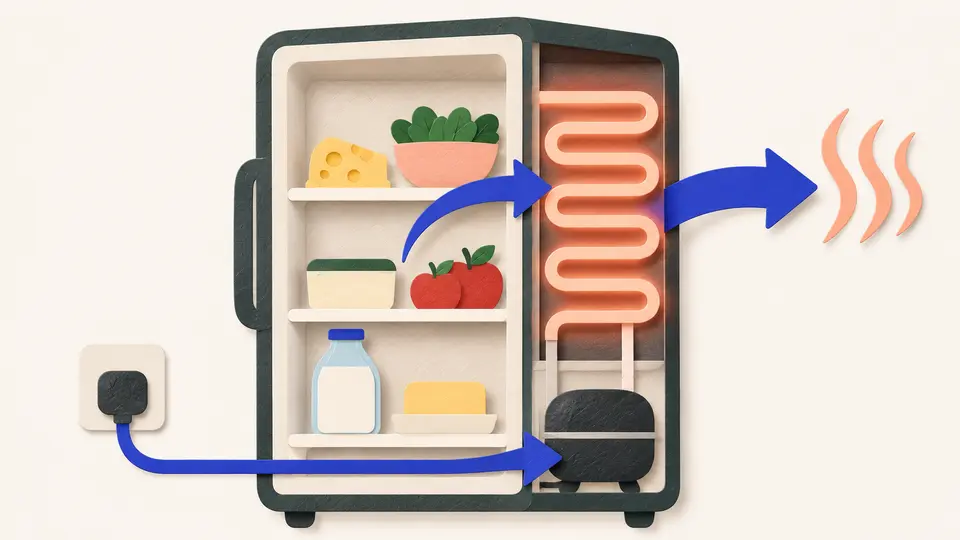
Put your hand near the coils at the back of a running fridge and you'll feel warmth. That warmth came out of your food. Cold isn't a substance a machine can make. All a fridge can do is take heat out of its food compartment and put it somewhere else, and that somewhere is your kitchen.
Heat doesn't move from a cold place to a warmer one unaided, so the fridge has to push it, and pushing takes work. An electric compressor supplies it. A machine that does this is called a heat pump.
The work ends up as heat too. So the heat coming off the back equals the heat taken from the food plus the work. Your kitchen gains more heat than your food lost.
That settles an old argument. Leave the fridge door open on a hot day and the room gets warmer. The fridge is pulling heat out of the kitchen and putting it straight back, with the compressor's work added.
How do you make heat flow out of a cold box into a warm room? With a fluid that can be colder than the food at one moment and hotter than the kitchen the next. It's called the working fluid, or refrigerant, and it travels around a sealed loop with four parts.
Start inside the fridge, in the coils of the evaporator. The fluid arrives as a liquid that's colder than the food. Heat flows from the food compartment into it, and that heat boils it into a gas.
So something boils inside your fridge whenever it runs. Isobutane, a refrigerant used in home fridges since 1993, boils at about minus 12 degrees Celsius at ordinary air pressure.
The gas now carries the food's heat, but it's still cold, far too cold to give that heat to a warm kitchen. So the compressor squeezes it. That raises its pressure and its temperature until the gas is hotter than the room.
The hot gas is forced into the condenser coils on the outside of the fridge. Now heat flows out of it into the kitchen air, and as it loses heat the gas condenses back into a liquid. That's the warmth you felt.
Last, the liquid passes through an expansion valve that drops its pressure. It cools as it expands and arrives back at the evaporator cold enough to take heat from the food again.
A fridge is a heat pump. Its fluid boils in the cold compartment to pick heat up and condenses behind the fridge to drop it off, and the compressor pays for the trip. Put the cold coils outdoors and the warm ones indoors, and the same loop heats a house.
Lessons in this topic
Nothing in your fridge makes cold
Follow the fluid that boils inside your fridge and condenses behind it, and see why an open fridge door warms the kitchen.
More heat out than electricity in
Meet the coefficient of performance, the score for heat pumps and fridges, and see why the same machine scores one point higher as a heater than as a cooler.
Why cold weather hurts a heat pump
A heat pump's score falls as the gap between indoors and outdoors widens. Work out the best score physics allows on one freezing day.
When a heat pump pays off
A heat pump can deliver three times the energy it uses and still cost more to run than a furnace. See what decides it.
Three quick stories from this topic
A liquid boils in your fridge
The cold in a fridge comes from a liquid boiling inside it
Isobutane, a refrigerant used in home fridges since 1993, boils at about minus 12 degrees Celsius at ordinary air pressure. Boiling takes in heat, and the heat it takes comes out of your food. A compressor then squeezes the gas until it's hot enough to pass that heat to the kitchen.
Why boiling cools
A liquid has to take in heat to turn into a gas. In the fridge's cold coils the refrigerant gets that heat from the food compartment.
Where the heat goes
A compressor squeezes the gas until it's hotter than the kitchen. In the coils outside the box it gives up the heat and turns back into a liquid.
An open fridge heats the kitchen
Leaving the fridge door open on a hot day makes the kitchen hotter
A fridge moves heat from inside the box to the coils at the back. With the door open, it takes heat from the room and returns it to the same room, and the electricity its compressor uses ends up as extra heat.
Nothing makes cold
Refrigerators and air conditioners cool something down in a warm environment, and it takes work to move heat from cold to hot. They move heat out. They don't create cold.
The same idea, relabeled
What counts as the benefit in a heat pump counts as waste heat in a refrigerator. It's one machine, with two names for the same flow of energy.
Weakest on the coldest day
A heat pump is at its weakest on the coldest day of the year
It moves heat from outdoors to indoors, and the wider the temperature gap, the more work each unit of heat costs. Between minus 15 and 45 degrees Celsius, even a perfect heat pump delivers only 5.3 units of heat per unit of electricity. Real ones manage 2 to 4.
The best case, worked out
Between a hot reservoir at 45.0 degrees Celsius and a cold one at minus 15.0 degrees Celsius, the best possible coefficient of performance is 5.30.
Where the extra energy comes from
Delivering 5.30 times the work input doesn't violate conservation of energy. The cold outside air supplies 4.3 joules for every 1 joule taken from the outlet.
Sources
- College Physics 2e, 15.5 Heat Pumps and Refrigerators, OpenStax / Rice University
- Bar Fridge (workshop tutorial activity, thermal physics), University of Sydney, School of Physics
- Isobutane, Wikimedia Foundation