Everyday Systems · Objects & appliances
Stoves, ovens and induction cooktops
A gas flame, a glowing element and an induction coil all heat a pan, but only induction makes the pan heat itself. See how each works, why an oven swings around its setting and what a pan's metal changes.
What you will learn
- Explain how a gas burner makes a hot flame by mixing air into the gas before it burns
- Explain how an electric element makes heat and why a pan smaller than the element wastes much of it
- Explain how an induction coil's changing magnetic field makes heat inside the pan's metal
- Explain why induction needs magnetic cookware and why its glass top stays cooler
Lesson 1 of 4 · 4 min
Where a burner's heat goes, and how much is wasted
Turn a gas knob and you hear a hiss before the click and the blue ring. That hiss is gas leaving small holes fast. How does a jet of gas turn into a flame hot enough to sear a steak?
A lab Bunsen burner shows the trick plainly. The gas jet rushes past openings in the tube and drags air in with it, a pull called the Venturi effect. So gas and air are already mixed when they reach the flame.
Well-mixed gas burns completely, which makes a hot blue flame. Close the air holes and the gas meets air only at the flame's edge. It burns cooler and glows yellow with soot.
A stove burner is rated by the gas it burns, not by the heat the pan gets. A big burner uses 3 to 6 kW of gas. A simmer burner uses 1 kW or less.
An electric element has no flame. Current is pushed through wire that resists it, and that resistance turns the electrical energy into heat. Most elements use nichrome wire, packed inside a metal tube or hidden under a glass top.
Either way, the heat has to cross into the pan by touch or by glowing infrared light. So contact matters. In tests by the Electric Power Research Institute, a coil under a large pan delivered 83% of its energy to the water.
Under a small pan the same coil delivered only 42%. The uncovered part of the coil glowed into the room. Gas has the same weakness, because flame that misses the pan heats the kitchen. The US Department of Energy measured a gas burner at 44% with a well-matched pan.
Try to recallWhy does a small pan on a large electric coil waste so much of the coil's heat?
The coil heats the pan mostly by touch and by glowing infrared light. A small pan covers only part of the coil, so the uncovered rings send their heat into the room. In tests, a coil's efficiency fell from 83% with a large pan to 42% with a small one.
A gas burner premixes air so its flame burns hot, and an element turns current into heat in resistant wire. Both make heat outside the pan, so the part that misses the pan is wasted.
Lessons in this topic
Where a burner's heat goes, and how much is wasted
See how a gas burner makes a hot blue flame and how an electric element makes heat, then find out how much of each one's heat ends up in the pan.
How an induction cooktop makes the pan heat itself
Learn how a coil under the glass drives electric currents inside the pan's own metal, and why that needs the right pan and leaves the glass cooler.
Why your oven is never exactly at its setting
Find out how an oven holds a temperature by switching its heat fully on and off, why that makes it swing and why some shelves run hotter.
What your pan's metal does to your cooking
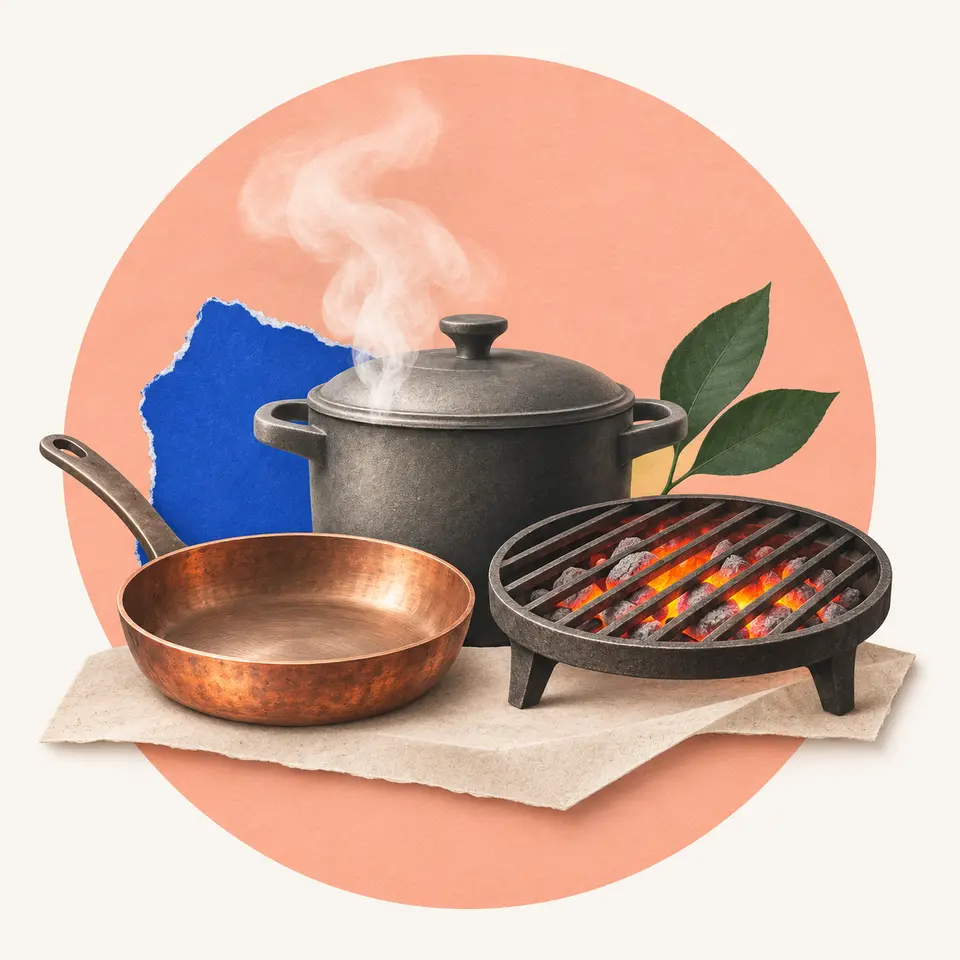
Compare copper, aluminum, cast iron and stainless steel by how they spread and hold heat, and learn what a non-stick coating is and what regulators say about it.
Three quick stories from this topic
The pan is the heater
On an induction cooktop the pan itself is the heating element
A coil under the glass flips its magnetic field about 25,000 to 50,000 times a second. That drives currents in the pan's base, and the metal's resistance turns them into heat right where the food is.
Pick the right pan
Magnetic iron and steel squeeze the currents into a thin skin, which makes plenty of heat. Copper and aluminum barely warm.
Cool glass
The glass warms only from the pan sitting on it, so a spill beside the pan doesn't burn on.
The small-pan penalty
An electric coil under a small pan wastes over half its heat
In Electric Power Research Institute tests, a coil delivered 83% of its energy into water in a large pan and only 42% in a small one. The bare rings glow straight into the kitchen.
Induction doesn't care
The same tests found induction delivered 76 to 77% with large and small pans alike, because the heat is made in the pan.
Gas loses too
A gas burner delivered well under half its heat even with a matched pan, because flame around the pan heats the air.
Non-stick's wartime start
The coating on non-stick pans first sealed equipment in the atomic bomb project
Chemist Roy Plunkett found PTFE by accident in 1938. Because almost nothing sticks to it or corrodes it, its first big job was sealing pipes against the corrosive uranium gas used in the wartime bomb program.
From fishing line to frying pan
A French engineer coated his fishing gear with PTFE. His wife suggested coating her pans, and a French patent followed in 1954.
Keep it below 260°C
Above about 260°C the coating starts to break down, so an empty pan shouldn't sit on high heat.
Sources
- Gas stove, Wikipedia
- Bunsen burner, Wikipedia
- Induction Cooking Technology Design and Assessment (ACEEE Summer Study 2014), Electric Power Research Institute via ACEEE
- Electric stove, Wikipedia
- Heating element, Wikipedia
- Induction cooking, Wikipedia
- Non-stick surface, Wikipedia