Engineering & Inventions · Materials & manufacturing
Why engineers choose one material over another
How stiffness, strength, toughness, mass and shape make a material right for one job and a poor choice for another.

What you will learn
- Tell stiffness from strength by looking at deformation and failure.
- Explain why resistance to cracking is a separate material requirement.
- Explain why low density can matter alongside stiffness in a material choice.
- Explain how letting thickness change alters a fair comparison between materials.
Lesson 1 of 4 · 3 min
Stiff, strong and tough are three different things
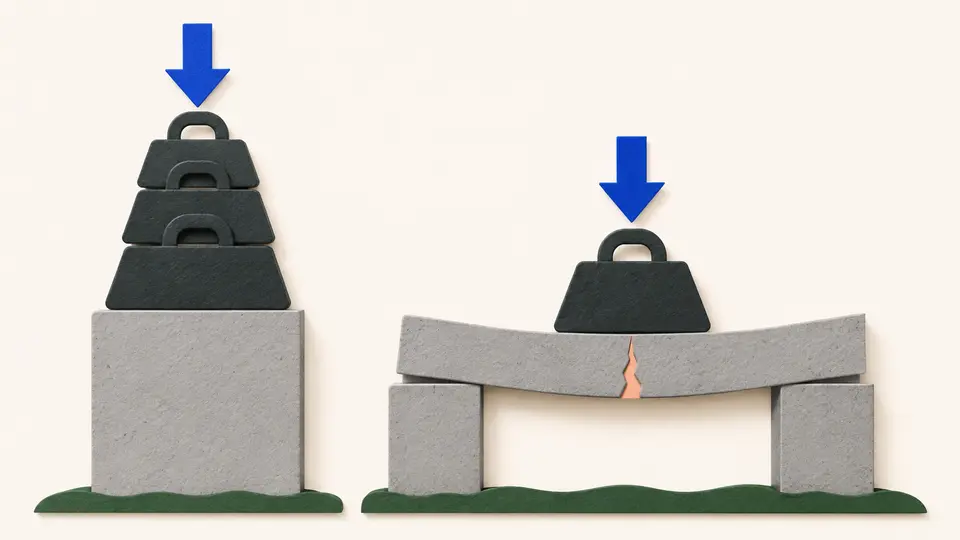
A bookshelf that sags under its books has failed at its job, yet nothing in it has broken. Take the books off and the board may spring back flat.
So strong is too loose a word. Stiffness is how little a material deforms under a load. Strength is the load at which it gives up, by bending for good or by breaking. The sagging shelf is strong enough. It isn't stiff enough.
Deformation comes in two kinds. Elastic deformation reverses when the load comes off, like the sag of that shelf. Plastic deformation stays, like the bend in a paper clip you've pulled open.
Strength marks where trouble starts. A ductile material reaches its limit when it begins to deform for good. A brittle one, like cast iron, breaks before it yields at all.
Picture two strips of the same size under the same light load. One bends a lot and springs back. The other barely bends. You've learned which is stiffer, and nothing else.
The bendy strip might take 10 times the load before it gives, and the stiff one might snap just past the point you tested. Finding out takes a different test, one that loads each strip until it fails.
Now add a crack. Many real parts carry small flaws, and a flaw concentrates stress at its tip.
Fracture toughness is a material's resistance to a crack spreading under load, and it's separate from stiffness and strength. Alumina, a ceramic, does very well on strength for its weight, yet its use is limited by its brittleness.
Toughness can also mean the energy a material soaks up before it fractures, which is what matters in an impact. Antler rates high on it. It's a composite of a hard mineral and the protein collagen, much like bone, and it lets stags clash without their antlers cracking.
So when a chart says toughness, check which measure it means.
So the word strong was hiding three properties. Stiffness is how little a material bends under load. Strength is how much load it takes before it yields or breaks. Toughness is how well it stops a crack or absorbs a blow.
The sagging shelf needs stiffness, and a stronger board of the same stiffness would sag just as far. Name the job first, and you know which property to look up.
Try to recallWhy doesn't a high stiffness value, on its own, show that a material will resist crack growth?
Stiffness describes elastic deformation, while fracture toughness describes how well a material resists a crack extending. They're different properties, so each has to be checked separately.
Lessons in this topic
Stiff, strong and tough are three different things
Tell apart how much a material bends, how much load it takes before it gives, and how well it resists a crack.
Why was an aircraft ever made from wood?
See why a fast wartime bomber was built of wood, and how letting a panel get thicker changes which material wins.
Why put steel inside concrete?
See how steel covers concrete's weakness when pulled, and why a material's ranking only holds for the conditions it was tested in.
Young's modulus puts a number on stiffness
Use stress, strain and Young's modulus to predict stretch, then see why the same material resists shear differently.
Three quick stories from this topic
A cable that stretches 18 meters
A steel cable 3 kilometers long stretches about 18 meters when pulled to its limit
That's a textbook figure for a ski-resort gondola cable 5.6 centimeters thick. Each meter of the steel stretches by only 0.6%, but every meter stretches by the same fraction, so over 3,020 meters the small stretches add up.
Stiff isn't rigid
Steel's Young's modulus is about 210 billion newtons per square meter, the highest in the textbook's table of common materials. Enough force over enough length still gives a stretch you could pace out.
Length multiplies stretch
Stretch equals force times length, divided by cross-sectional area and Young's modulus. Double the length and the stretch doubles.
Equally stiff, unequally strong
Thighbone is equally stiff pulled or squeezed, yet about 50% stronger when squeezed
Stiffness and strength are separate properties. Tests find the same stiffness in both directions, but the bone takes about 205 megapascals of squeezing before it fails and only about 135 of pulling. Bones usually break from bending or a sideways blow.
Two different questions
Stiffness is how little a material deforms under load. Strength is the load at which it yields or breaks. One doesn't predict the other.
How bones break
Bones rarely fail from a straight pull or squeeze. They generally fracture from a sideways impact or from bending.
The wooden bomber
One of the fastest aircraft of 1941 was a bomber built mostly of wood
Britain's Mosquito wasn't a makeshift. Wood has only a quarter of steel's strength but 4 times its strength for the same weight, and a light material can be made into a thicker, stiffer panel without adding mass.
Low density creates options
For a fixed mass, a less dense material can make a thicker panel, if the design has room for it.
The constraints choose the comparison
A part with a fixed thickness and a panel with an adjustable thickness can favor different material properties.
Sources
- Optimisation of materials properties in living systems, University of Cambridge DoITPoMS
- Building Big: materials lab, PBS / WGBH
- Elasticity: stress and strain, OpenStax, College Physics 2e
- Bone Mechanical Properties in Healthy and Diseased States, Annual Review of Biomedical Engineering
- Determination of mechanical properties of human femoral cortical bone by the Hopkinson bar stress technique, Journal of Biomechanics
- De Havilland Mosquito, Wikimedia Foundation