Engineering & Inventions · Materials & manufacturing
Reinforced concrete and the steel hidden inside it
Concrete cracks when it's pulled, and a little steel in the right place fixes that. See why the two materials work together, how a beam is made to sag before it fails, and what rust does in the end.
What you will learn
- Say what each material contributes and why neither works alone
- Describe what the composite can do that plain concrete can't
- Name the three physical characteristics that make the pairing work
- Explain what composite action requires of the two materials
Lesson 1 of 4 · 5 min
Why concrete needs steel inside it
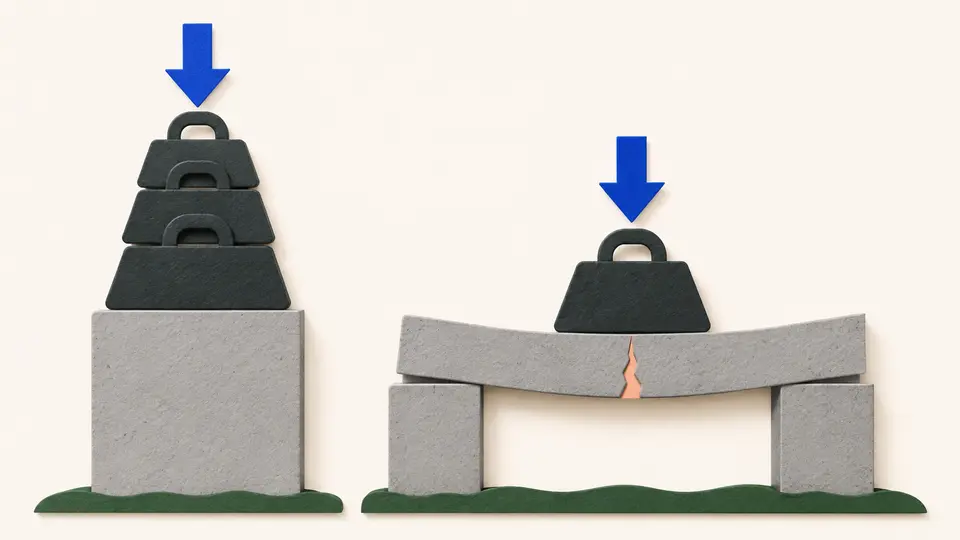
Pile heavy weights on a concrete block and it holds. Lay a plain concrete slab across a gap and load the middle, and it cracks. It's the same material both times. The block was being squeezed. The underside of the slab was being pulled.
Concrete is stone and sand glued together by a paste of water and cement. As the cement reacts with the water, it grows microscopic crystal lattices that lock the stones into a rigid mass. Squeezing presses that mass together, and a typical mix resists about 28 megapascals, or 4,000 pounds per square inch.
Pulling is different. Any real tension, the engineer's word for pull, breaks the rigid lattice, and the concrete cracks apart instead of stretching. So plain concrete only works where it's never pulled. That rules out beams and slabs, because bending always stretches one face.
Reinforced concrete solves this with a second material. Steel bars, called rebar, are set in place and the concrete is poured around them. The steel doesn't make the concrete better at being squeezed. Its job is to carry the pull, the one thing concrete can't do.
With steel inside, the two materials split the work. The concrete takes the squeeze and the rebar takes the pull. That one change makes concrete beams, slabs, walls, columns and frames possible, in almost any shape.
It takes very little steel. Rebar is about 1% of the cross-sectional area in most beams and slabs, and up to about 6% in some columns. The other 99% can be the cheap material.
So little is enough because the steel only goes where the pull is. When a beam bends, the face on the outside of the curve is stretched and the face on the inside is squeezed. Bars near the stretched face carry that pull. The same bars in the middle of the beam would do almost nothing.
Try to recallReinforcing steel is typically only about 1% of a slab's cross section. How can so little of it change what the slab can do?
The steel only has to cover the one thing concrete can't do, which is carry tension. Concrete handles the squeezing by itself. In a bending slab, the pull is confined to the face on the outside of the curve, so the steel only needs to sit there. Placed near that face, a small amount of steel carries the pull, and the slab can then resist bending instead of cracking.
So the recipe is short. Concrete takes the squeeze and steel takes the pull. Because the pull sits along one face of a bending beam, steel making up about 1% of the cross section is enough, as long as it's on that face.
In a simple beam loaded from above, that face is the bottom. Where the steel goes matters as much as how much there is.
Lessons in this topic
Why concrete needs steel inside it
Concrete is strong when squeezed and cracks when pulled. See how steel bars making up about 1% of a slab's cross section carry the pull.
Why steel and concrete can work as one material
Steel and concrete expand at nearly the same rate and grip each other, and the concrete keeps the steel from rusting. Take away any one of these and the pairing fails.
Why a beam with less steel is the safer one
A concrete beam can be built to sag visibly before it fails, or to fail in an instant, and the difference is how much steel it holds. Prestressing goes further and keeps the concrete from being pulled at all.
What makes reinforced concrete crack from the inside
Over the years concrete stops protecting its steel, and rust takes up more room than the steel it came from. See how carbonation, salt and swelling reactions crack concrete from within.
Three quick stories from this topic
The gardener's patent
In 1867 a French gardener patented concrete plant tubs strengthened with iron
Joseph Monier found that clay pots broke too easily, so he cast concrete around iron. By 1878 he held patents for reinforced pipes, bridges and beams, and reinforced concrete is now one of the most common engineering materials.
Why iron in concrete
Concrete resists squeezing but cracks when it's pulled. Metal set inside it carries the pull, so the pair can do what neither does alone.
The doubt he had to beat
People expected the iron to swell in the heat and burst the concrete. It doesn't, because the two materials expand at nearly the same rate.
Rust needs more room
Rust is bulkier than steel, so a rusting bar inside concrete cracks it open from within
Steel bars in concrete are shielded by the concrete's alkalinity. When that wears off and a bar starts to rust, the rust swells, cracks the concrete around it and breaks pieces off the surface. Engineers call it spalling.
The shield wears off
Fresh concrete is alkaline enough to keep steel from rusting. Carbon dioxide and rain slowly neutralize it from the surface inward.
Why depth matters
The thickness of concrete over a bar sets how long that takes. Road salt speeds everything up, which is why bridge decks and parking garages often fail early.
Less steel, more warning
Adding more steel to a concrete beam can make its failure more dangerous
With modest steel, the bars stretch first and the beam sags visibly before it fails. With too much, the concrete crushes first, instantly and without warning. So beams are normally designed to hold less steel than they could.
Over-reinforced
The concrete crushes before the steel yields, instantly and with no warning. The extra steel has made the failure worse.
Balanced
The concrete crushes just as the steel yields. It sounds elegant, but it's just as risky, because the failure is still sudden, with very little warning.
Sources
- Reinforced concrete - Wikipedia, Wikimedia Foundation
- Joseph Monier, Wikimedia Foundation