Engineering & Inventions · Materials & manufacturing
Iron and steel
Steel is iron with a small, controlled amount of carbon. See how a blast furnace turns ore into iron, how the Bessemer converter made steel cheap, and why steelmaking is now one of the hardest industries to clean up.
What you will learn
- Explain how a blast furnace uses carbon to strip oxygen from iron ore
- Explain why the iron that comes out of a blast furnace is brittle but easy to cast
- Tell cast iron, wrought iron and steel apart by their carbon content and how they behave
- Explain how the Bessemer converter and its oxygen successor made steel cheap
Lesson 1 of 4 · 4 min
How a blast furnace turns rock into iron
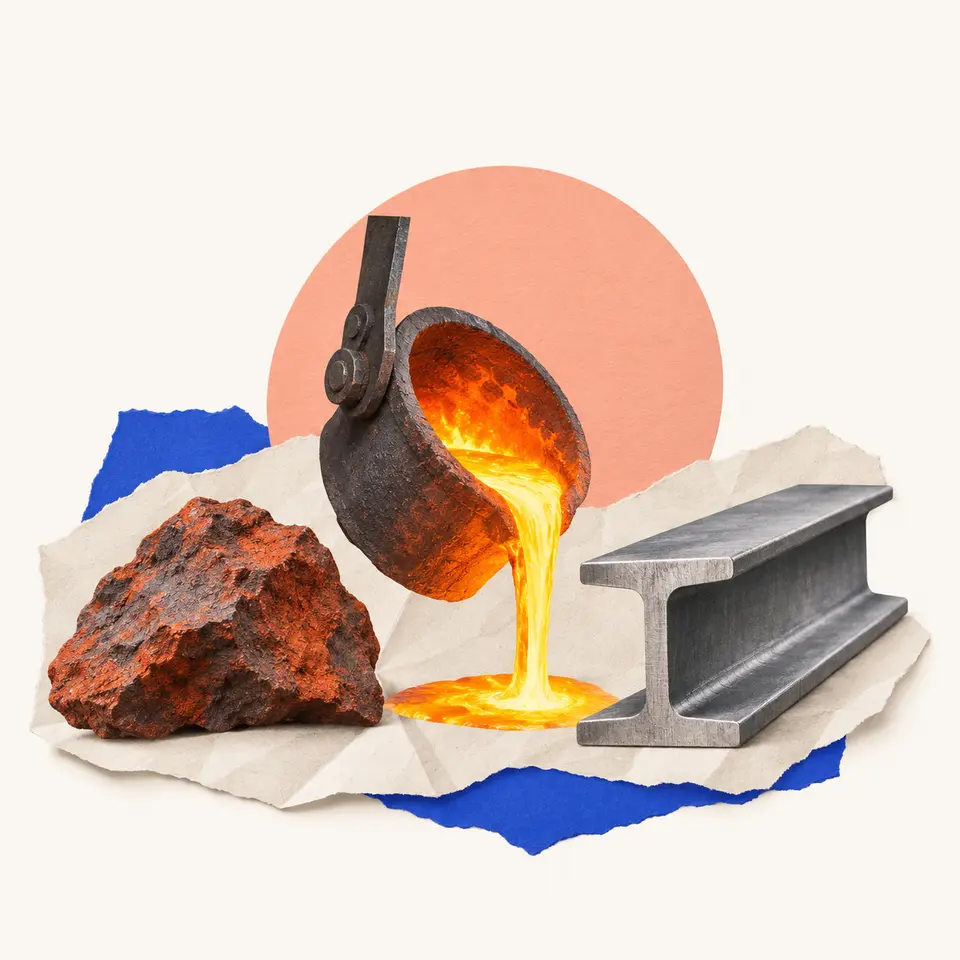
Iron ore is rock that's mostly iron oxide, iron locked together with oxygen. To get metal out, you have to pull the oxygen off, and carbon is what grabs it.
A blast furnace is a tall tower fed from the top with ore, coke and limestone. Coke is coal that's been baked without air until it's nearly pure carbon. Near the bottom, pipes blow in a blast of hot air, and the coke burns.
Burning coke makes heat and carbon monoxide gas. The hot gas rises through the falling ore and takes its oxygen, leaving iron and carbon dioxide. The furnace runs nonstop, and molten iron collects at the bottom to be drained off.
The iron that runs out of a blast furnace, called pig iron, has soaked up carbon from the coke, typically about 4%. That carbon lowers its melting point, which is why it flows out as a liquid.
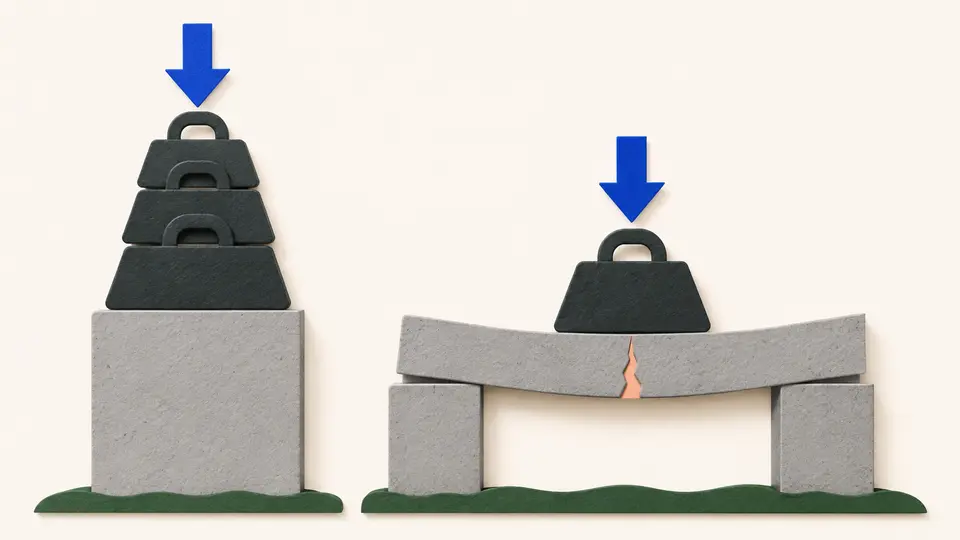
The same carbon makes it brittle. A sharp knock can crack it instead of bending it. Iron with this much carbon, more than about 2%, is called cast iron, because the easy way to use it is to pour it into a mold.
That's still useful. Cast iron pours into complicated shapes and wears well, so it's used for pipes and engine cylinder blocks. Most pig iron, though, goes on to have its carbon cut down.
Try to recallWhy is the iron that pours out of a blast furnace easy to cast but too brittle for most jobs?
It picks up about 4% carbon from the coke. That much carbon lowers the melting point, so the iron flows and fills molds well. But it also makes the iron brittle, so it cracks instead of bending.
A blast furnace uses carbon to pull oxygen off ore, and the iron that comes out keeps about 4% of that carbon, which makes it easy to cast and too brittle for beams or blades.
Lessons in this topic
How a blast furnace turns rock into iron
See how burning coke pulls oxygen out of iron ore, and why the iron that pours out is too brittle for most jobs.
How a little less carbon turned iron into steel
Tell cast iron, wrought iron and steel apart by their carbon, and see how blowing air, then oxygen, through molten iron made steel by the ton.
Steel before the factories
How ancient China cast iron by the ton, and how smiths in India and Japan made famous blade steel in small batches.
Hardening, stainless and the carbon problem
How heat and chromium change what steel can do, and why making it puts so much carbon dioxide in the air.
Three quick stories from this topic
Bessemer's price cut
The Bessemer process cut the price of British steel from £40 a ton to about £6
Blowing air through molten iron burned off its carbon in 10 to 20 minutes instead of a day or more. The burning carbon even supplied the heat, so the job needed no extra fuel.
Before
Steel had been too expensive for bridges and building frames, so the Industrial Revolution was built mostly of wrought iron.
After
Cheap steel spread fast. Andrew Carnegie opened a Bessemer mill in the US in 1875.
Stainless from gun barrels
Stainless steel was found in 1913 by a metallurgist looking for better gun barrels
Harry Brearley's alloy was rich in chromium. Steel with at least 10.5% chromium grows a thin oxide film that seals out oxygen and repairs itself when scratched.
Why plain steel rusts
Rust is porous and flaky. It falls away and keeps exposing fresh metal underneath.
A slow name
Brearley first called it rustless steel. A local cutlery maker gave it the name stainless steel.
Cast iron by 500 BC
Chinese metalworkers were pouring molten iron into molds around 500 BC
Smiths in the state of Wu got furnaces to about 1,130 degrees Celsius, hot enough to melt carbon-rich iron. Casting many tools at once beat hammering each one, and by 300 BC iron was China's main tool metal.
Brittle but cheap
Cast iron cracks under a sharp blow, so smiths also learned to remove carbon to make tougher wrought iron for weapons.
Europe much later
Europe's blast furnaces appear in the 12th and 13th centuries. Whether the idea came from China is still unknown.
Sources
- Steel, Wikipedia
- Blast furnace, Wikipedia
- Coke (fuel), Wikipedia
- Pig iron, Wikipedia
- Cast iron, Wikipedia
- Bessemer process, Wikipedia
- Stainless steel, Wikipedia
- Ferrous metallurgy, Wikipedia