Engineering & Inventions · Machines & robotics
How robots work
A robot senses, decides and acts in a loop. See what its sensors, computer and motors each do, why walking is harder for it than chess, and how much of today's robots is still a person at the controls.
What you will learn
- Describe the sense, decide and act loop that every robot runs
- Explain what sets a robot apart from other automatic machines, and why the line is blurry
- Explain what degrees of freedom are and why an arm needs six to place its hand at any position and angle
- Explain why a robot needs sensors on its own joints as well as sensors that watch the world
Lesson 1 of 4 · 4 min
What a robot vacuum is doing when it bumps a chair
Watch an early Roomba and it looks almost aimless. It rolls until its bumper hits a chair leg, backs off, turns and tries again. Infrared cliff sensors underneath stop it from driving off the top of the stairs.
That clumsy dance is the loop every robot runs. It senses the world, decides what to do, then acts. The action changes what it senses next, so the loop starts again.
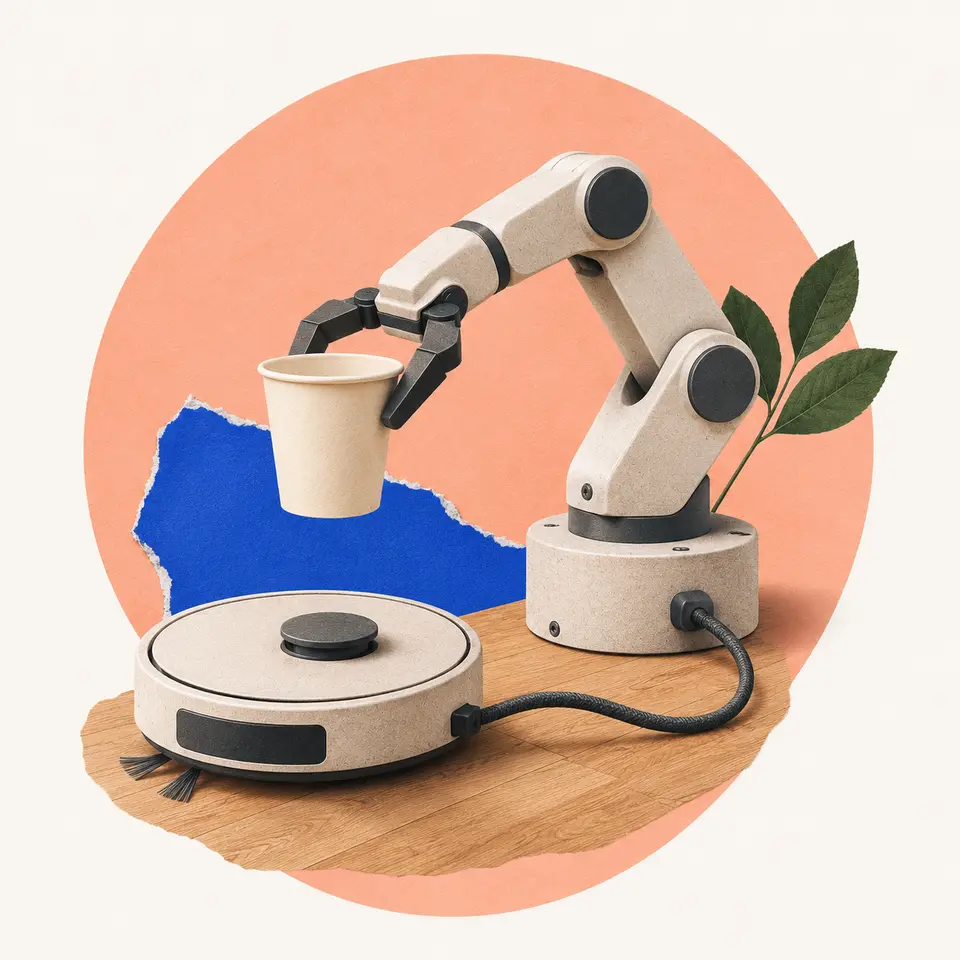
Engineers call the three steps perception, processing and action. Sensors report on the world and on the robot itself, such as where its joints are. A computer turns those readings into commands. Actuators, usually electric motors, turn the commands into movement.
The deciding can be simple or elaborate. Early Roombas used a few rules, such as spiraling, following walls and turning at a random angle after a bump. From the sixth generation, a camera and a floor sensor let them build a map and clean in neat rows.
There's no agreed definition of a robot. Experts and the public broadly agree that robots tend to sense and act on their surroundings, move, and work with some independence.
Factory robots get a sharper test. Under the international standard, an industrial robot is a jointed arm that is automatically controlled, multipurpose and reprogrammable. Reprogrammable means you change its motions by changing its program, without rebuilding it.
That's what made Unimate different. It went to work on a General Motors line in New Jersey in 1961, moving die castings. Workers taught it a job by moving its gripper by hand while a drum memory recorded the positions.
The word itself is older than any of these machines. It comes from Karel Čapek's 1920 play R.U.R. In Czech, robota means forced labor.
Try to recallWhy is it hard to say exactly which machines are robots, and what does the standard for industrial robots add?
There's no agreed definition, only a set of abilities robots tend to share, such as sensing, moving and acting with some independence. The standard for factory robots adds that an industrial robot is an automatically controlled arm that's reprogrammable. You can give it a new job by changing its program instead of rebuilding it.
A robot runs a loop of sensing, deciding and acting. What separates it from other automatic machines is a matter of degree, and for factory arms the test is whether you can reprogram it for a new job.
Lessons in this topic
What a robot vacuum is doing when it bumps a chair
Learn the sense, decide, act loop that every robot runs, and see why nobody fully agrees on which machines count as robots.
How a robot arm knows where its own hand is
Count the joints a robot arm needs to put its hand anywhere, and see why it needs sensors that watch its own body as well as the world.
Why walking is harder for a robot than chess
See why skills a toddler has are harder to build than adult reasoning, and how walking robots keep from falling over.
How much of a robot demo is really a person
See where robots actually work today, from factories to warehouses and operating rooms, and learn how to tell when a person is steering one.
Three quick stories from this topic
The robot that isn't
The FDA says robotic surgery devices aren't really robots, since they can't operate alone
The surgeon sits at a console, watching a 3D camera view and steering instrument arms at the bedside. The agency says the device can't perform surgery without direct human control, which is why it doesn't count as a robot.
Operating from a distance
Running a machine from a distance is called teleoperation, and many famous robots work this way.
The demo problem
In 2024, viewers spotted a gloved hand mirroring a humanoid robot folding a shirt in a company video.
Moravec's paradox
In 1988 Hans Moravec said a toddler's skills are harder for machines than adult IQ tests
It's comparatively easy, he wrote, to make computers perform like adults on intelligence tests or at checkers. Giving them a one-year-old's perception and mobility is hard or impossible, because evolution spent millions of years refining those skills.
Chess came first
IBM's Deep Blue beat the world chess champion in 1997. Honda's walking humanoid ASIMO was unveiled in 2000.
Why it feels backward
Skills we find effortless are the oldest and most refined, so they're the hardest to copy.
Where robot comes from
The word robot comes from a 1920 Czech play, and robota means forced labor
Karel Čapek's play R.U.R., short for Rossum's Universal Robots, premiered in January 1921 and gave English the word. Čapek credited his brother Josef with inventing it from robota, the forced work serfs owed their masters.
Before real robots
The play came four decades before Unimate, the first industrial robot, started work on a General Motors line in 1961.
What the word replaced
Robot pushed aside older words such as automaton and android in languages around the world.
Sources
- Roomba, Wikipedia
- Robotics, Wikipedia
- Robot, Wikipedia
- Industrial Robots: Definition, International Federation of Robotics
- Unimate, Wikipedia
- R.U.R., Wikipedia
- Computer-Assisted Surgical Systems, US Food and Drug Administration
- Moravec's paradox, Wikipedia