Engineering & Inventions · Machines & robotics
Simple machines and mechanical advantage
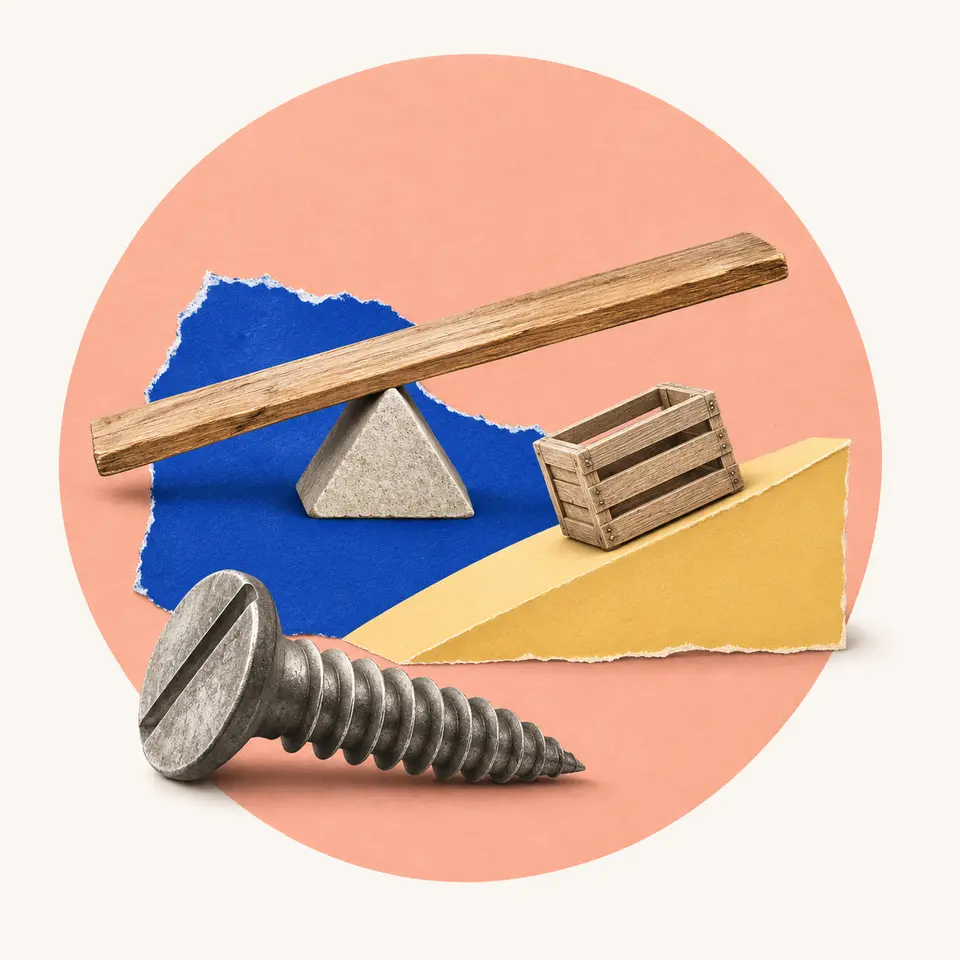
Levers, pulleys, ramps, wedges, screws and wheels all trade distance for force. See how each does it, why none saves any work, and how to find them inside a bicycle or a crane.
What you will learn
- Explain how the arm lengths of a lever set how much it multiplies a force
- Explain why a ramp needs less force but the same work as lifting straight up
- Explain why pulleys and the wheel and axle count as levers, and wedges and screws as ramps
- Work out the ideal mechanical advantage of a pulley system, a wheel and axle and a screw from their shape
Lesson 1 of 4 · 4 min
Why a longer handle lets you lift more
Lift the handles of a loaded wheelbarrow and the load feels far lighter than it is. In one textbook example, 45 kg of barrow and load needs a lift of only 32.4 newtons. That's the pull of about 3.3 kg.
A wheelbarrow is a lever, a rigid bar that turns around a fixed point called the fulcrum. Here the fulcrum is the wheel's axle. The load sits close to it, and your hands are far from it.
A lever balances when force times distance from the fulcrum is equal on both sides. Your hands are 13.6 times farther from the axle than the load, so they need about a fourteenth of its weight. That ratio is the mechanical advantage, the output force divided by the input force.
The catch is distance. For every centimeter the load rises, your hands rise about 13.6 centimeters. A longer handle would make the lift easier still, and your hands would travel farther again.
Say you need a 100 kg crate on a truck bed 1 m high. You could lift it straight up, or push it up a ramp 4 m long. The ramp, or inclined plane, is the easier way.
A ramp's mechanical advantage is its slope length divided by its height. A 4 m ramp rising 1 m cuts the force to about a quarter, ignoring friction. You pay by pushing four times as far.
Physicists measure effort as work, the force times the distance it moves. A quarter of the force over four times the distance is the same work as the straight lift.
Galileo showed in 1600 that this holds for every simple machine. None of them creates energy. They only change how you spend it, as a big force over a short distance or a small force over a long one.
Try to recallWhy doesn't a ramp save any work, even though it makes a heavy load easier to push up?
A ramp lowers the force you need, but the load has to travel the whole slope instead of straight up. Work is force times distance, so less force over a longer distance adds up to the same work. Ignoring friction, the ramp only spreads the work out.
A lever or a ramp multiplies your force by the ratio of two distances. The small push always travels farther, so the work you do stays the same.
Lessons in this topic
Why a longer handle lets you lift more
See how a lever and a ramp let a small push move a heavy load, and why that push always has to travel farther to do it.
Six classic machines built from two ideas
Meet the pulley, the wheel and axle, the wedge and the screw, see which are levers and which are ramps, and work out their mechanical advantage from their shape.
Why a car jack stays up when you let go
See how friction makes every real machine fall short of its ideal figure, and why a screw jack holds its load only because it wastes so much of your effort.
The simple machines hiding in a bicycle
Take apart a screw jack, a Roman crane and a bicycle into the levers, wheels and pulleys inside them, and see why a bicycle gives up force to gain speed.
Three quick stories from this topic
Archimedes and the ship
Plutarch says Archimedes pulled a loaded three-masted ship toward him by hand with pulleys
The ship sat on shore with passengers and cargo aboard. Archimedes sat at a distance and drew it along smoothly with a system of compound pulleys, to show King Hiero what a small force could move.
Could it work?
Nobody can check the story now. The physics is sound, because every rope section holding the moving pulleys adds to the pull.
The price is rope
A sixfold advantage means pulling 6 m of rope for every 1 m the load moves.
The bicycle's force trade
In every gear, a bicycle's tire pushes the road less hard than your foot pushes the pedal
In one worked example for an 18-speed bike, the mechanical advantage ran from 0.62 in the lowest gear to 0.16 in the highest. The bike gives up force on purpose, because that turns a slow leg push into fast travel.
Why lower gears help
A lower gear raises the mechanical advantage, so you push with less force and pedal faster. That's why riders shift down for hills.
Levers do it too
Tweezers put your fingers between the pivot and the tips, so the tips get less force but move farther.
Why screws stay put
A screw holds its load by itself only if friction wastes more than half your effort
Below 50% efficiency, the friction in the threads is more than a load can overcome to turn the screw backward. That's why a screw jack stays up when you let go, while a low-friction ball screw doesn't.
Waste by design
A screw jack's real mechanical advantage is often only 30% to 50% of its ideal figure, because its threads slide over a large area.
The hydraulic contrast
A hydraulic jack has no such lock. It can sink if the pressure holding it is released by accident.
Sources
- 9.5 Simple Machines, College Physics 2e, OpenStax, Rice University
- Lever, Wikipedia
- Simple machine, Wikipedia
- Inclined plane, Wikipedia
- Plutarch, Life of Marcellus (Loeb Classical Library, 1917), LacusCurtius, University of Chicago
- Mechanical advantage, Wikipedia
- Screw (simple machine), Wikipedia
- Jackscrew, Wikipedia