Engineering & Inventions · Energy & power
How a heat pump moves heat
See how a machine warms a house with heat taken from freezing outdoor air, follow its refrigerant around the loop, and learn to read the performance number on its spec sheet.

What you will learn
- Explain why a heat pump needs work to transfer heat from a colder place to a warmer one.
- Work out delivered heat as energy taken from outside plus work put in, using an idealized example.
- Explain the roles of the evaporator and compressor in a heating cycle.
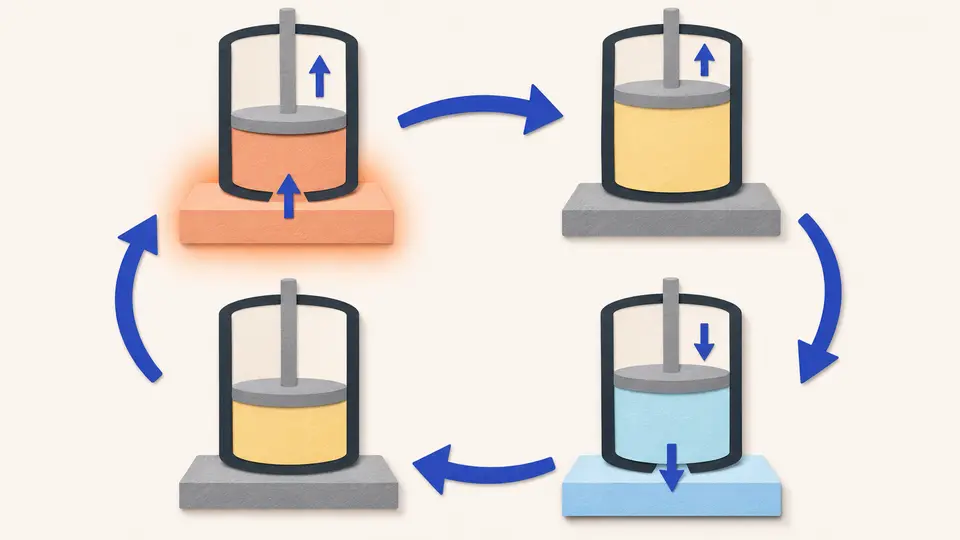
- Order the stages through heat release and the pressure drop that lets the cycle repeat.
Lesson 1 of 4 · 4 min
How can cold air help heat a room?
It's below freezing outside, and a machine on the wall is warming the house with heat taken from that air. For every unit of electricity it uses, it often delivers two to four units of heat. Where does the extra come from?
Cold air still holds thermal energy. Air at minus 15 degrees Celsius is 258 degrees above absolute zero, the coldest anything can get. A heat pump collects some of that energy and releases it indoors.
That runs against the usual direction. Left alone, heat flows from warm places to cold ones, so it leaks out of the house. Moving it the other way takes an energy input.
That input is work, usually supplied as electricity. The electricity doesn't become the heat. It runs a cycle that carries heat from one place to another.
You already own a machine like this. A refrigerator takes heat out of its cold interior and releases it into the kitchen. A heat pump does the same job, with the outdoors as the cold interior and your house as the kitchen.
The outdoor air doesn't have to feel warm to you. It only has to be warmer than the fluid inside the outdoor coil, the heat exchanger where fluid and air swap heat.
The heat pump makes that fluid colder than the air. So heat passes from the air into the fluid in the ordinary direction, from warmer to colder. Later, the cycle raises the fluid's temperature above the room's, and the heat passes out again indoors.
Now count the energy. The heat delivered indoors equals the heat taken from outside plus the work put in. Nothing is created.
So the warmth in the room has two sources. One is the electricity, which you pay for. The other is the outdoor air, which costs nothing.
Say a heat pump uses 1 unit of electrical energy and takes 2 units of heat from outside. It delivers 3 units indoors.
The numbers are made up to keep the sum easy, but real machines follow the same pattern. Here, two-thirds of the warmth in the room came from the yard.
An electric resistance heater turns its electricity into heat and stops there. One unit in gives one unit out.
A heat pump spends its unit on moving extra energy in from outside, so it delivers more heat than the electricity it uses. No law of physics is broken, because the extra energy was already out there.
ENERGY STAR says an air-source heat pump can deliver up to three times more heat energy than the electrical energy it consumes. The two to four units given earlier are a physics textbook's range for real machines. The exact ratio depends on conditions, above all on how cold it is outside.
Try to recallIn a simplified cycle, a heat pump delivers four units of energy indoors while using one unit of work. How much heat came from outside?
Three units. Delivered heat equals extracted heat plus work, so four minus one leaves three units from outside.
Lessons in this topic
How can cold air help heat a room?
A heat pump warms a house with heat taken from freezing outdoor air. See why that takes work, and why the energy still adds up.
How refrigerant carries heat from outdoors to indoors
Follow a heat pump's refrigerant through four stages, and see why the machine squeezes it before the room and lets the pressure drop after.
How to read a heat pump's efficiency number
A heat pump's COP is the heat it delivers divided by the electricity it uses. Learn to work one out, and what to ask before you trust it.
The best a heat pump could ever do
Calculate the best possible heating COP from two temperatures, then explain why real machines stay below it.
Three quick stories from this topic
Two to four times the electricity
A typical heat pump delivers two to four times as much heat as the electricity it uses
The electricity doesn't become the heat. It runs a cycle that carries heat in from outdoors, so at least half the warmth in the room was collected from the outside air. An electric heater turns one unit of electricity into one unit of heat.
The books still balance
In an illustrative example, one unit of work plus two units from outside gives three units delivered indoors.
Conditions decide the ratio
Those numbers are an example, not a fixed promise. Heating COP compares delivered heat with input under stated conditions.
Heat from freezing air
A heat pump can warm a house with heat taken from air that is below freezing
It chills its refrigerant until the fluid is colder than the outdoor air, so heat flows from the air into the fluid. ENERGY STAR tests cold-climate models at 5 degrees Fahrenheit, which is minus 15 Celsius.
Compression changes the next step
Work raises the vapor's temperature so it can release heat into the warmer room.
The cycle gets ready to repeat
After the refrigerant releases its heat indoors, a drop in pressure cools it so it can absorb heat outdoors again.
The heat pump in your kitchen
A refrigerator is a heat pump, and the room it heats is your kitchen
It moves heat out of the food compartment and releases it into the room, together with the energy from the electricity it used. A house heat pump does the same thing, with the outdoors as the cold compartment and the living room as the kitchen.
Same machine, different goal
A refrigerator is judged by the heat it removes from its cold side. A heat pump is judged by the heat it delivers to its warm side.
The warm side always gets more
The heat released on the warm side equals the heat removed from the cold side plus the work put in. So a refrigerator gives the kitchen more heat than it took from the food.
Sources
- College Physics 2e, 15.5 Heat Pumps and Refrigerators, OpenStax / Rice University
- Air source heat pumps, ENERGY STAR