Engineering & Inventions · Energy & power
The efficiency limit no engine can beat
Two temperatures set the most work any engine can get from heat, and the most heat any heat pump can move. See where the limit comes from and how far below it real machines run.
What you will learn
- Describe the four stages of the ideal cycle and what each one is for
- Explain why some heat has to be rejected instead of all of it becoming work
- Compute the ideal efficiency from two absolute temperatures
- Say which temperature is worth changing, and why that choice is often out of your hands
Lesson 1 of 4 · 6 min
Why some heat has to be thrown away
In 1824, a typical steam engine turned only about 5 to 7% of its fuel's energy into work. A French army engineer, Sadi Carnot, asked whether there was a limit to how much better engines could get. He paid to print 600 copies of his answer, and few people read it while he was alive.
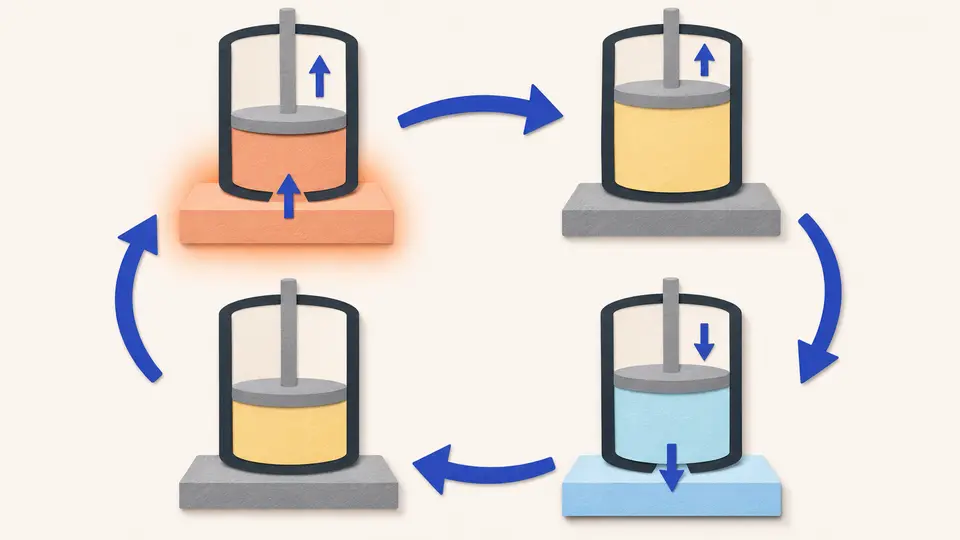
His answer was an imaginary engine, now called the Carnot cycle. A gas in a cylinder works between a hot source at temperature T_H and a cold one at T_C. Each is called a reservoir. The cycle has four stages.
First, the gas touches the hot reservoir, takes in heat Q_H and expands at a steady temperature. Second, it's cut off from both reservoirs and keeps expanding, so it cools to T_C. Third, it touches the cold reservoir and is compressed, giving up heat Q_C. Fourth, it's cut off again and squeezed until it's back at T_H.
Stages at one temperature are called isothermal. Cut-off stages, with no heat flowing in or out, are called adiabatic.
The alternation is the point. Heat only crosses when the gas and a reservoir are at almost the same temperature, and the gas only changes temperature while it's cut off. So heat never falls across a large temperature gap. That makes the cycle reversible, and no engine can beat a reversible one.
Why does the third stage exist? An engine is meant to turn heat into work, and stage three hands heat back to the cold reservoir. A machine that skipped it would seem better. It can't be skipped.
The reason is a quantity called entropy. When heat crosses into the gas at a steady temperature, the gas gains entropy equal to the heat divided by that temperature. So taking in Q_H at T_H adds Q_H over T_H.
The gas ends each cycle exactly where it began, so that entropy has to leave again. The only way out is with heat going to the cold reservoir. Giving up Q_C at T_C removes Q_C over T_C, and the two amounts have to match.
The cold side is at a lower temperature, so it takes less heat to carry the same entropy out. Q_C is smaller than Q_H, and the difference is the work. On the diagram, each heat is an area, and the work is the rectangle left over.
Q_C can shrink, but it can't be zero. That's why a power station stands next to a river or a cooling tower, and why a car engine needs a radiator.
Try to recallA designer proposes an engine that takes heat from a boiler and turns all of it into work, rejecting nothing. What does the ideal Carnot cycle show is wrong with that?
It can't work. Taking in heat Q_H at temperature T_H adds entropy to the gas, equal to Q_H over T_H. The gas returns to its starting state every cycle, so that entropy has to leave, and the only way out is heat flowing to something colder.
So the rejected heat Q_C can't be zero. An engine with no cold side has nowhere to send the entropy, which is why real engines have a radiator, a condenser or a cooling tower.
An engine doesn't use heat up. It takes heat in hot, hands less of it back cold and keeps the difference as work. How big that difference can be depends on just two numbers, the reservoir temperatures.
Lessons in this topic
Why some heat has to be thrown away
Every heat engine hands some of its heat back to something colder. An ideal engine from 1824 shows why no design can avoid that.
Two temperatures set an engine's best efficiency
The ideal efficiency is 1 minus the cold temperature over the hot one, both in kelvin. That one line caps what a power station can do before anyone designs it.
Run an engine backwards and you get a heat pump
A heat pump is a heat engine in reverse, which is why it can deliver four kilowatts of heat for one kilowatt of electricity.
Why a perfect engine would be useless
A perfectly efficient engine would have zero power. See why real machines trade efficiency for speed, and what the gap between an ideal COP of 8.8 and a measured 3.5 is made of.
Three quick stories from this topic
The perfect engine has zero power
The most efficient engine physics allows would produce no power at all
The ideal engine wastes nothing because heat only crosses between parts at almost the same temperature. Heat moves that way infinitely slowly, so one cycle would take forever. Every real engine gives up some efficiency to run at a useful speed.
Why slowness is built in
Heat flows fast across a big temperature difference and slowly across a small one. The ideal Carnot cycle allows only vanishingly small differences, so its heat flow is vanishingly slow.
A bound, not a target
The ideal figure tells you the most any engine could do between two temperatures. Measured values for real machines are always well below it.
A third of the heat, gone
A perfect engine fed 500 degree steam would still throw away over a third of its heat
The best possible efficiency is 1 minus the cold temperature over the hot one, in kelvin. With steam at 500 degrees Celsius and cooling water at 30, that's 61%. Nothing about the engine's design appears in the formula.
Kelvin, not Celsius
A boiler at 500 degrees Celsius is at 773 kelvin and a condenser at 30 degrees Celsius is at 303 kelvin, so the ceiling is about 61%. The Celsius numbers would suggest 94%.
Nobody gets past it
No engine working between two heat reservoirs can be more efficient than a Carnot engine between the same two, and all reversible engines between them are equally efficient.
Carnot's unread book
The limit on every engine comes from an 1824 book its author paid to print
Sadi Carnot, a French army engineer, had 600 copies printed, and the book drew little attention in his lifetime. He died of cholera at 36. Two years later another engineer explained his work, and it led to the second law of thermodynamics.
The question he asked
Engines of the 1820s turned about 5 to 7% of their fuel's energy into work. Carnot asked whether there was a limit to the work a given heat source could produce.
The answer
He imagined an ideal engine working between a hot source and a cold one. Its efficiency depends only on those two temperatures, and no real engine can beat it.
Sources
- Carnot cycle, Wikimedia Foundation
- Nicolas Léonard Sadi Carnot, Wikimedia Foundation