Engineering & Inventions · Energy & power
How electricity is generated
Almost every power station spins a magnet inside coils of wire. See how a generator works, how steam, water and wind turn it, why steam plants waste most of their heat, and why solar panels are the exception.
What you will learn
- Explain why a moving magnet makes current flow in a coil of wire and a still one doesn't
- Describe how a power-station generator spins an electromagnet inside fixed coils
- Trace how a steam power station turns heat from fuel or splitting atoms into a spinning shaft
- Compare how water, wind and gas turbines drive a generator, and say why solar panels need none
Lesson 1 of 4 · 4 min
The magnet and coil inside every power station
In October 1831, in a basement laboratory at the Royal Institution in London, Michael Faraday pushed a bar magnet into a coil of wire. A needle on a meter wired to the coil jumped. When he pulled the magnet out, it jumped again.
The meter was a galvanometer, which detects electric current. Earlier tests had shown that a magnet sitting still beside a wire does nothing. The current flowed only while the magnet was moving.
The effect is called electromagnetic induction. A wire in a changing magnetic field has current pushed through it. Moving the magnet changes the field around the coil. So does moving the coil past a magnet that stays put.
That's why every generator needs motion. Stop the motion and the current stops, however strong the magnet is.
Faraday's coil gave a brief twitch of current. A power station needs a steady flow for decades, so its generator turns the push and pull into rotation.
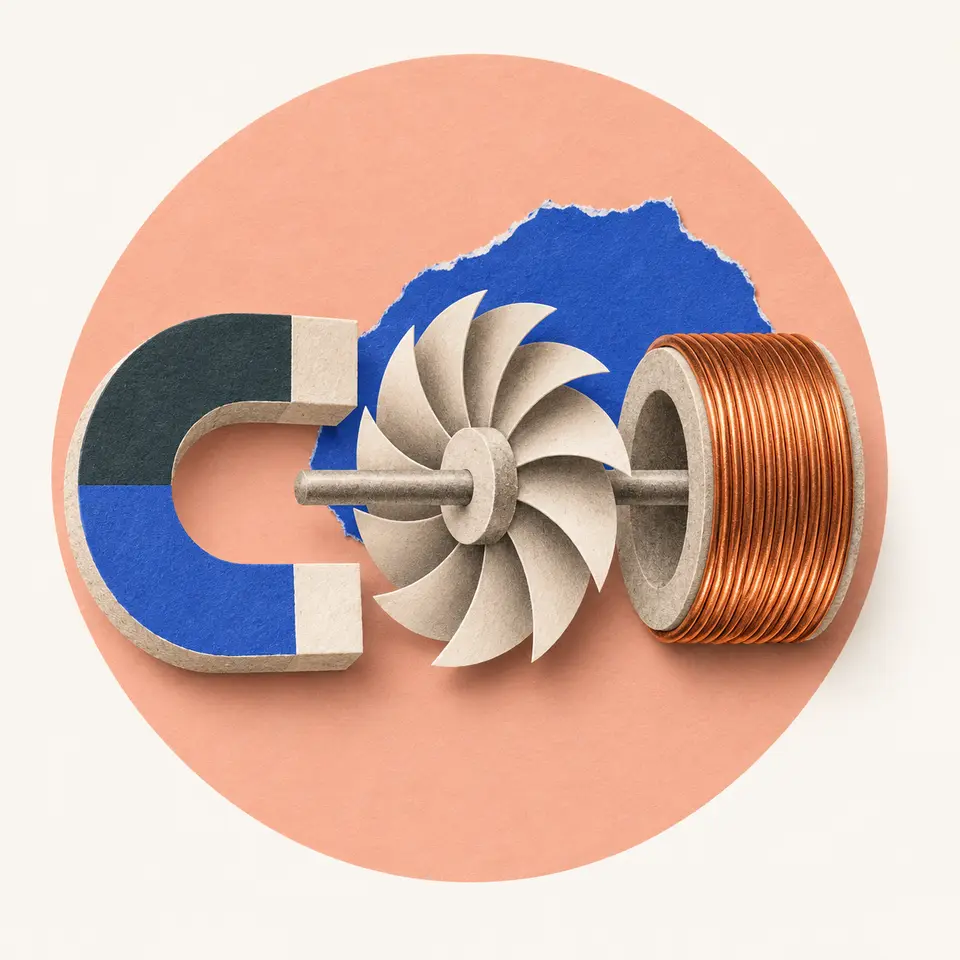
Inside the machine, a heavy part called the rotor spins on a shaft. The rotor is an electromagnet, a magnet made by running current through its own windings. Around it sits the stator, a fixed cylinder of insulated copper coils. More turns of wire in the coils give a higher voltage.
As the rotor's north and south poles sweep past each coil, the field through that coil rises, falls and reverses. So the current flows one way, then the other. This is alternating current, the kind in a wall socket.
The rotor's speed sets the rhythm. A generator with one north and one south pole turns 3,000 times a minute on a grid that runs at 50 cycles a second, as in Europe. On a 60-cycle grid, as in North America, it turns 3,600 times.
Try to recallIn a power-station generator, which part spins, which part stays still, and why does the current keep reversing direction?
The rotor, an electromagnet on the shaft, spins. The stator's copper coils stay still around it. As the rotor's poles sweep past each coil, the field through the coil keeps reversing, so the current flows one way and then the other.
A generator is Faraday's moving magnet made continuous. Keep an electromagnet spinning inside coils of wire and current flows for as long as something turns the shaft.
Lessons in this topic
The magnet and coil inside every power station
See what Michael Faraday found in 1831 when he pushed a magnet through a coil, and how a power-station generator turns that into a steady supply.
Steam, water and wind, the ways to turn a shaft
Follow coal, gas, nuclear fuel, falling water and wind from their source to the spinning generator, and see why solar panels need no generator.
Why power stations throw away most of their heat
See why a steam plant turns only about a third of its fuel's energy into electricity, what rises from a cooling tower, and how combined-cycle gas plants get more out.
Why France runs on nuclear and Kenya on hot rock
Compare how France, China, Brazil, Kenya and Denmark make their electricity, and learn what capacity factor says about a plant's real output.
Three quick stories from this topic
Spinning magnets everywhere
In 2025 about 91% of the world's electricity came from magnets spinning inside coils
Coal, gas, nuclear, hydro and wind plants all turn a generator built on the effect Michael Faraday found in 1831. Nearly all the rest came from solar panels, which make current with no moving parts.
Different fuels, one machine
Burning coal, splitting uranium, falling water and wind all do the same job. They turn a shaft, and the shaft spins a generator.
The odd one out
A solar cell turns sunlight straight into electricity. It has no shaft, magnet or coil.
Cooling towers make clouds
The white clouds pouring from power station cooling towers are water, not smoke
Warm water from the plant falls through the tower, and a little of it evaporates, carrying heat away. In cooler air that vapor condenses into droplets, the way your breath fogs on a cold day.
Why the heat must go
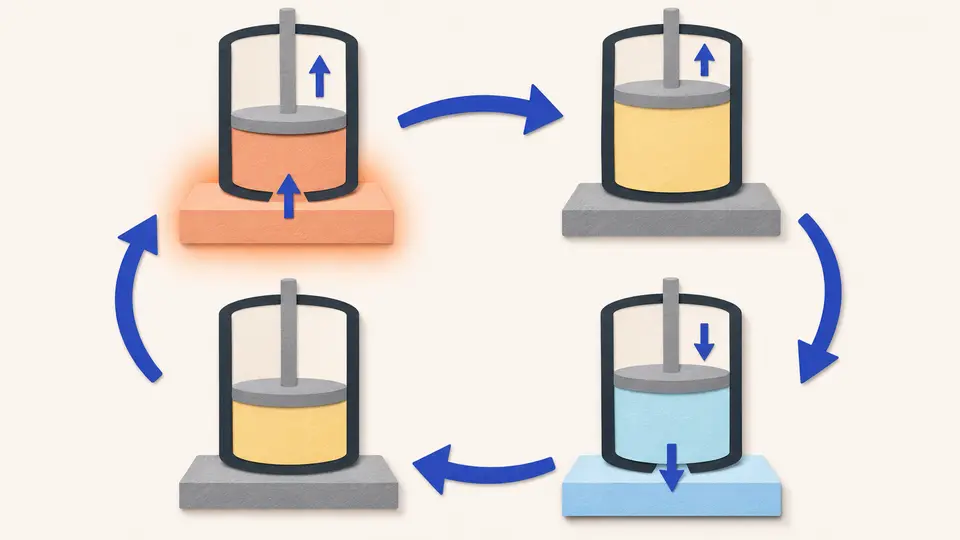
A steam plant has to cool its spent steam back into water to keep the turbine turning. That heat goes into a river, the sea or the air.
How much heat
In 2025 the average US coal plant turned about 32% of its fuel's energy into electricity. Most of the rest left as heat.
Kenya's underground steam
Kenya makes almost half its electricity from steam rising out of hot rock
Its geothermal plants at Olkaria, in the Great Rift Valley, gave about 46% of Kenya's electricity in 2025. Kenya was the first African country to build geothermal power.
Why there
The Rift Valley's hot rock heats underground water into steam that wells can tap.
The same machine
The steam spins a turbine and generator, just as steam from a coal boiler would.
Sources
- Michael Faraday's generator, The Royal Institution
- Faraday's law of induction, Wikipedia
- Michael Faraday, Wikipedia
- Electric generator, Wikipedia
- Electricity explained: how electricity is generated, US Energy Information Administration
- Utility frequency, Wikimedia Foundation
- Share of electricity production by source, Our World in Data, from Ember (2026)
- Cooling tower, Wikipedia
- Thermal power station, Wikipedia
- Geothermal power in Kenya, Wikipedia