Engineering & Inventions · Transport & aerospace
How a car works
Follow power from the engine to the road. See what the clutch, gears and differential do, how a press on a pedal stops more than a ton of metal, and why a safe car is built to crumple.
What you will learn
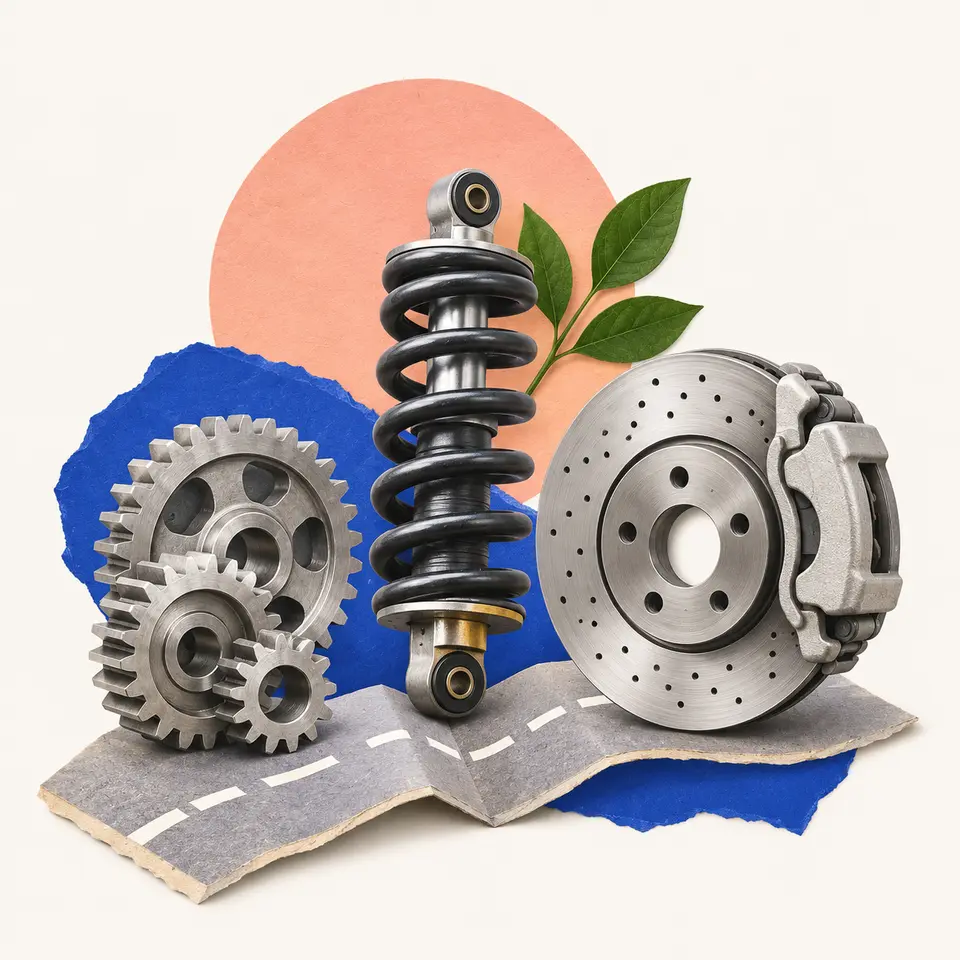
- Explain why a fuel-burning engine needs a clutch and a gearbox to drive a car
- Explain how a differential lets a car's driven wheels turn at different speeds in a turn
- Describe how a car's steering aims the front wheels and how springs and dampers keep them on the road
- Explain how hydraulic brakes multiply the push of a foot and turn motion into heat
Lesson 1 of 4 · 5 min
Why an engine can't drive the wheels on its own
Start a petrol car and its engine is already spinning while the wheels sit still. So something between engine and road has to let one turn without the other. That part is the clutch.
In a manual car, the clutch is a friction disk that springs press against the engine's flywheel. Press the left pedal and the disk pulls away, so the engine stops driving the wheels. Without a clutch, the engine would stall every time the car stopped.
To move off, you press the pedal, pick first gear, then let the pedal up slowly. The disk slips, then grips, and the car rolls away.
A fuel-burning engine makes good power only across a narrow range of speeds, its power band. The car has to crawl from a stop and also cruise on a highway. Low gears let a fast engine turn the wheels slowly and with more force. High gears let it turn them fast.
Most petrol and diesel cars have 4 to 10 forward gears. Electric cars usually manage with one fixed gear, because an electric motor works well from a standstill up to top speed.
Watch a car take a tight corner. The outer wheels trace a bigger circle than the inner ones, so they travel farther in the same time. Wheels the engine drives can't, because both are tied to the same gearbox.
The fix is the differential, a cluster of gears in the middle of the driven axle. It keeps pushing both wheels but lets them turn at different speeds. The average of the two wheel speeds always matches what comes in from the engine. So when the outer wheel speeds up, the inner one slows by the same amount.
Without one, a driven wheel has to skid through every turn. Go-karts and trams put up with that. The idea is older than the car. Clockmaker Joseph Williamson used a differential in a clock in 1720, and Carl Benz built one into his first motor car.
Where the differential sits depends on which wheels are driven. Most cars today use front-wheel drive, with engine, gearbox and differential packed across the front. Rear-wheel drive grips better when accelerating hard. All-wheel drive adds a third differential between the axles, so front and rear can turn at different speeds too.
Try to recallWhy does a car need a differential on the axle the engine drives?
In a turn, the outer wheel travels farther than the inner one, so it has to spin faster. Both driven wheels are connected to the engine, so without help one would have to skid. The differential lets them turn at different speeds while still driving both.
The clutch lets the engine run while the car stands still, and the gears keep it in its power band. The differential then lets the driven wheels share a turn without skidding.
Lessons in this topic
Why an engine can't drive the wheels on its own
See why a car puts a clutch and gears between engine and wheels, and how a differential lets two driven wheels turn at different speeds.
How a car steers, soaks up bumps and stops
See how turning the wheel aims the front tires, how springs and dampers keep them on the road, and how a light press on a pedal stops more than a ton of metal.
Why a safe car is built to crumple
See why a car whose front crushes in a crash protects you better than one that doesn't, and how crash tests turn that protection into a rating.
From one three-wheeler to 1.6 billion cars
Follow the car from Carl Benz's 1886 patent through Ford's moving assembly line and Toyota's factories, and see how cars took over the street.
Three quick stories from this topic
The 0.04-second airbag
A car's airbag is fully deployed about 0.04 seconds after a crash begins
An igniter sets off a fast chemical reaction that makes mostly nitrogen gas. It has to be that quick, because a car's speed changes so fast in a crash that you'd otherwise hit the inside of the car first.
Then it empties
As soon as the bag has deployed, gas starts escaping through vents in its fabric.
Partner, not replacement
Carmakers once pitched airbags as a substitute for belts. Now they're designed as supplemental restraints that work alongside a belt.
Fuel from a pharmacy
The first long-distance drive in a petrol-engined car refueled at a pharmacy
In August 1888 Bertha Benz drove 105 km from Mannheim to Pforzheim without telling her husband Carl. The car ran on ligroin, a petroleum solvent sold only by chemists, so she stopped at the pharmacy in Wiesloch.
Repairs on the road
She cleared a blocked fuel line with her hat pin and had a cobbler fit leather to the failing brakes.
Why she went
Carl was a poor salesman. Her trip showed the public that his motor car could make a real journey.
The clockmaker's differential
The first proven use of a car's differential gear was in a clock in 1720
Clockmaker Joseph Williamson used one to show both clock time and sun time from the same pendulum. Carl Benz built a similar gear into his first motor car in 1885, so its driven wheels could turn at different speeds.
Invented again and again
Mill machinery, cotton spinning and steam carriages all used a differential before the car came along.
Why a car needs one
In a turn the outer wheel travels farther. The differential lets it spin faster while both wheels keep driving.
Sources
- Clutch, Wikipedia
- Transmission (mechanical device), Wikipedia
- Manual transmission, Wikipedia
- Differential (mechanical device), Wikipedia
- Front-wheel drive, Wikipedia
- Rear-wheel drive, Wikipedia
- Four-wheel drive, Wikipedia
- Airbag, Wikipedia
- Bertha Benz, Wikipedia