Engineering & Inventions · Buildings & infrastructure
How bridges carry a load
Trace weight through beams, arches, cables and supports, and see why shape matters as much as material.

What you will learn
- Describe a load path from a bridge deck to its supports.
- Tell tension from compression in a bending beam.
- Explain why an arch needs supports that resist outward thrust.
- Describe what the cables, towers and anchorages do in a conventional suspension bridge.
Lesson 1 of 4 · 3 min
Where does a truck's weight go?
A loaded truck stops halfway across a bridge. Under its wheels is a strip of roadway, and under that is air. So what's holding it up?
The truck's weight presses on the roadway. The roadway passes that push to the structure beneath it, then to the supports, then to the ground. That chain is called a load path. A bridge works by handing forces from part to part until they reach the ground.
The simplest case is a beam bridge, one horizontal piece resting on a support at each end, like a plank across a stream.
A load on the middle bends the beam, and the beam pushes down on its supports. The supports push back up. Those upward pushes are called reactions, and without them the beam and the truck would fall.
The picture of a path has a limit. Force doesn't pour through a bridge like water through a pipe. Each part pushes or pulls on its neighbors, and each neighbor has to push or pull back.
So ask of every part whether it can supply its share. One connection or support that can't supply the force breaks the chain, however strong the deck looks.
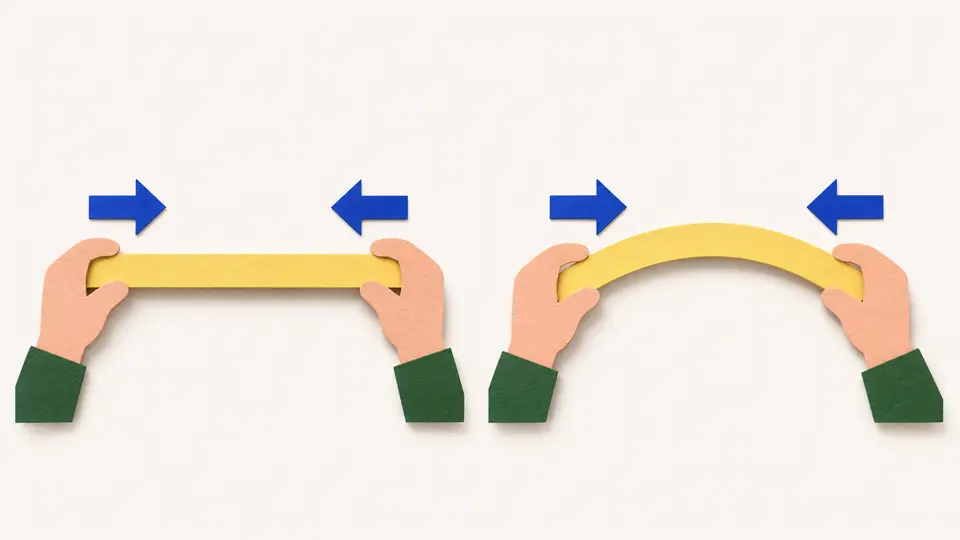
Squeeze a sponge between your hands and it gets shorter. That's compression. Pull on its ends and it gets longer. That's tension.
A bending beam does both at once. Load a beam on two supports from above and it sags. The sag pushes the top edge together, so the top is in compression. It pulls the bottom edge apart, so the bottom is in tension. Calling the whole beam squeezed gets half of it wrong.
The split matters because many materials handle one far better than the other. Brick and plain concrete resist compression well and pull apart easily. Steel is strong both ways.
So a concrete beam gets steel bars cast into its lower part. The concrete carries the squeeze along the top and the steel carries the pull along the bottom. To pick a material, you have to ask which way the load acts on it.
Top squeezed, bottom stretched is the pattern for this beam, held up at both ends and loaded from above. It isn't a rule for every bridge part.
Say a beam sticks out from a wall like a diving board, with a weight on its free end. It droops, so its top is stretched and its bottom is squeezed, the reverse pattern. So start from how a part deforms. Whatever gets shorter is in compression, and whatever gets longer is in tension.
Try to recallA beam rests on supports at both ends and sags under a load in the middle. Why is it incomplete to describe the whole beam as compressed?
Bending shortens the upper part of the beam, which puts it in compression, and stretches the lower part, which puts it in tension. Both happen in the same beam at once.
Lessons in this topic
Where does a truck's weight go?
Follow a truck's weight through a simple bridge to the ground, and see why a bending beam is squeezed along the top and stretched along the bottom.
Why can a curve carry a road?
See why an arch pushes outward on its supports while a suspension bridge pulls on its cables, and what each needs at its ends to stand.
Why a ruler on edge barely bends
See why the same material bends far less when it's arranged differently, and why passing one load test doesn't clear a bridge for every load.
A bridge carries more than traffic
Sort the loads a structure must survive, then explain why a hot day needs a joint that can slide.
Three quick stories from this topic
A bridge that changes length
Heat can make the Golden Gate Bridge's main span 84 centimeters longer
That's the textbook figure for 1,275 meters of steel warming from minus 15°C to 40°C. Bridges are built with joints that let the deck slide, because a span held rigidly at both ends would push against its own supports.
A tiny fraction, a long bridge
Steel grows by about 12 millionths of its length for each degree Celsius. Over 1,275 meters and a 55-degree swing, that adds up to 0.84 meters.
Why the joints slide
A beam fixed at both ends has nowhere to put the extra length, so it pushes on its supports. Roller and expansion joints let it move, and the movement is shared among many joints.
An arch pushes sideways
An arch bridge works by squeezing, so it can be built of brick that pulls apart easily
A load on an arch presses each piece against the next, and the push travels along the curve to the ends. There it shoves outward, so the arch stands only while its supports, called abutments, keep its feet from spreading.
The ends tend to spread
Abutments resist that outward thrust.
The supports are part of the idea
A stronger material for the arch doesn't remove the need for a proper load path and restrained ends.
A ruler on edge
Stand a flat ruler on its edge and it becomes about 100 times stiffer
That's the figure for a ruler 10 times as wide as it is thick. A beam's stiffness in bending grows with the cube of its depth, so the same material resists far more when it stands tall against the load.
Depth counts three times over
For a rectangular beam, bending stiffness is proportional to the width times the depth cubed. Doubling the depth makes the beam 8 times stiffer.
Same material, new shape
Nothing about the plastic changes when you turn the ruler. Only its arrangement against the load does, which is why a beam's shape matters as much as its material.
Sources
- Building Big: beam bridge forces, PBS / WGBH
- Building Big: suspension bridge forces, PBS / WGBH
- Building Big: arch bridge forces, PBS / WGBH
- Building Big: forces lab, PBS / WGBH
- Building Big: materials lab, PBS / WGBH
- Reinforced concrete - Wikipedia, Wikimedia Foundation
- 13.2 Thermal Expansion of Solids and Liquids, OpenStax, College Physics 2e
- Building Big: loads lab, PBS / WGBH
- Optimisation of materials properties in living systems, University of Cambridge DoITPoMS