Engineering & Inventions · Buildings & infrastructure
Why a strong column still folds
A column can fold sideways while its material is nowhere near its limit. See what buckling is, why length and end supports matter more than strength, and where engineers let it happen on purpose.
What you will learn
- Say what buckling is and why it happens below the failure stress of the material
- Use slenderness to predict which failure mode a column will show
- Name what the Euler critical load depends on and what each quantity does
- Explain how the end conditions change the load through the effective length
Lesson 1 of 4 · 6 min
Why a column folds before its steel fails
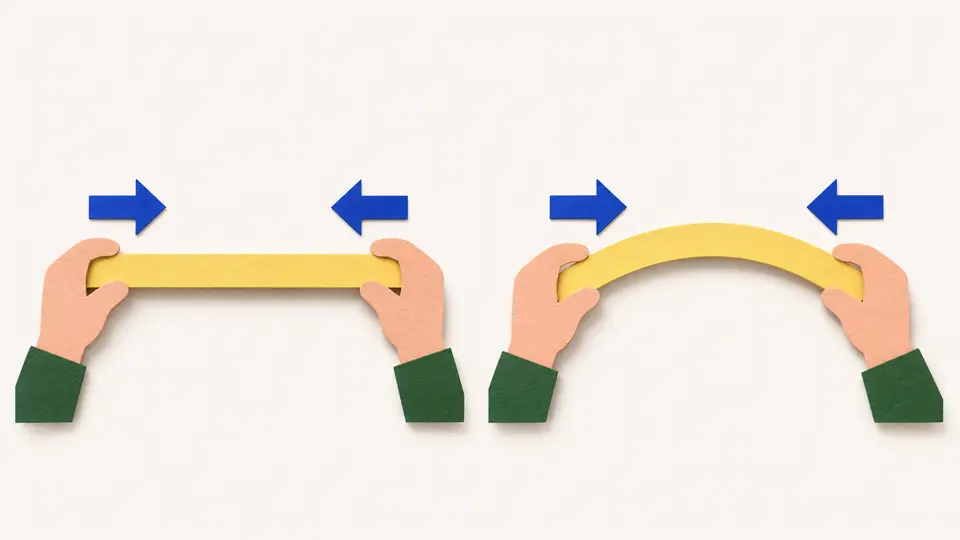
Stand a plastic ruler on end and push down on the top. For a while, nothing happens. Push a little harder and it suddenly bows out to the side. The plastic hasn't snapped or been crushed. The ruler has lost its straight shape.
That's buckling, a sudden change of shape in a part of a structure under load. A column bows sideways. A thin plate wrinkles. Add load gradually and little shows until it reaches a critical level, and then the shape goes all at once.
What makes buckling a separate kind of failure is that it can happen while the stress in the material is well below what the material can take. Cut a sample from a buckled steel column and test it, and the steel would pass. The column lost its shape while its steel was still sound.
A buckled column isn't always finished. Sometimes the bend runs away and it can carry nothing. But if it doesn't collapse, it keeps holding the load that buckled it, and in a building any extra load shifts to the parts around it.
If strength doesn't decide when a column buckles, what does? Mostly its proportions. Engineers capture them in one number, the slenderness ratio. It compares the column's length, adjusted for how its ends are held, with how widely its cross section is spread. Long and thin gives a high number. Short and stout gives a low one.
The ratio sorts columns by how they fail. A short column under a load pushing straight down its length is crushed before it can buckle. A long one springs sideways well before the material would yield or break. Columns in between fail by a mix of crushing and bending.
For steel, the rough boundaries are 50 and 200. Up to 50, a column counts as short. From about 50 to 200 it's intermediate, and the steel's strength still dominates. Above 200 it's long, and what dominates is the steel's stiffness, which engineers call its modulus of elasticity.
So the property that limits a column changes as it gets more slender. A stocky column is as good as its steel is strong. A slender one is only as good as its steel is stiff.
Try to recallTwo steel columns carry the same load. One has a slenderness ratio of about 30 and the other about 250. What limits each one, and why does the same material behave so differently?
The column at 30 is short, below 50, so it fails by being crushed and is limited by the strength of the steel. The column at 250 is long, above 200, so it buckles sideways before the steel comes near its strength. Its limit is set by the steel's stiffness and the column's proportions. The steel is the same in both. Slenderness decides which kind of failure arrives first.
So a column has two ways to fail. A stout one is crushed when the load beats the strength of its material. A slender one folds sideways at a load set by its shape and stiffness, with its material still sound.
For the slender case there's an exact formula for that load. Leonhard Euler worked it out in the 1700s, and the material's strength doesn't appear in it anywhere.
Lessons in this topic
Why a column folds before its steel fails
A slender column can fold sideways while its steel is nowhere near breaking. See what buckling is and how a column's proportions decide which way it fails.
What decides when a column buckles
Euler's formula for a slender column has four ingredients, and the material's strength isn't one of them. See what stiffness, shape, length and end supports each do.
Why engineers don't design columns with Euler's formula
Euler assumed a perfectly straight column of perfectly elastic material. Real columns are neither, so the formulas used in design are fitted to tests instead.
When buckling is part of the design
Aircraft skins are meant to wrinkle. Rails and roads aren't, but the sun buckles them anyway.
Three quick stories from this topic
Stronger steel, same buckling load
Making a slender column from stronger steel doesn't raise the load at which it buckles
A slender column fails by folding sideways while its steel is still sound. The load that folds it depends on the steel's stiffness, the column's shape and its length, so a stronger alloy that's no stiffer gains nothing.
The shape of the section
The buckling load is directly proportional to the smallest second moment of area. Moving material away from the axis helps, so a tube beats a solid bar of the same weight.
Length, squared
Doubling the unsupported length quarters the load. Fixing both ends instead of pinning them multiplies it by four.
Sun kinks
Railroads slow their trains in a heat wave because hot rails can jump sideways
Steel rail expands as it heats, but it's held in place and can't grow. The trapped expansion squeezes the rail along its length until the track buckles sideways, often dragging its ties along. Railroaders call it a sun kink.
Nothing broke
The steel in a kinked rail is sound. Buckling happens at stresses well below what the material can take, because the rail loses its shape first.
Roads do it too
Sun-heated concrete slabs push against each other, and the pavement can lift and crack without warning. Asphalt is more flexible.
Skin that wrinkles and keeps working
A B-52 bomber's skin wrinkles under the weight of its own nose and keeps carrying load
Thin aircraft skin buckles at very low loads. Once wrinkled, a panel still carries load as a pull along its diagonal ridges, so designers let it buckle and size the rivets and stiffeners for the tug.
Unplanned buckling
It shows up as sun kinks in rail, lifted concrete pavement, taco-shaped bicycle wheels and imploding pressure hulls.
Heat is the usual cause
A restrained member that can't expand is a member in compression, so heat supplies the load for free.
Sources
- Buckling - Wikipedia, Wikimedia Foundation
- Euler critical load - Wikipedia, Wikimedia Foundation