Engineering & Inventions · Electronics & communication
Why sampling too slowly creates signals that aren't there
Measure a signal often enough and the samples hold all of it. Measure a little too slowly and its fast parts come back disguised as slow ones, with nothing in the data to give them away.
What you will learn
- State the sampling theorem and the condition it places on the sample rate
- Tell the Nyquist rate apart from the Nyquist frequency
- Describe what aliasing does to a signal sampled too slowly
- Recognize temporal and spatial aliasing in everyday examples
Lesson 1 of 4 · 5 min
How 44,100 numbers a second can hold a whole song
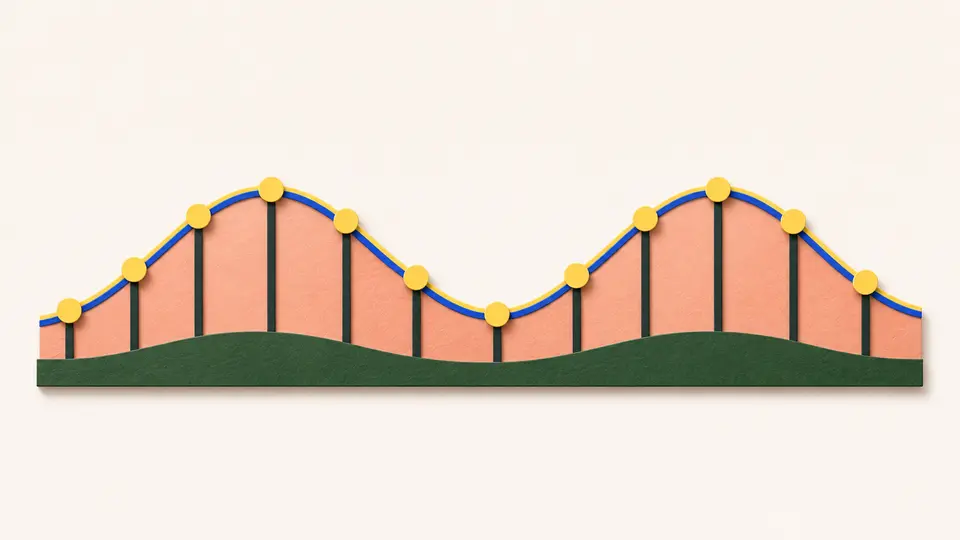
A CD stores sound as a list of numbers, 44,100 of them for every second of music. Each number is one sample, the height of the sound wave at one instant. Everything the wave did between two samples goes unrecorded. It seems something must be lost.
The sampling theorem says that under one condition, nothing is. Claude Shannon stated it. If a signal contains no frequencies higher than some limit, then sampling it at more than twice that limit completely determines it. The curve between the samples can be rebuilt exactly.
That works out to more than two samples for every cycle of the fastest wave in the signal. Human hearing stops at about 20,000 hertz, or cycles per second, so audio needs more than 40,000 samples a second. The CD's 44,100 clears that.
Two details matter. The rate must be strictly more than twice the top frequency, and exactly twice isn't enough. And if the signal does contain higher frequencies, you don't get a slightly rougher copy. You get a specific error called aliasing, in which fast content shows up disguised as slow content.
Two terms with Nyquist's name on them are easy to swap. The Nyquist rate is twice the highest frequency in the signal. It belongs to the signal, so a different signal has a different Nyquist rate.
The Nyquist frequency is half the sample rate. It belongs to the equipment. A CD's is 22,050 hertz, whatever music is on the disc.
The rule can be said either way. The sample rate must exceed the signal's Nyquist rate. Or everything in the signal must lie below the equipment's Nyquist frequency. Either way, you have to know something about both the signal and the instrument.
None of this is special to time. A camera sensor samples a scene across space, with a fixed number of pixels per millimeter. The same rule decides how fine a pattern the sensor can record.
Try to recallAn instrument samples at 1,000 samples per second. A colleague says its Nyquist rate is 500 hertz. Correct the statement and say what actually needs checking.
The two names are swapped. Half the sample rate, 500 hertz here, is the Nyquist frequency. It belongs to the instrument and stays at 500 hertz whatever is connected. The Nyquist rate is twice the highest frequency in the signal, and you can't work it out from the instrument at all.
So what needs checking is the signal. Find the highest frequency it contains and confirm that it's strictly below 500 hertz. That's the same as confirming that 1,000 samples per second exceeds the signal's Nyquist rate. If the signal holds something at 600 hertz, the sample rate is too low.
So the samples are enough on one condition. The sample rate has to be more than twice the highest frequency in the signal. Meet it and the list of numbers holds the whole wave. Miss it and the numbers still look fine, which is what makes the failure hard to spot.
Lessons in this topic
How 44,100 numbers a second can hold a whole song
A digital recording keeps only snapshots of a sound wave, yet nothing has to be lost. Learn the rule that says how often you must sample, and the two Nyquist terms people mix up.
Why wheels spin backwards on film
Sample a fast signal too slowly and it doesn't blur. It comes back as a slow signal that was never there. See how that happens in film, in photographs and in sound.
Why the same samples fit many different waves
Any set of samples fits a whole family of frequencies, evenly spaced. See which ones, why a recording returns the lowest of them, and why no later processing can undo the mix-up.
Why the anti-aliasing filter has to come first
The cure for aliasing is a filter that removes fast content before sampling. See why it can't work afterward, why a little aliasing always remains, and when engineers alias on purpose.
Three quick stories from this topic
The backwards wheel
A film camera can make a wheel that's spinning forward appear to turn backwards
The camera samples the scene one frame at a time. If each spoke lands just short of where the next spoke was a frame earlier, the eye links the two, and the wheel seems to creep backwards while the wagon rolls on.
Too few frames
The effect is called temporal aliasing. The frame rate is too low to follow the spokes, so their motion comes back as a slower one that never happened.
The same error in a photo
Photograph fine stripes with too few pixels and broad wavy bands appear. It's the same mistake made in space, and it's called a moire pattern.
The blur filter
Some digital cameras carry a filter that blurs the image before it reaches the sensor
A sensor samples the scene with a fixed grid of pixels. Detail finer than the grid can record doesn't vanish. It comes back as false wavy bands called moire. Removing that detail first, with a slight blur, keeps the bands from forming.
Why not fix it afterward
Once the image is sampled, a false band and a real one are the same pixel values. Later processing has nothing to tell them apart by.
The same rule for sound
Audio recorders do the equivalent. They remove the pitches above half the sample rate before the signal is sampled.
Sounds that weren't in the room
Sounds too high to hear can come back as audible ones when music is recorded digitally
Record at 32,000 samples a second, and anything at or above 16,000 hertz is too fast for the samples to follow. It doesn't drop out. It reappears at a lower frequency, as a tone nobody played.
The half-rate limit
Samples can only follow frequencies below half the sample rate, a limit called the Nyquist frequency. Anything above it shares its samples with a lower frequency.
The fix comes first
Recorders filter out everything above the limit before sampling. Afterward, the false tone can't be told from a real one.
Sources
- Nyquist-Shannon sampling theorem - Wikipedia, Wikimedia Foundation
- 44,100 Hz, Wikimedia Foundation
- Aliasing - Wikipedia, Wikimedia Foundation
- Wagon-wheel effect, Wikimedia Foundation