Engineering & Inventions · Electronics & communication
The transistor
A transistor is a switch with no moving parts, worked by a small voltage. See how it switches and amplifies, how Bell Labs built the first one in 1947, and how billions now fit on one chip.
What you will learn
- Explain how a voltage on the gate turns a transistor on and off
- Explain why transistors replaced vacuum tubes
- Explain how a transistor amplifies a weak signal
- Explain how transistor switches stand for ones and zeros and combine into logic gates
Lesson 1 of 4 · 4 min
A switch with no moving parts
A light switch works because your finger pushes two pieces of metal together. A phone chip flips billions of switches with no finger and no moving parts. Each one is a transistor, and voltage works it.
It's made of a semiconductor, usually silicon. A semiconductor conducts better than an insulator but worse than a metal. Mix in even one impurity atom per 100 million, a step called doping, and you change how well it conducts.
The kind on chips, the MOSFET, has three connections. Current can flow between two of them, the source and the drain. The third, the gate, sits above that path on a thin layer of insulating oxide.
Put a voltage on the gate and its electric field pulls charge into a thin channel under the oxide. Current now flows from source to drain, so the switch is on. Take the voltage away and the channel goes, so the switch is off.
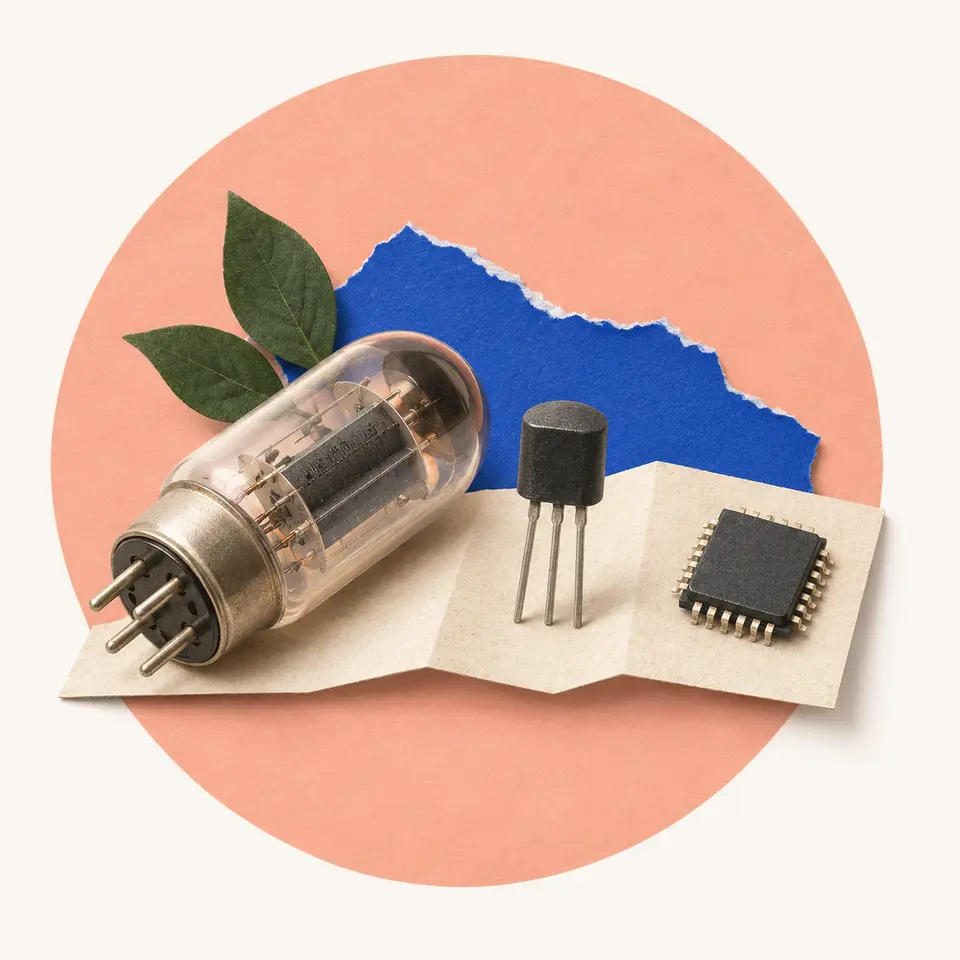
Before transistors, this job fell to the vacuum tube, a glass bulb with a heated filament glowing orange inside. It worked, but it was fragile. Its heater used a lot of power and needed time to warm up.
The ENIAC computer showed the cost. By 1955 it held 18,000 tubes and weighed more than 30 tons. Tubes burned out so often that it was out of action about half the time, until engineers cut failures to one tube every two days.
A transistor has no heater, so it saves power and works the moment it's switched on. It's small, survives knocks and runs on a few battery cells. And you can make huge numbers of them together on one chip.
Try to recallWhy did transistors replace vacuum tubes in most electronics?
A vacuum tube needs a heated filament, so it uses a lot of power, takes time to warm up and burns out. A transistor has no heater, so it saves power, starts at once and lasts. It's also small and tough, and many can be made together on one chip.
A transistor is a semiconductor switch. A voltage on its gate opens a channel for current, and taking it away closes the channel. With no heater and no moving parts, it beat the vacuum tube on power, size and reliability.
Lessons in this topic
A switch with no moving parts
Find out how a small voltage opens and closes a path through silicon, and why that simple trick pushed the glowing vacuum tube aside.
How one part runs both radios and computers
See how a transistor turns a weak signal into a strong one, and how the same part, used as an on-off switch, stands for ones and zeros.
How Bell Labs built the first transistor in 1947
Follow Bardeen, Brattain and Shockley from a failed idea to a slab of germanium that amplified, then see why a later design by Atalla and Kahng took over every chip.
How billions of transistors fit on one chip
See how Kilby and Noyce put a whole circuit on one piece of semiconductor, what Moore's law really claims, and why shrinking has slowed.
Three quick stories from this topic
19 billion on a fingertip
A 2023 phone chip holds 19 billion transistors on a square about a centimeter across
Intel's 4004 of 1971, the first single-chip microprocessor, held 2,250. The difference came from shrinking transistors decade after decade, the trend Gordon Moore first spotted in 1965.
The forecast
Moore first said the count doubled every year. In 1975 he slowed it to every two years.
Why it's slowing
Since the mid-2000s, smaller transistors have leaked enough current to make chips hard to cool, and they're nearing the size of atoms.
ENIAC's failing tubes
ENIAC's vacuum tubes burned out so often it was out of action about half the time
By 1955 the computer held 18,000 tubes and weighed more than 30 tons. Most failures came while the tubes warmed up or cooled down, when their heaters were under the most stress.
The fix
Engineers cut the failure rate to about one tube every two days, and could usually find the dead one within 15 minutes.
What came next
A transistor needs no heater, so it uses less power, starts the moment it is switched on and has no hot filament to wear out.
The first transistor
The first transistor was two gold contacts pressed onto germanium by a plastic wedge
John Bardeen and Walter Brattain got it working at Bell Labs on December 16, 1947. A voltage on one contact controlled the current through the other, amplifying a signal up to 100 times.
A Christmas present
They showed it to lab officials on December 23. William Shockley called it a magnificent Christmas present.
Going public
Engineer John Pierce named it the transistor, and Bell Labs announced it in New York on June 30, 1948.
Sources
- Transistor, Wikipedia
- MOSFET, Wikipedia
- Semiconductor, Wikipedia
- Doping (semiconductor), Wikipedia
- ENIAC, Wikipedia
- Transistor count, Wikipedia
- 1965: "Moore's Law" Predicts the Future of Integrated Circuits, Computer History Museum, The Silicon Engine
- 1947: Invention of the Point-Contact Transistor, Computer History Museum, The Silicon Engine