Engineering & Inventions · Electronics & communication
How electric circuits work
A circuit is a loop that lets charge carry energy from a source to whatever does the work. Learn what voltage, current and resistance measure, how they connect, and why a short circuit trips a breaker.
What you will learn
- Explain why charge needs a closed loop and what a battery supplies
- Tell voltage and current apart using the water-pipe picture and say where it misleads
- Use Ohm's law to link voltage, current and resistance
- Work out power in watts from volts and amps, as on a charger label
Lesson 1 of 4 · 4 min
Why electricity only flows around a loop
Click a flashlight off and the bulb goes dark at once, though the battery is still full. Nothing moved except a small piece of metal in the switch. So why does the light depend on it?
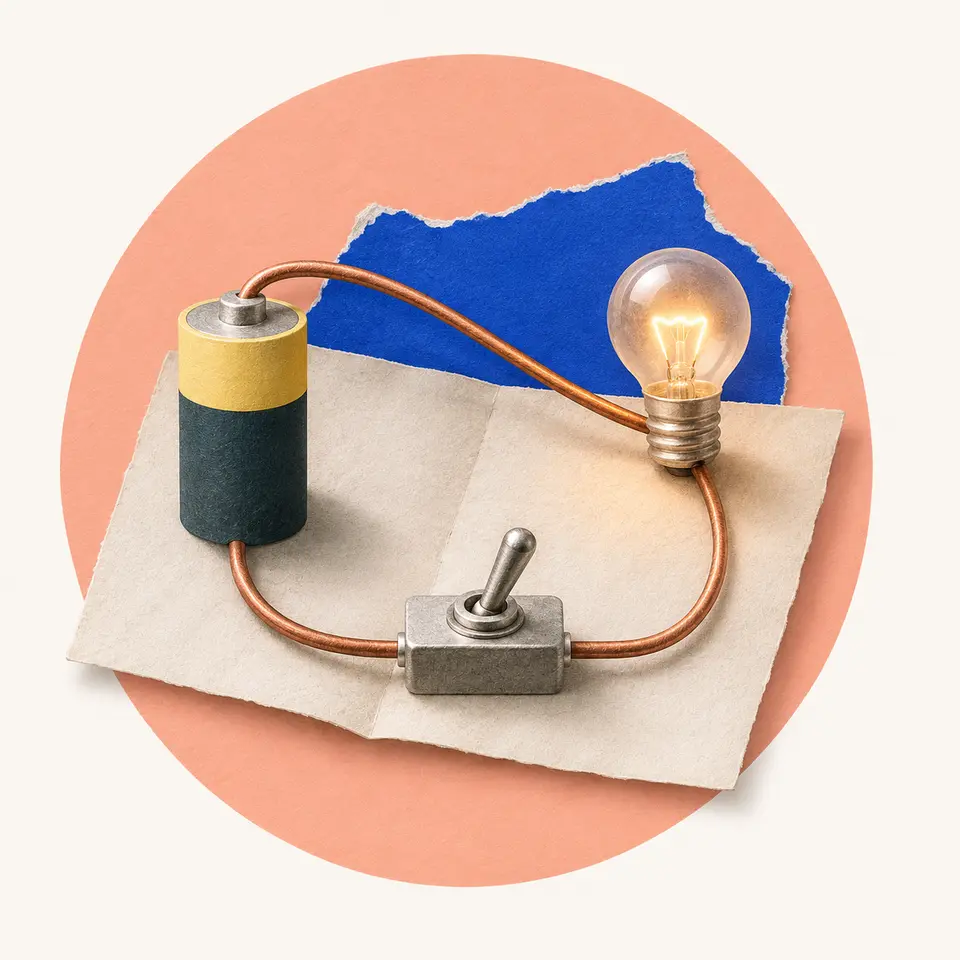
Electricity only flows around a closed loop, called a circuit. Charge leaves one end of the battery, passes through the bulb and comes back to the other end. Open the switch and you cut a gap in the loop, so charge stops everywhere at once.
The charge was never stored in the battery. Copper is full of free electrons, which can drift through the metal. The battery turns chemical energy into electrical energy and uses it to push charge around the loop.
Follow one bit of charge. It gains energy in the battery and travels along the wire to the bulb. There it gives up that energy as light and heat. Then it returns along the other wire to the battery to be pushed again. A flat battery has no energy left to give.
Two numbers describe that loop. Current is how much charge passes a point each second, measured in amperes or amps. One amp means one coulomb of charge per second. Voltage is how much energy each bit of charge gains or gives up between two points. One volt means one joule per coulomb.
A water picture helps. Imagine a pump pushing water around a closed ring of pipe. The pressure difference the pump makes stands for voltage. The amount of water flowing past each second stands for current. A narrow stretch of pipe that slows the flow stands for resistance, which the next lesson covers.
Try to recallIn the water-pipe picture of an electric circuit, what stands for voltage and what stands for current, and where does the picture mislead?
The pump's pressure difference stands for voltage, the energy each bit of charge carries. The flow of water past a point each second stands for current. The picture misleads about speed, because electrons only drift about a millimeter a second while the push races along the wire.
A circuit is a closed loop where a battery gives charge energy and a bulb or motor takes it out. Voltage is the energy per bit of charge, and current is how much charge passes each second.
Lessons in this topic
Why electricity only flows around a loop
See why charge needs a complete path, what a battery really supplies, and how voltage and current differ, with a water-pipe picture and the places it breaks down.
Ohm's law and what a charger label tells you
Learn how resistance ties voltage to current, then multiply volts by amps to get watts and read the numbers printed on a phone or laptop charger.
Why one dead bulb used to kill the whole string
Compare series and parallel wiring through old Christmas lights and the sockets in your home, then see how two resistors in a row can make a smaller voltage.
Short circuits, breakers and what makes a shock deadly
See why a short circuit pulls a huge current, how fuses and breakers stop it, and why the current through your body, not the voltage on its own, decides the harm.
Three quick stories from this topic
Breakers guard wires, not people
A 20-amp home circuit breaker trips at about 1,000 times a current that can kill
US safety researchers at NIOSH note that 20 milliamps through the chest can be fatal, while household breakers are rated at 15, 20 or 30 amps. Breakers exist to stop wires overheating, not to protect people.
What does protect you
A GFCI compares the current going out with the current coming back. OSHA says one cuts the power when more than 5 milliamps go missing.
Why wet skin matters
Wet skin can drop the body's resistance from about 100,000 ohms to 1,000, so the same 120 volts drives about a hundred times the current.
One bulb, whole string dark
In the 1950s, one burned-out bulb could darken a whole string of Christmas lights
Those strings were wired in series, a single path through every bulb. A dead filament broke that path, so current stopped everywhere and you had to swap bulbs one at a time to find it.
The fix
Later mini-lights added a shunt inside each bulb that lets current bypass a dead filament, so the rest of the string stays lit.
Your house is different
Home sockets are wired in parallel, so each appliance gets the full voltage and switching one off leaves the rest alone.
Electrons at a crawl
In a thin copper wire carrying 5 amps, electrons drift about a millimeter a second
The light still comes on the instant you flip the switch. The push travels along the wire at nearly the speed of light and sets charge moving all around the loop at once, so no electron has to race to the bulb.
A snail's pace
At a millimeter a second, one electron would need about 17 minutes to drift a single meter of wire.
Where the energy goes
The energy doesn't ride inside the slow electrons. It travels through the electric and magnetic fields around the wires.
Sources
- Controlling Electrical Hazards (OSHA 3075, 2002 revision), US Occupational Safety and Health Administration
- Electric current, Wikipedia
- Hydraulic analogy, Wikipedia
- Electric battery, Wikipedia
- Voltage, Wikipedia
- Microscopic view of electric current, HyperPhysics, Georgia State University
- Worker Deaths by Electrocution (NIOSH Publication 98-131, 1998), US National Institute for Occupational Safety and Health (archived copy)
- Christmas lights, Wikipedia
- Series and parallel circuits, Wikipedia