Arts & Culture · Cultural traditions & heritage
What a tattoo can say
Ötzi's 5,300-year-old tattoos may have been a pain treatment, a Māori moko was carved with a chisel, and tattooed ancestors once traded for muskets are coming home from museums.
What you will learn
- Explain why researchers think Ötzi's tattoos were a treatment rather than decoration
- Describe how a 2024 study changed the account of how Ötzi's tattoos were made
- Describe how carving a moko with narrow uhi differed from pricking a tattoo
- Explain what a moko signaled about its wearer and which readings remain uncertain
Lesson 1 of 4 · 6 min
Why Ötzi's tattoos sit on sore joints
About 5,300 years ago a man died in the Alps, and glacier ice preserved his body so well that his skin still carries 61 tattoos. He's known as Ötzi, or the Iceman. None of the tattoos is a picture. They're all lines or crosses.
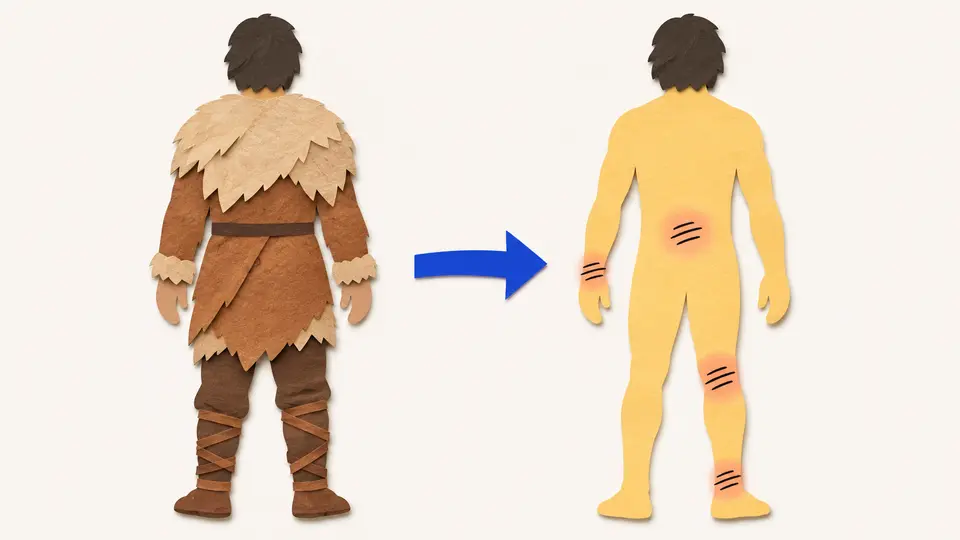
Look at where they are. Parallel lines run on both sides of his lower spine and around his left wrist. There's a cross behind his right knee and another on his right ankle. His legs carry 12 of the 19 groups of lines.
Decoration is the obvious guess, but the placement argues against it. The tattoos sat where clothing covered them most of the time. And they line up with the parts of his body that were wearing out. X-rays show degeneration in his lower spine and wear in his knees and especially his ankles.
So the South Tyrol Museum of Archaeology in Bolzano, which keeps his body, says the tattoos are now assumed to be therapeutic, made to soothe pain in joints that probably hurt.
There's a second clue. The marks lie on acupuncture lines still used today. Yet Ötzi lived at least 2,000 years before acupuncture's earliest known use in China, around 1000 BC.
Treatment is the favored reading, not a settled one. The museum says scientists are still puzzled about what the tattoos meant.
How were the marks made? His museum still gives the older account, with no needle involved. It describes fine cuts in the skin with powdered charcoal rubbed in.
Part of that has held up. Under a microscope, samples from the tattoos show pigment made from fireplace ash or soot.
The method is in doubt. In 2024 a research team tried out several early tattooing techniques. They found Ötzi's marks most consistent with puncture tattooing, where a sharp point pricks the pigment into the skin. The tool was probably a bone point or a copper awl.
Nobody watched Ötzi being tattooed, so every account of the method is an inference from the marks, the pigment and experiments. None of it changes where the tattoos sit, and the treatment idea rests on that.
Try to recallHow did a 2024 experiment change the usual account of how Ötzi's tattoos were made, and what part of the older account still holds?
The older account, still given by the museum that keeps his body, says the tattoos were fine cuts in the skin with powdered charcoal rubbed in. In 2024 a research team tried out possible early techniques and found his marks most consistent with puncture tattooing, probably with a bone point or copper awl, rather than cuts. The part about the pigment holds, since microscope tests show it was made from fireplace ash or soot.
Ötzi's tattoos sit over worn joints and under his clothes, so the best guess is that they treated pain. If so, the practice is at least 2,000 years older than acupuncture's first known use. How the marks were made is still argued, and the 2024 study favors puncture over cuts.
Lessons in this topic
Why Ötzi's tattoos sit on sore joints
A 5,300-year-old man's 61 tattoos sit over his worn joints and under his clothes. See what that placement suggests they were for, and how a 2024 study changed the account of how they were made.
How a Māori moko was carved and read
Māori tattooists cut a moko into the skin much as a carver cuts wood. See how that was done, what a moko signaled about its wearer and which readings remain uncertain.
How tatau became the English tattoo
Trace the word tattoo to a Samoan verb meaning to strike, and sort the four kinds of skin marking one anthropologist named in 1900.
Why tattooed ancestors are going home
Preserved Māori heads with moko were traded to Europeans for muskets. See how that trade grew and ended, and why museums abroad are now returning them as ancestors.
Three quick stories from this topic
A tattoo you could feel
Traditional Māori tattoos were carved with bone chisels and left grooves in the skin
Tattooists struck narrow blades of albatross bone with a mallet to cut the lines, then added pigment with small toothed combs. Te Papa, New Zealand's national museum, describes the practice as very similar to wood carving.
From pricking to carving
Māori brought the Pacific method of pricking pigment in with a toothed comb. As the art developed in New Zealand, tattooists began using narrower blades without teeth that cut grooves through the skin.
Smooth again
In the late 19th century needles replaced the chisels. They were quicker and carried fewer health risks, but the moko they left was smooth.
Tattooed ancestors going home
Museums are sending home tattooed Māori heads that were once traded for muskets
They're called toi moko, the preserved heads of ancestors with facial moko, and in the early 1800s they were bartered to Europeans for guns. Te Papa, New Zealand's national museum, says it has returned close to 850 Māori and Moriori ancestors. Returned toi moko are kept off display.
How the trade ran
It peaked from 1820 to 1831, when the governor of New South Wales banned it, saying it tended to increase the sacrifice of human life. By 1840 the export trade had virtually ended.
What happens after the return
A returned head goes to the person's relatives or into respectful storage at Te Papa, while researchers work out where the person came from and try to contact descendants.
Tattoos as pain treatment
Ötzi the Iceman's 61 tattoos sit on worn parts of his body that his clothes kept hidden
That's why the museum that keeps him assumes the marks were a pain treatment and weren't for show. They also lie on acupuncture lines still used today, although he lived at least 2,000 years before acupuncture's earliest known use in China.
Lines and crosses
None of the tattoos is a picture. They're groups of short lines and two crosses, along his lower spine, around a wrist, behind a knee and on his legs and ankles.
How they were made
The pigment came from fireplace ash or soot. His museum describes fine cuts with charcoal rubbed in, but a 2024 study found the marks most consistent with pricking by a bone point or copper awl.
Sources
- The body, South Tyrol Museum of Archaeology
- Ötzi, Wikipedia
- Tāmoko | Māori tattoos: history, practice, and meanings, Museum of New Zealand Te Papa Tongarewa
- Tā moko, Wikipedia
- Mokomokai, Wikipedia
- Repatriation, Museum of New Zealand Te Papa Tongarewa