Arts & Culture · Theatre & dance
Ancient Greek theatre
How plays began at a festival of Dionysus in Athens, what a chorus, masks and three actors could do, and why Oedipus and Antigone are still staged 2,400 years later.
What you will learn
- Explain how the City Dionysia ran plays as a religious festival and a competition
- Describe how the theater's layout, the masks and the three-actor limit shaped a performance
- Explain what a Greek tragedy was and what each of the three great playwrights brought to it
- Trace how Oedipus the King uses what the audience already knows
Lesson 1 of 4 · 4 min
How Athens staged plays as a festival for a god
Every spring in Athens, in March or April, a procession carried a wooden statue of the god Dionysus to his theater on the slope below the Acropolis. Bulls were sacrificed and the city feasted. Then came days of plays.
This festival was the City Dionysia, and its plays were a contest. Three tragic playwrights each brought three tragedies and a satyr play, a rowdy comic take on a myth, and each set filled a day. From the 480s BCE, five comic poets competed too.
Judges were chosen by lot, and the winners got a wreath of ivy. The prize went jointly to the playwright and his choregos, a rich citizen appointed to pay for the chorus, costumes, rehearsals and masks. It was a public duty that brought prestige. Pericles and Plato both served.
A new play was an offering to a god and a bid to beat your rivals in front of the whole city.
The audience sat on the hillside itself, the theatron, or "seeing place". At the bottom lay a flat circle about 24 meters across, the orchestra, or "dancing place". There a chorus of 12 to 15 men sang and danced in verse.
Behind the circle, from about 465 BCE, stood the skene, a backdrop building where actors changed. Our word "scene" comes from it. Killings happened behind it, heard but not seen. A crane could swing a god into view, which gives us deus ex machina, "god from the machine".
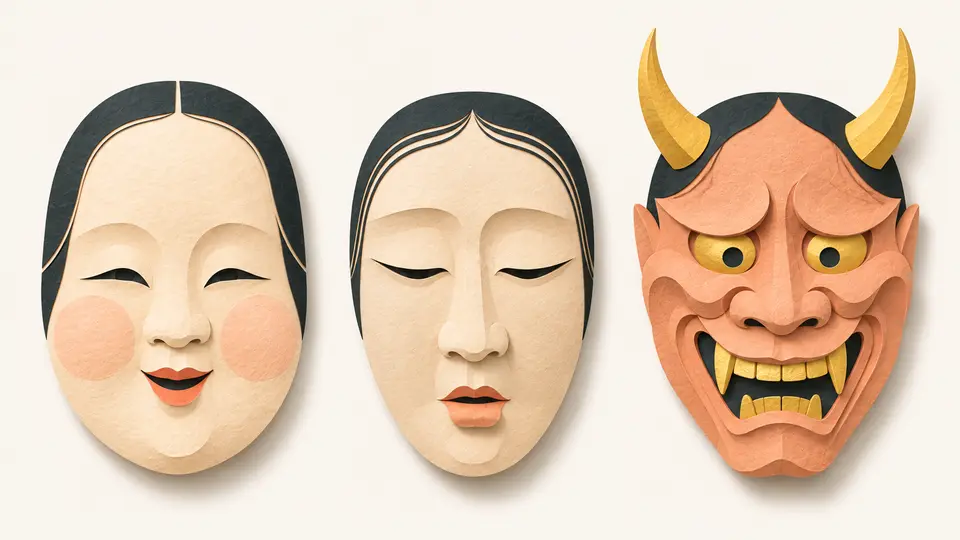
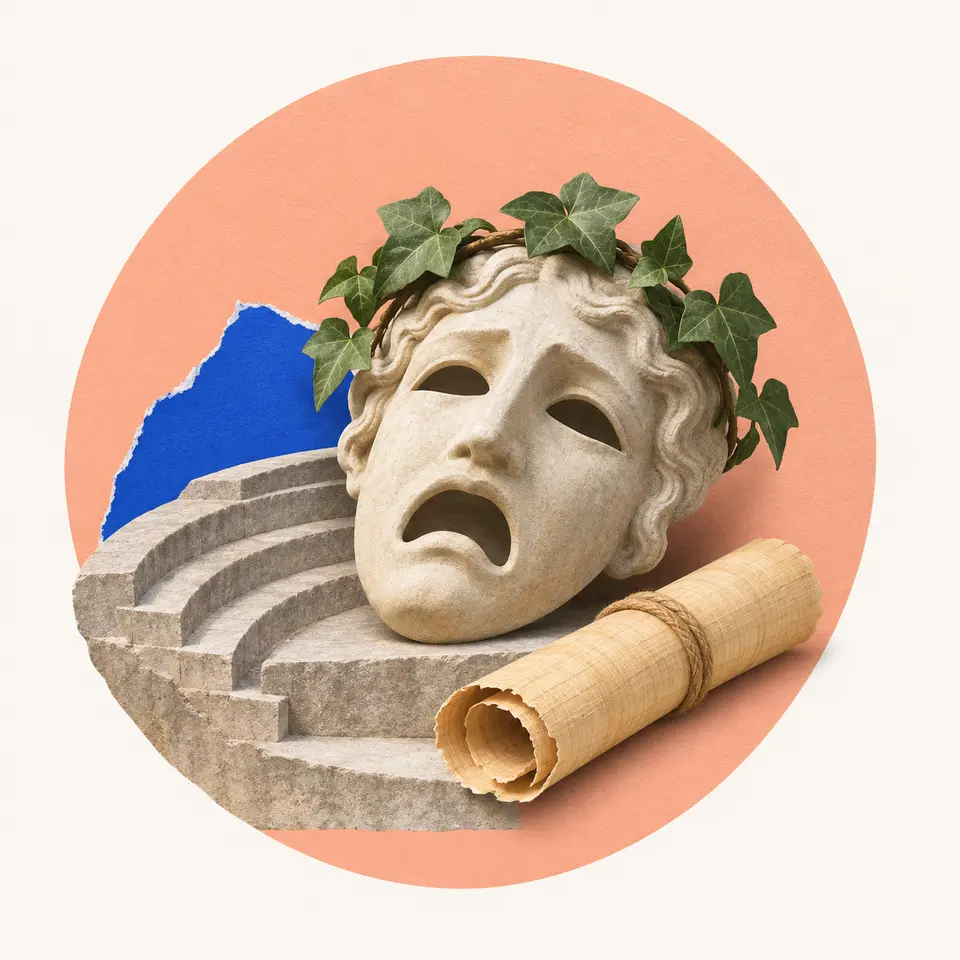
Every performer was a man in a mask that covered the whole head, made of linen, wood or cork with real hair. The chorus all wore the same mask, because together they played one character. Masks rotted, so most of what we know comes from vase paintings.
Masks solved a casting problem. A tragedy never used more than three actors, so each played several parts and swapped masks behind the skene. Aristotle said Aeschylus added the second actor and Sophocles the third.
Try to recallHow could an Athenian tragedy with many characters be performed by only three actors?
Each actor wore a mask that covered his whole head and played several parts. Behind the skene he swapped masks to become another character. The masks also let the all-male cast play women.
Athens staged plays as a contest at a god's festival, funded by its richest citizens. On a hillside around a dancing circle, a masked chorus and three actors played every part.
Lessons in this topic
How Athens staged plays as a festival for a god
See how the City Dionysia turned plays into a contest paid for by rich citizens, and how a hillside, a dancing circle, masks and three actors made the shows work.
How a Greek tragedy works, told through Oedipus
Meet the three great tragic playwrights, then follow Sophocles' Oedipus the King from the king's first vow to his last terrible discovery.
How Greek comedy went from mocking leaders to family farce
See how Aristophanes ridiculed living politicians and philosophers by name, and how Menander's later comedies of lovers, fathers and clever servants set patterns comedy still uses.
What Aristotle saw in tragedy, and why it's still staged
See what Aristotle's Poetics says about plot, error and catharsis, how scholars still argue over it, and why the 32 surviving tragedies keep returning to modern stages.
Three quick stories from this topic
The play that haunted Socrates
A comedy that came last at its festival was later blamed in part for Socrates's trial
Aristophanes's The Clouds, staged in 423 BCE, shows Socrates running a school that measures how far a flea can jump. It finished last of three. Plato's account of the trial names it as one source of the prejudice against him.
Not the only one
One of the comedies that beat The Clouds that year, Connus by Ameipsias, also made fun of Socrates.
Friends at dinner
Plato's Symposium puts Aristophanes and Socrates at the same dinner party, with no sign of bad feeling.
Oedipus came second
Oedipus the King, Aristotle's model tragedy, lost first prize at its premiere
Sophocles' play took second place at the City Dionysia in Athens. First prize went to Philocles, a nephew of Aeschylus. Long after, Aristotle used Oedipus again and again as his example of how a tragedy should be built.
Judges picked by lot
The festival's judges were chosen by lot, and their verdict didn't always match later taste.
Even giants lost
Euripides wrote about 90 plays and won first prize only five times.
Fined for a sad play
Athens fined a playwright 1,000 drachmas for reminding the city of a disaster
In 493 BCE Phrynichus staged The Fall of Miletus, about a Greek city the Persians had just conquered. Herodotus says the whole theater burst into tears. Athens fined him and banned the play from ever being performed again.
Too close to home
Herodotus says the fine was for bringing to mind a calamity that touched the Athenians personally.
Back to myths
Most later tragedies retold old myths. Aeschylus's The Persians is the only surviving tragedy about a recent event.
Sources
- Dionysia, Wikipedia
- Choregos, Wikipedia
- Theatre of ancient Greece, Wikipedia
- The Clouds, Wikipedia
- Oedipus Rex, Wikipedia
- Aeschylus, Wikipedia
- The Poetics of Aristotle, translated by S. H. Butcher, Project Gutenberg