Arts & Culture · Theatre & dance
Ballet
How a court dance of Louis XIV became an art of turned-out legs, pointe shoes and stories told without words, and how to watch Swan Lake knowing what the steps and the mime mean.
What you will learn
- Explain how ballet grew from court entertainment into a profession under Louis XIV
- Describe turnout and the five positions, and why ballet's terms are French
- Identify what pointe work, the corps de ballet and the pas de deux each add to a classical ballet
- Explain how mime and recurring music carry the story of Swan Lake
Lesson 1 of 4 · 4 min
How a king's party dance became ballet
In 1489 the Duke of Milan married Isabella of Aragon, and the wedding feast came with dancing. Each dance matched a course of the dinner, strung together by a thin story about Jason and the Argonauts. Italian courts loved shows like this, and that's where ballet starts.
The dancers were nobles in ordinary court clothes, and guests often joined in at the end. The Italian Catherine de' Medici married into the French royal family and brought these shows with her. In France they became ballet de cour, court ballet.
Louis XIV took it further. At 14 he danced five roles in Ballet de la Nuit, a court ballet that ran for 12 hours. At court, how you danced showed your rank, and the king was the best-placed dancer in the room.
In 1661 Louis founded the Académie Royale de Danse, a board of 13 dancing masters. No new dance could be performed in France unless most of them approved it, and they alone licensed dance teachers.
The rules raised the standard, which changed who danced. Dance historian Maureen Needham argues the steps soon got too hard for courtiers, who moved to the sidelines to watch. Louis himself stopped dancing in 1670.
In 1669 the dancers were attached to the new royal academy of music, the start of the Paris Opera. The Opera calls the result Europe's first troupe of professional dancers.
Every ballet class still starts from the academy's work. Pierre Beauchamp, the king's own dance teacher, ran it from 1680 and is credited with fixing the five positions of the feet.
All five use turnout, rotating each leg outward from the hip so the feet point away from each other. In first position the heels touch and the toes point to the sides. Turnout lets a dancer lift the leg higher to the side and back.
The rotation has to come from the hip. Twisting at the knee instead leaves the knee facing forward and can injure the joint.
The words stayed French because Paris set the rules. A pas de deux is literally a step of two. The word ballet itself comes from Italian balletto, a little dance.
Try to recallWhat is turnout in ballet, and where should the rotation come from?
Turnout is rotating each leg outward so the feet point away from each other, as in the five positions. The rotation should come from the hip, which lets the leg lift higher to the side and back. Twisting at the knee instead can injure it.
Ballet began as nobles dancing at court feasts. Louis XIV's academy turned it into a profession with rules, and you can now spot its turned-out legs, five positions and French names.
Lessons in this topic
How a king's party dance became ballet
See how dances at Italian and French court feasts became a trained profession under Louis XIV, and where ballet's turned-out legs and French words come from.
How Swan Lake tells a story without words
Learn what pointe shoes, the corps de ballet and the duet each do on stage, and how mime and Tchaikovsky's music let Swan Lake tell its story.
Petipa, Diaghilev and the night of the Rite of Spring
See how a Frenchman built Russia's grand ballets, how Diaghilev's touring company made ballet modern, and what really happened at The Rite of Spring in 1913.
Ballet after Balanchine, and who it leaves out
See how Balanchine took the story out of ballet in America, what the training costs dancers' bodies, and how Black dancers were kept out and forced their way in.
Three quick stories from this topic
Shoes painted with makeup
Brown pointe shoes weren't made in the UK until 2018
Before then, Black, Asian and mixed-race dancers painted pink shoes with foundation or powder to match their skin. Ballet Black says this "pancaking" could take up to two hours and three coats of makeup.
Who made them
Freed of London developed brown and bronze shades with dancers from the London company Ballet Black.
An old barrier
Arthur Mitchell became the first African American principal at a major American ballet company only in 1962.
The riot named later
Nobody called the Rite of Spring premiere a riot until 1924, eleven years later
On 29 May 1913 the Paris audience shouted so loudly that the dancers couldn't hear the orchestra, and about forty people were thrown out. Yet the ballet played to the end, with curtain calls for Stravinsky and Nijinsky.
Stories that grew
One writer said a man drummed on his head that night, then admitted he'd been at the second performance. Saint-Saëns supposedly stormed out, but he wasn't there.
What upset them
Several people present blamed Nijinsky's heavy, stamping choreography more than Stravinsky's music.
Six thousand pairs a season
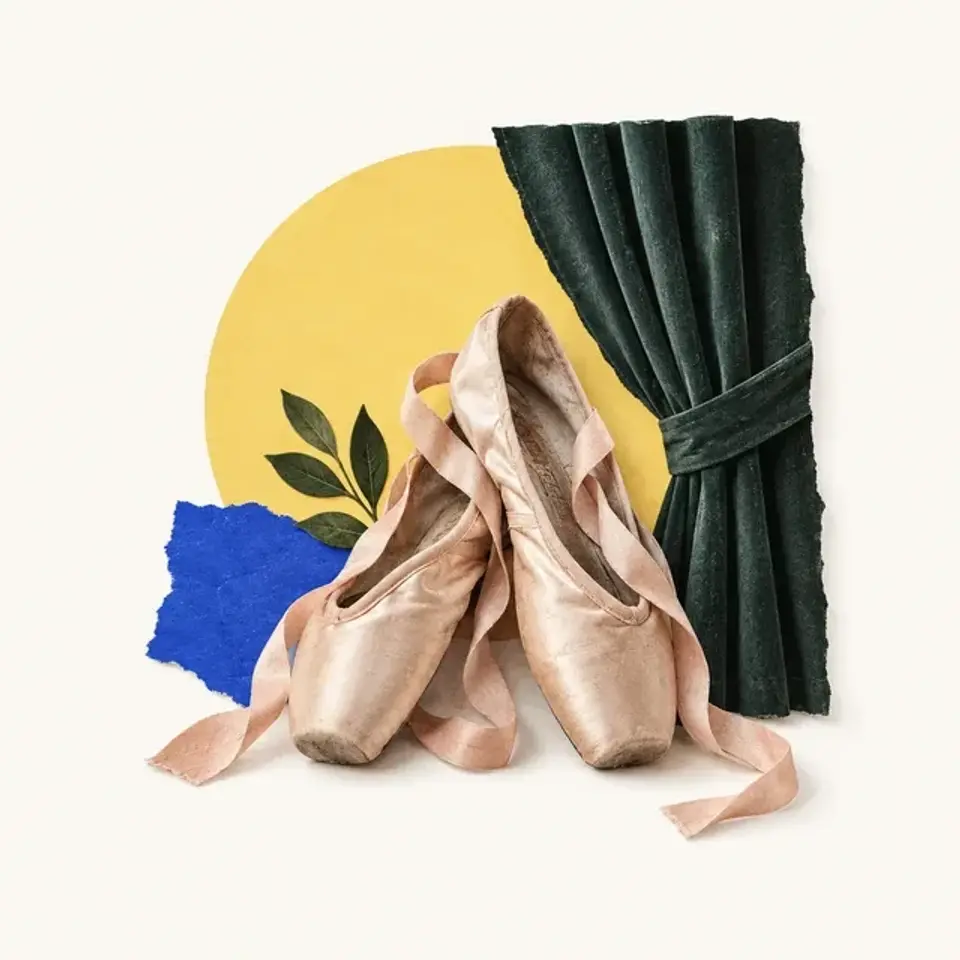
The Royal Ballet's dancers wear through more than 6,000 pairs of pointe shoes a season
A box of glued paper, paste and fabric holds the toes, and it softens with every performance. A professional can wear out a new pair in a single show, and the company puts the price at around £50 a pair.
It started with slippers
Marie Taglioni danced La Sylphide in Paris in 1832 in darned satin slippers that gave no support at all.
Why dance on the toes
Pointe work grew from a wish to make dancers look weightless, as if they barely touched the stage.
Sources
- History of ballet, Wikipedia
- Académie Royale de Danse, Wikipedia
- L'Opéra au XVIIe siècle, Opéra national de Paris
- Positions of the feet in ballet, Wikipedia
- Turnout (ballet), Wikipedia
- Ballet, Wikipedia
- Pas de deux, Wikipedia
- Freed of London Pointe Shoe Collaboration, Ballet Black
- The Rite of Spring, Wikipedia
- Pointe Shoe Appeal, Royal Ballet and Opera
- Pointe shoe, Wikipedia