Arts & Culture · Theatre & dance
How Noh masks seem to change expression
A Noh mask is one fixed face of cypress and oyster-shell paint. See who wears one, how a small tilt is meant to change its expression, and why the same tilt read the opposite way in laboratory tests.
What you will learn
- Name the main families of Noh masks and the kinds of characters each one portrays
- Explain which Noh performers usually wear masks and what performing bare-faced, called hitamen, asks of an actor
- Describe the materials and layers that make up a traditional Noh mask, from wood to paint
- Explain how new masks follow old models and how marks on a mask's back identify its maker
Lesson 1 of 4 · 6 min
Who wears a Noh mask and what the masks show
The ordinary Japanese word for a mask is kamen, which means "temporary face." Noh actors don't use it. They call their masks omote, which simply means "face."
Noh is a Japanese musical drama performed since the 14th century, and in most plays the main character wears a mask of carved, painted wood. A guide from the Nohgaku Performers' Association says the word omote suggests truth. It treats the mask as something that reveals instead of something that conceals.
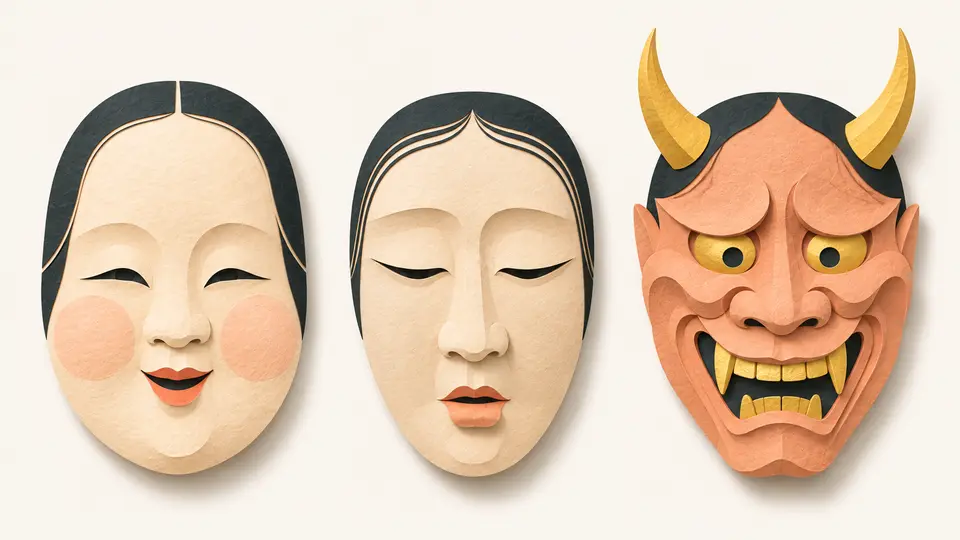
Most masks show a type of character, such as an old man, a young woman or a demon. There were about 60 basic types to begin with, and well over 200 kinds are in use today. They sort into families.
The oldest family is the Okina, or old man, masks. Others show elders, women, men, and demons and goblins. One family is for spirits of the dead who still have regrets, and it includes the famous hannya, a woman turned into a horned demon by resentment.
Women's masks vary the most, and they're sorted by age. A Ko-omote shows the youngest. The Hikone Castle Museum's example has a high forehead, plump cheeks and eyes set close to the nose. A Waka onna is older, about 25 to 30, with long downcast eyes, a small mouth and blackened teeth.
Not every role gets a mask. The shite, the lead actor, usually wears one, and so does a role called the tsure. The waki, another of Noh's main roles, plays a character living in the story's present and performs without a mask.
As a rule, masks aren't used for male characters who are alive in the present of the story. Playing bare-faced is called hitamen, or "direct mask." The actor is meant to make their own face a mask, putting power and emotion into the performance without using the face to express them.
The mask is smaller than you might expect. It covers the face but not the head, and it leaves the chin showing. Performers think it best if some of the chin or jowls can be seen, because Noh isn't trying to look realistic.
Try to recallWhich performers in a Noh play usually wear masks, who usually doesn't, and what is a bare-faced performer still expected to do?
The shite, the lead, usually wears a mask, and so does the tsure. The waki plays a character living in the story's present and performs without one, which is called hitamen, or direct mask. Even bare-faced, the performer is meant to make the face a mask, putting power and emotion into the performance without using the face to express them.
Noh actors don't say they put a mask on, the way you put on clothes. They say they hang it or attach it, wording that implies the performer is becoming the mask. So a Noh mask is a face for a type of character, worn by the lead while the living men of the story show their own.
Lessons in this topic
Who wears a Noh mask and what the masks show
Meet the main families of Noh masks, from old men to jealous demons, and see why the lead actor wears one while living men in the story go bare-faced.
What a Noh mask is made of and who made it
Under its paint a Noh mask is one block of cypress coated in powdered oyster shell, and its back often records who carved it.
How a tilt makes a wooden mask smile or weep
A Noh mask's carved face can't move, so actors change its angle. See how small tilts are meant to brighten or cloud it, and how the mask shapes the way they walk.
Why tilted Noh masks read backwards in the lab
In experiments, viewers saw a downward-tilted Noh mask as happy, the opposite of the stage convention. See what the mouth and shadows had to do with it, and why a theater may be different.
Three quick stories from this topic
The tilt that reads backwards
A Noh mask tilted down is meant to look sad, yet lab viewers more often called it happy
In a 2012 experiment in Japan, faces carrying the mouth of a downward-tilted mask were judged happy 95.4% of the time. From that angle the corners of the carved lips appear pulled up, and viewers went by the mouth.
What the actor intends
On the Noh stage, tilting the mask up is meant to brighten its expression and tilting it down to cloud it. The carved face itself never changes.
Why the stage may differ
The researchers note that a Noh stage is dark and the audience sits at a distance, so the mouth may be hard to see. The actor's body, the chorus and the music carry the feeling too.
A face painted with oyster shell
The white skin of a traditional Noh mask is painted with powdered oyster shells
Makers mixed the powdered shell, called gofun, with animal glue and water and painted it over a mask carved from Japanese cypress. Facial details were then added on top in pigments from earth, minerals or plants.
One block of cypress
Under the white layer, a Noh mask is carved from a single block of wood. Hinoki, or Japanese cypress, has long been the main choice.
Where old masks wear out
On 52 old masks at Oxford's Pitt Rivers Museum, damage was most common at the tie holes, the top of the head, the chin and the tip of the nose, where masks were held or laid face down.
The demon mask is a woman
The horned demon mask of Noh theater, the Hannya, shows a woman transformed by jealousy
On an example in London's Victoria and Albert Museum, the top of the head keeps the neat parting of a beautiful woman's mask. Below it come stray strands of hair, metal eyes, gold fangs and two sharp horns.
Horns, metal eyes and fangs
Two sharp horns sprout from the temples, and bulbous metallic eyes lie half hidden beneath scowling brows. The gaping mouth is full of gold teeth, with upper and lower fangs. The Victoria and Albert Museum dates the mask 1650 to 1750 and records it as painted cypress wood and gilded metal.
Where the mask appears
The shite, or protagonist, wears it in the second acts of Aoi no Ue, Dōjō-ji, Kurozuka and Momijigari. The first two plays depict women betrayed or spurned by their lovers. The other two portray demons who first appear in human form to trap the unwary.
Sources
- The Mysterious Noh Mask: Contribution of Multiple Facial Parts to the Recognition of Emotional Expressions, PLoS ONE, via PubMed Central
- Nohgaku: Masks, Japan Arts Council
- Nō masks, The Nohgaku Performers' Association
- Introducing the world of Noh: Masks, the-noh.com
- Noh Mask: Ko-omote, Hikone Castle Museum
- Waka Onna (Young Woman) Noh mask, The Art Institute of Chicago
- Noh Masks Database, the-noh.com
- Noh Mask: Hannya, Hikone Castle Museum
- Noh-men | Noh Terminology, the-noh.com
- Hannya | Unknown | V&A Explore The Collections, Victoria and Albert Museum
- Shadows Alter Facial Expressions of Noh Masks, PLOS ONE
- Conservation case study: Noh theatre masks, Pitt Rivers Museum, University of Oxford
- Noh Masks Database: Onryo, the-noh.com