Arts & Culture · Literature & storytelling
How oral poets composed epics
Singers built long epics from ready-made phrases as they performed. Recordings made in 1930s Yugoslavia suggest Homer's poems took shape the same way.
What you will learn
- Define a formula in Milman Parry's sense and give an example from Homer
- Explain how stock epithets help a singer fill a line of dactylic hexameter
- Describe what Parry set out to test in Yugoslavia and how he collected songs
- Explain how Parry's two-turntable recorder let singers perform at full length
Lesson 1 of 4 · 5 min
Why Homer keeps saying wine-dark sea
Read the Iliad or the Odyssey and the same phrases keep coming back. Dawn is rosy-fingered. The sea is wine-dark. Achilles is swift-footed. Gods and heroes, places and things each get fixed describing words, called epithets, and in the Greek even whole lines repeat. Why would a great poet keep saying the same thing?
In the 1920s a young American named Milman Parry set out to answer that by counting. He was the son of an Oakland pharmacist and the first in his family to go to college. In France, where he wrote his doctorate, his wife Marian remembered him forever upstairs, "counting all these epithets."
His teacher in Paris, the linguist Antoine Meillet, had written in 1923 that Homeric epic "is entirely composed of formulae handed down from poet to poet." Parry's dissertations, published in 1928, pinned the idea down. A formula, he wrote, is "an expression that is regularly used, under the same metrical conditions, to express a particular essential idea."
Swift-footed Achilles fits. It names the same hero, with the same rhythm, every time it's used. Notice that the definition is as much about rhythm as about meaning.
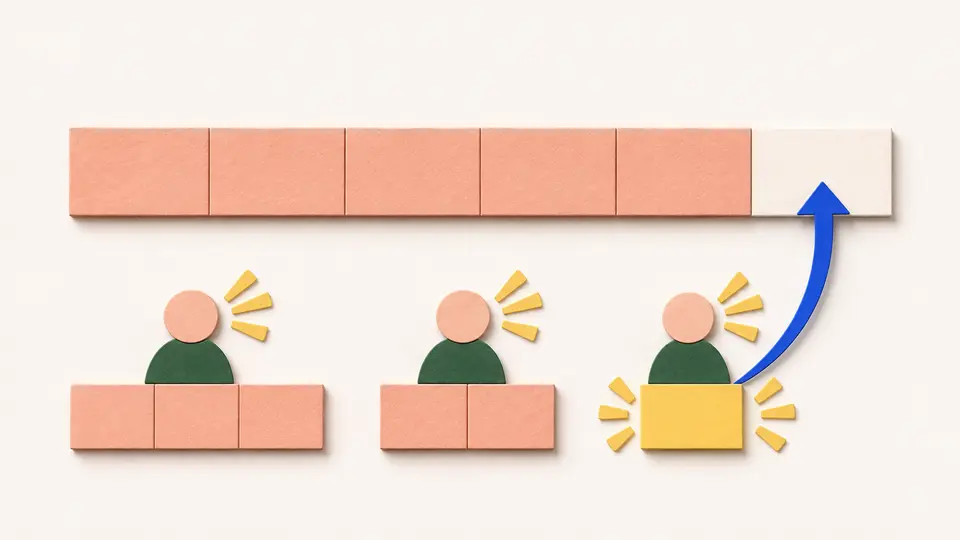
The answer is the meter, the fixed rhythm every line has to keep. The Iliad and the Odyssey are in dactylic hexameter, a line of six feet, or groups of syllables. Each epithet has its own rhythm in Greek, so each one fits a particular stretch of the line. A poet can reach for whichever version fills the space that's left.
Parry showed it with Odysseus, who is divine Odysseus, many-counseled Odysseus or much-enduring divine Odysseus. The three take up different amounts of the line. Which one turns up depends less on the story than on how much room remains.
It's like filling the last gap on a bookshelf, where you take the book that fits and not the one you'd choose first. The comparison stops at meaning, because every version still names the same hero.
Some phrases are interchangeable. In Greek, podas okus Akhilleus, swift-footed Achilles, has the same metrical shape as koruthaiolos Ektor, glancing-helmed Hector. Either hero drops into the same slot.
The giveaway is an epithet that doesn't suit the moment. Homer's ships are swift, and Parry noted that they stay swift "even when drawn up on land." The phrase is there for the line, not the scene. Ready-made phrases let a poet composing aloud work fast, and in the 1930s Parry argued that this style is a mark of oral composition.
Try to recallWhy might Homer call ships swift even when they're drawn up on land?
"Swift ships" works as a formula. The epithet belongs with the noun, and its rhythm fits a set place in the dactylic hexameter line, so the poet uses it whenever ships need naming in that spot, whatever the ships are doing. Parry argued that stock phrases like this let a singer compose quickly while performing, which is why they turn up even where the meaning doesn't quite fit.
Homer's repeated phrases are tools for filling a line of verse at speed. Parry built this case from the texts alone. He had never actually heard an oral poet sing.
Lessons in this topic
Why Homer keeps saying wine-dark sea
Homer repeats phrases like swift-footed Achilles and wine-dark sea. See what Milman Parry meant by a formula, and how such phrases helped a poet fill a line.
How Parry recorded songs too long for one disc
Milman Parry went to Yugoslavia to hear epic poetry being made. See what he wanted to test, and how a recorder with two turntables let singers perform without stopping.
Why an oral epic is never sung the same way twice
A farmer who couldn't read sang epics as long as the Odyssey. See why a singer like him never repeats a song exactly, and what that suggests about Homer.
The fight over who made the Iliad
For two centuries scholars argued over whether one poet or many made Homer's epics. See how Parry changed the question, and what's still disputed about when the poems were written down.
Three quick stories from this topic
Swift ships on dry land
Homer's ships are called swift even when they're pulled up on land, going nowhere
The scholar Milman Parry pointed it out. The adjective describing them is there because its rhythm fills a set place in the verse line. A poet composing aloud reached for the phrase that fit, whatever the ships were doing.
A name for every space
Homer calls the same hero divine Odysseus, many-counseled Odysseus or much-enduring divine Odysseus. Parry showed that the choice depends less on the story than on how much of the hexameter line is left to fill.
Parry's definition of a formula
He defined a formula as "an expression that is regularly used, under the same metrical conditions, to express a particular essential idea." His teacher Antoine Meillet had written that Homeric epic is made of formulas handed down from poet to poet.
The recorder that never had to stop
To record songs that ran for hours, Milman Parry had a machine built with two turntables
Discs of the 1930s held only a few minutes, and a singer who stopped while a new blank went on tended to forget his place. Parry's team switched from one turntable to the other, so the song never had to pause.
Built in Connecticut
The Sound Specialties Company of Waterbury, Connecticut, built the device for Parry. Its two turntables were connected by a toggle switch, and alternating between them stretched recording time virtually without limit.
What the discs hold
The team filled over 3,500 double-sided aluminum discs, each with a playing time of about four minutes, and transcribed them into 95 notebooks. They're now part of the Milman Parry Collection at Harvard.
Heard once, sung three times longer
A farmer who couldn't read heard a 2,294-line song once and sang it back at 6,313 lines
It happened in Yugoslavia in 1935, when researchers had another singer perform a song Avdo Međedović didn't know. He wasn't reciting from memory. Oral poets compose as they perform, from stock phrases and scenes, so he could retell the story and stretch it.
Our Yugoslav Homer
Avdo was a farmer in his sixties. Two of his songs ran past 12,000 lines, about the length of the Odyssey, and the scholar Albert Lord called him "our Yugoslav Homer."
Why it mattered for Homer
Milman Parry argued that the Iliad and the Odyssey came into being the same way, composed aloud from traditional phrases fitted to the meter.
Sources
- Oral-formulaic composition, Wikipedia
- Milman Parry | Harvard Magazine, Harvard Magazine
- Homeric Question, Wikipedia
- Milman Parry, Wikipedia
- An Introduction to the Collection - Milman Parry Collection of Oral Literature, Milman Parry Collection of Oral Literature, Harvard University
- The Milman Parry Collection, 1933-35 - Milman Parry Collection of Oral Literature, Milman Parry Collection of Oral Literature, Harvard University
- Parry Collection of Yugoslav Folk Music, by Béla Bartók (The New York Times, June 28, 1942), Milman Parry Collection of Oral Literature, Harvard University
- Avdo Međedović, Wikipedia