Arts & Culture · Visual art & craft
Ultramarine and the price of blue
Why one blue pigment once cost more than gold, how you can see that cost in where painters put it, and what happened when chemists learned to make it from clay and sulfur.
What you will learn
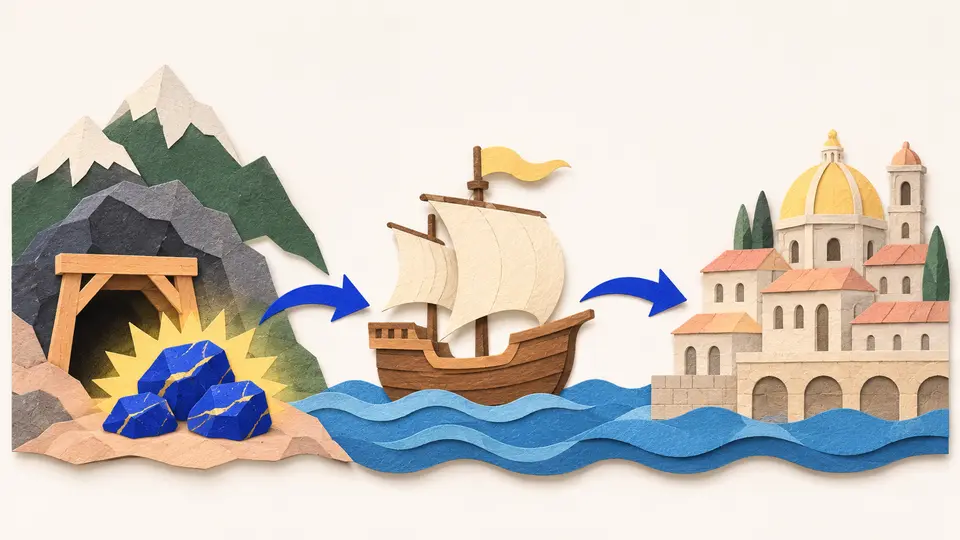
- Trace natural ultramarine from the stone it was made from to a European painter
- Explain why grinding lapis lazuli alone gave only a weak, grayish blue
- Identify where ultramarine appears in the Wilton Diptych and in Sassoferrato's The Virgin in Prayer
- Explain how painters stretched ultramarine with lead white and cheaper azurite
Lesson 1 of 4 · 5 min
Ultramarine, the blue that cost more than gold
For centuries the finest blue paint in Europe started as a rock in the mountains of Afghanistan. The rock is lapis lazuli, a semi-precious stone, and its color comes from a blue mineral in it called lazurite. The mines were in Badakhshan, a remote region in the northeast.
People had prized the stone for a very long time. It was traded to Mesopotamia and Egypt as early as the third millennium BCE, and the Egyptians made it into jewelry. There's no record that they ever managed to turn it into paint.
Italian traders brought it into Europe in the 14th and 15th centuries, and Venice became a center of the trade. The name records the trip. Ultramarine comes from the Latin ultramarinus, beyond the sea.
By the time it reached a painter's workshop it was the most expensive blue there was. The National Gallery in London says it was once more expensive than gold. Cheaper blues existed, azurite among them. A painter who wanted the purest, richest blue paid for ultramarine.
The trouble with lapis lazuli is that it isn't pure blue. The lazurite is mixed with a lot of colorless material, so when you grind the stone you grind everything together. For all but the very best stone, the result is a pale grayish-blue powder. The earliest painters to use it, in cave temples in Afghanistan, ground the best pieces they could find and got an ashy blue.
The fix was to pull the blue out. Ahmad ibn Yusuf al-Tifashi, who died in 1254, was the first to describe how, in a book on precious stones. In Italy the painter Cennino Cennini set it down in a handbook for apprentices, probably in the late 1390s.
You mixed the ground stone with melted wax, resins and oils, wrapped the lump in cloth and kneaded it in a weak lye made from wood ash and water. The blue particles sank to the bottom of the pot. The colorless material stayed at the top.
Each batch was worked at least three times, and each round gave a poorer grade. The last, mostly colorless with a few blue specks, was ultramarine ash, which painters liked as a pale, see-through glaze. Cennini had no doubts about the best of it. He called ultramarine "a glorious, lovely and absolutely perfect pigment beyond all the pigments."
Try to recallWhy couldn't a painter get a strong ultramarine just by grinding lapis lazuli very fine?
The stone mixes the blue mineral, lazurite, with a lot of colorless material. Grinding everything together dilutes the blue, so for all but the best stone the powder comes out a pale grayish blue. The extraction method described by al-Tifashi and in Cennini's treatise separates the blue. The ground stone is mixed into a dough of wax, resins and oils, wrapped in a cloth and kneaded in dilute lye, and the blue particles sink to the bottom while the colorless material stays at the top.
That labor made the price. The stone itself was only moderately expensive. The long grinding, sifting and washing made the finished pigment roughly ten times as costly as the lapis lazuli it came from. A painter buying ultramarine was paying for the journey and, far more, for the work.
Lessons in this topic
Ultramarine, the blue that cost more than gold
Natural ultramarine was made from a blue stone mined in Afghanistan. See why grinding the stone wasn't enough, and why the work of extracting the blue set the price.
Where painters spent their most expensive blue
Three National Gallery paintings show where ultramarine went and where it's missing. Then see how painters made a small amount go further.
The blue found in a lime kiln
Blue lumps on the walls of lime kilns led to a 6,000-franc prize and a factory recipe. See how the synthetic pigment differs from the natural one in price and in looks.
Vermeer's lavish blue and why it has turned pale
Vermeer mixed the costliest pigment into colors where nobody would see blue. Some of that blue is now paler than he painted it, and scientists can only partly say why.
Three quick stories from this topic
From gold to laundry blue
Ultramarine once cost more than gold and now turns up in laundry blue and mascara
The natural pigment came from lapis lazuli mined in Afghanistan and extracted by hand. In the 1820s chemists learned to make it by heating clay, sulfur and charcoal in a kiln, and the price collapsed. In 1990 industry made an estimated 20,000 tons.
A prize for a recipe
In 1824 a society offered 6,000 francs to anyone who could make ultramarine artificially. Jean Baptiste Guimet found a process in 1826 and kept it secret. Christian Gmelin found one in 1828 and published it.
More vivid than the original
Synthetic ultramarine is a more vivid blue than the natural pigment, because its particles are smaller and more uniform and diffuse light more evenly. In 1990 industry made an estimated 20,000 tons.
Michelangelo's missing blue
A blank corner of Michelangelo's Entombment was probably meant for a Virgin in ultramarine
The painting, in London's National Gallery, was left unfinished in 1501. The museum says her mantle needed ultramarine, the most expensive pigment, and Michelangelo may have been waiting until the last moment to add it. Then he left Rome for Florence.
Saved for the Virgin
European painters used ultramarine sparingly and kept their best blue for the robes of the Virgin Mary and the Christ Child.
Why it cost so much
Ultramarine was made from lapis lazuli mined in Afghanistan. Extracting the blue by hand made the pigment roughly ten times as costly as the stone.
Ultramarine in the ceiling
Vermeer mixed ultramarine, the costliest pigment of his day, into brown ceiling beams
National Gallery scientists found it in The Music Lesson, along with ultramarine in the purples and in the shadows on a man's skin. Most painters used the blue sparingly, to get the most from its color. The museum calls Vermeer's use liberal and almost unorthodox.
Why spend it that way
The museum suggests the pigment unified a picture's colors, and that its presence may have subtly raised the paintings' value for collectors.
Some of it has turned pale
The blue chair in A Young Woman standing at a Virginal is now lighter than Vermeer intended. The top of the paint has altered, and the process isn't well understood.
Sources
- Ultramarine, Wikipedia
- Sassoferrato | The Virgin in Prayer | NG200 | National Gallery, London, The National Gallery, London
- Journey through colour, The National Gallery
- Cennino Cennini, National Gallery, London
- English or French (?) | The Wilton Diptych | NG4451 | National Gallery, London, The National Gallery, London
- Michelangelo, The Entombment (or Christ being carried to his Tomb), NG790, The National Gallery, London
- Vermeer's palette | Vermeer and technique | Research | The National Gallery, London, The National Gallery, London
- Altered appearance of ultramarine | Vermeer and technique | Research | The National Gallery, London, The National Gallery, London