Arts & Culture · Cultural traditions & heritage
The Seven Wonders of the Ancient World
Which seven buildings and statues Greek writers called sights worth the journey, what each one was, why only the Great Pyramid still stands, and whether the Hanging Gardens ever existed.
What you will learn
- Explain that the wonders began as a Greek list of sights worth traveling to
- Describe what each of the seven wonders was and where it stood
- Explain how earthquakes, fire and the reuse of stone destroyed the lost wonders
- Describe what survives of the wonders and where it can be seen
Lesson 1 of 4 · 5 min
The seven sights every Greek traveler wanted to see
Around 100 BC a Greek poet, Antipater of Sidon, wrote a short poem about the great things he'd seen. He named the walls of Babylon, a giant Zeus, hanging gardens and the pyramids. Then he said the temple of Artemis outshone them all.
Why would a poet tour the world like that? In the 4th century BC Alexander the Great conquered Egypt, Persia and Babylon. Greek speakers could now travel through those lands, and they started listing the most impressive things they saw.
They didn't call them wonders at first. The Greek word was theamata, which means sights, or things to be seen. So the list worked like a travel guide for the Greek-speaking world.
That also explains its limits. Every site is around the eastern Mediterranean or in the Middle East, the world Greeks knew. And five of the seven were Greek works. Only the pyramid and the Babylonian gardens came from other peoples.
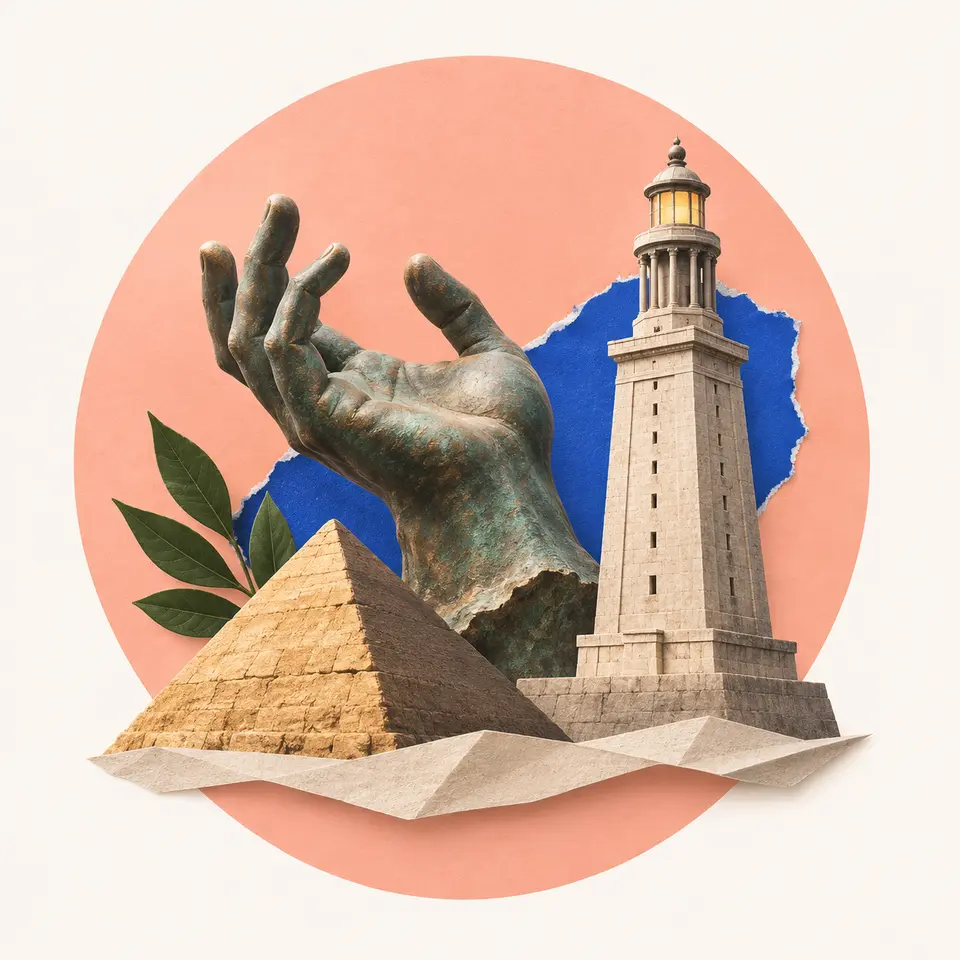
Start at Giza in Egypt. The Great Pyramid was the tomb of the pharaoh Khufu, built about 2600 BC. At 146.6 meters it stayed the tallest human-made structure for more than 3,700 years.
Next are the Hanging Gardens of Babylon, in today's Iraq. Later writers said King Nebuchadnezzar II built tiered gardens for a wife who missed the green hills of her homeland.
At Ephesus, in today's Turkey, stood the Temple of Artemis. Its last version, built of marble, was about 137 meters long.
At Olympia in Greece sat the Statue of Zeus, made by the sculptor Phidias around 435 BC. It was about 12 meters tall, in ivory and gold over a wooden frame. One writer said that if Zeus stood up, he'd go through the roof.
At Halicarnassus, now Bodrum in Turkey, the ruler Mausolus got a tomb finished around 351 BC. It rose about 45 meters with some 400 statues. It was so famous that the word mausoleum now means any grand tomb above ground.
On the island of Rhodes, the people beat off a year-long siege. They sold the enemy's abandoned siege gear and paid for the Colossus, a bronze statue of the sun god about 33 meters tall, put up in 280 BC.
Last comes the Lighthouse of Alexandria in Egypt, built under the king Ptolemy II. It stood at least 100 meters tall. A mirror flashed sunlight by day, and a fire burned at night.
Try to recallName as many of the Seven Wonders of the Ancient World as you can, and say what kind of thing each one was.
The Great Pyramid of Giza was a pharaoh's tomb. The Hanging Gardens of Babylon were tiered gardens. The Temple of Artemis at Ephesus was a marble temple, and the Statue of Zeus at Olympia was a giant ivory and gold statue.
The Mausoleum at Halicarnassus was a ruler's tomb, the Colossus of Rhodes was a bronze statue of the sun god, and the Lighthouse of Alexandria guided ships into port.
The wonders were a Greek traveler's list of sights. You can now name all seven, from Giza to Alexandria.
Lessons in this topic
The seven sights every Greek traveler wanted to see
Find out who first listed the wonders and why, then meet all seven, from the pyramid at Giza to the lighthouse at Alexandria.
Earthquake, fire and scavengers took six of the seven
See what destroyed each lost wonder, why stone builders were as dangerous as earthquakes, and where you can still see pieces of them today.
Were the Hanging Gardens ever in Babylon?
See why no one has found the most famous garden in history, and weigh the case that it was really an Assyrian king's garden in another city.
Why we keep choosing seven wonders
Learn where today's fixed list of seven really comes from, why it's seven, and what happened when 2007's online vote picked new wonders.
Three quick stories from this topic
The list fixed in 1572
The standard list of seven ancient wonders was fixed by a set of prints in 1572
Ancient writers never agreed on seven. A 1906 study of 18 ancient lists found 22 different places named. The familiar seven became standard after Philips Galle printed eight vivid pictures drawn by Maarten van Heemskerck.
One wonder too many
Heemskerck added the Colosseum in Rome as an eighth wonder. Later readers kept his other seven and dropped it.
Why it stuck
The engravings were the first complete set of pictures of the wonders, and their images became the list people remembered.
Babylon's missing gardens
No surviving Babylonian text mentions the Hanging Gardens of Babylon
King Nebuchadnezzar II left long inscriptions about his buildings, and none mentions a garden. The earliest known account was written about 300 years after his reign, and digs at Babylon have found no clear trace.
Another city's garden?
Stephanie Dalley argues the gardens were really at Nineveh, where the Assyrian king Sennacherib described a garden he called "a wonder for all peoples".
Water screws
Sennacherib wrote that he cast bronze screws to lift water to his terraces, matching Greek descriptions of the gardens.
Seven wonders, briefly together
All seven ancient wonders stood at the same time for less than 60 years
The Colossus of Rhodes was the last to be finished, after 280 BC, and an earthquake toppled it in 226 BC. So by the time Greek writers listed it, the giant statue was already lying in pieces.
Famous as a ruin
The broken Colossus lay on the ground for over 800 years. Visitors still came, and a Roman wrote that few men could get their arms around its thumb.
A traveler's list
The list named sights worth seeing, and a fallen giant was still worth the trip.
Sources
- Seven Wonders of the Ancient World, Wikipedia
- Antipater of Sidon, Wikipedia
- Great Pyramid of Giza, Wikipedia
- Hanging Gardens of Babylon, Wikipedia
- Temple of Artemis, Wikipedia
- Statue of Zeus at Olympia, Wikipedia
- Mausoleum at Halicarnassus, Wikipedia
- Colossus of Rhodes, Wikipedia
- Lighthouse of Alexandria, Wikipedia
- Octo Mundi Miracula, Wikipedia
- The Colosseum at Rome, from The Eight Wonders of the World, plate 8, The Metropolitan Museum of Art