Science · Forces, energy & matter
Why things keep moving
Moving things don't stop by themselves. Find out what stops them, what mass really measures, and why astronauts float while gravity is still pulling on them.
What you will learn
- State the first law of motion and what it treats as needing an explanation
- Identify the cause when a moving object slows to a stop
- Define inertia and say what mass measures
- Explain why an object's mass doesn't depend on where it is
Lesson 1 of 4 · 5 min
Slowing down needs a cause
Push a box across the floor and it slides a little way and stops. Voyager 1, launched in 1977, was still moving at 17 kilometers per second in 2024, far out past the planets. Why does one stop and the other keep going?
Everyday experience says motion runs out, and that keeping something moving takes effort. The first law of motion says the opposite. A body at rest remains at rest, or, if in motion, remains in motion at a constant velocity, unless acted on by a net external force.
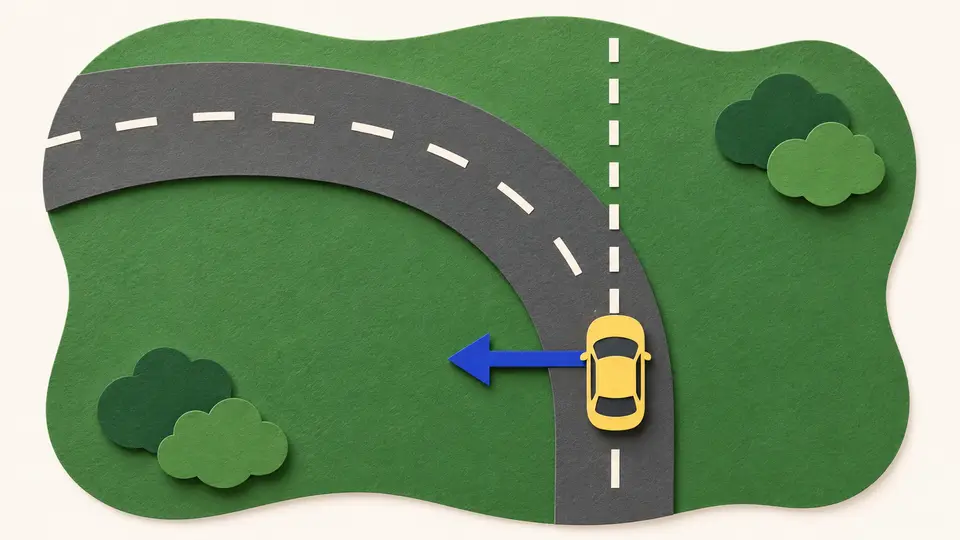
So the law changes which fact needs explaining. Staying still needs no explanation, and neither does moving at a steady speed in a straight line. What needs a cause is a change in velocity, and that includes a change in direction as well as in speed.
A car going around a bend at a constant 50 kilometers per hour is changing direction. So it's changing velocity, and a net force must be acting on it.
That leaves the obvious objection. Boxes really do stop. If nothing is needed to keep them moving, what stops them?
The answer is friction, and you can see it by removing friction in stages. An object sliding along a rough horizontal surface grinds to a halt quickly. Dust the surface with talcum powder and it slides farther. Rub lubricating oil on it and it slides farther still. Extrapolate to a surface with no friction at all, and the object would slide in a straight line indefinitely.
An air hockey table is the same experiment with a switch on it. With the air off, the puck travels a short distance before friction stops it. With the air on, the surface is nearly frictionless and the puck glides a long way without slowing. The puck didn't change between the two runs. What changed was the size of the external force acting on it.
So the box and Voyager 1 follow the same law. The box stops because the floor rubs against it. Out past the planets there's no floor to rub against, so the spacecraft keeps going.
Galileo first developed the idea, and Newton clarified it. Their step was to ask what causes a change. The older habit, in the style of Aristotle, was to say that stopping is simply the nature of moving things.
The law covers a box on a floor, a satellite in orbit and blood pumped from the heart. When something speeds up, slows or turns, look for the force. When it moves steadily in a straight line, nothing needs explaining.
Lessons in this topic
Slowing down needs a cause
Everyday experience says moving things stop by themselves. The first law of motion says something has to stop them, and that reversal is the whole idea.
What mass actually measures
Inertia is the tendency to keep doing what you were doing. Mass says how much of it something has, and it's the same in orbit, where a spring device can measure it.
Why you can't push a car from the inside
Only forces from outside a system can change how it moves. See how to tell which forces those are, and how force and mass together set the acceleration.
Why astronauts float when gravity is still pulling
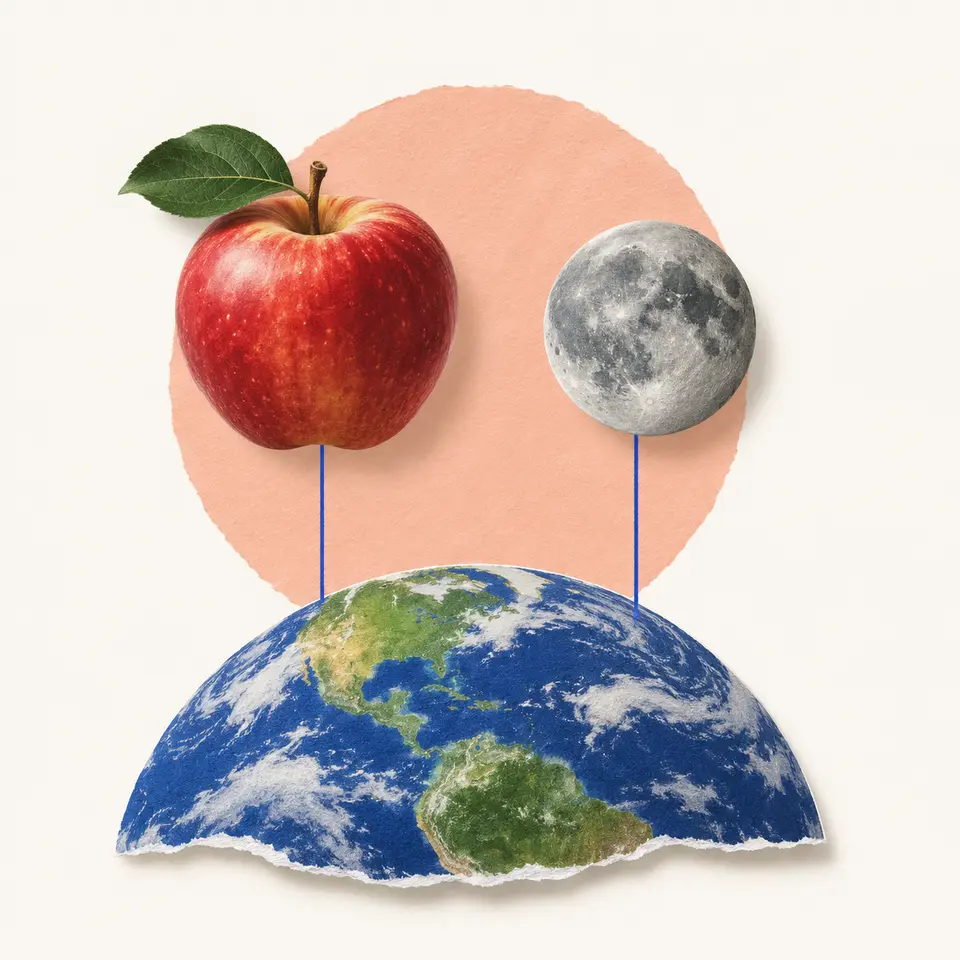
Weight is a force that depends on where you are, and mass isn't. Keeping them apart shows that astronauts in orbit float because they're falling.
Three quick stories from this topic
Weighing astronauts with springs
A NASA device measures an astronaut's mass in orbit by pushing them with two springs
A bathroom scale is no use to someone who's floating. So the device on the International Space Station pushes with a known force and measures how quickly the person speeds up. More mass means less acceleration. NASA gives its accuracy as about a quarter of a kilogram.
Mass is resistance to a push
Mass measures inertia, how strongly an object resists a change in its motion. It's the same on Earth, in orbit and on the Moon.
The second law does the sum
Acceleration equals net force divided by mass. Know the force of the springs, measure the acceleration, and the mass follows.
Gravity in orbit
Gravity on the International Space Station is about 90% as strong as on the ground
Astronauts float there because they're falling. The station and everyone in it fall toward Earth together, so nobody presses on the floor. It never lands because it's also moving sideways at about 28,000 kilometers per hour, fast enough to keep missing the planet.
Weight depends on where you are
Weight is mass times local gravity, so a 1.0-kilogram mass weighs 9.8 newtons on Earth and about 1.6 newtons on the Moon. Even across Earth's surface, g varies slightly.
Mass stays the same everywhere
An object contains the same matter everywhere and resists a change in motion by the same amount, which is why the laws of motion are written in terms of mass rather than weight.
Voyager 1 keeps going
Voyager 1, launched in 1977, was still moving at 17 kilometers per second in 2024
That's about 61,000 kilometers per hour, measured against the Sun. A box sliding across a floor stops because the floor rubs on it. Far beyond the planets there's no floor, and a moving object keeps moving until a force changes its motion.
Stopping is what needs a cause
The first law of motion says a moving body keeps moving at a constant velocity unless a net external force acts on it. On Earth that force is usually friction.
Take the friction away in steps
A sliding object goes farther over talcum powder than over a rough surface, and farther still over oil. With no friction at all it would never stop.
Sources
- 4.2 Newtons First Law of Motion: Inertia - College Physics 2e, OpenStax, Rice University
- Voyager 1: The Farthest Spacecraft, NASA Science
- ISS Daily Summary Report, 10/29/2019, NASA
- What Is Microgravity? (Grades 5-8), NASA
- 4.3 Newtons Second Law of Motion: Concept of a System - College Physics 2e, OpenStax, Rice University