Science · Living things & evolution
How new species form
Start with what a species is, then follow the two ways populations split and the barriers that keep them from merging again.
What you will learn
- State the biological species definition and apply it to two similar-looking organisms
- Explain why only some changes in an organism can contribute to speciation
- Explain how a geographic barrier leads to divergence by cutting off gene flow
- Judge whether a particular barrier would separate a particular organism
Lesson 1 of 4 · 5 min
Where the line between species is drawn
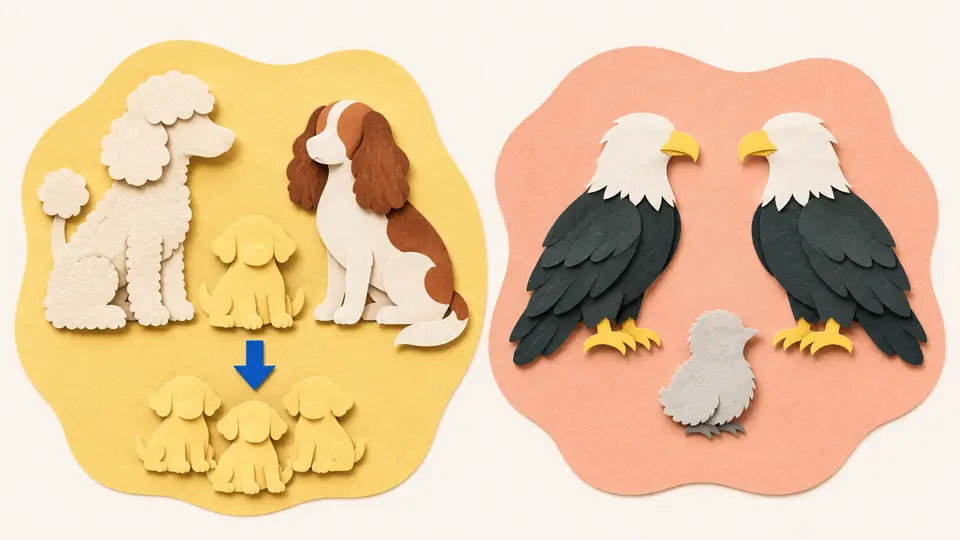
A poodle and a cocker spaniel look nothing alike. A bald eagle and an African fish eagle look very similar. Yet the two dogs are one species, and the two eagles are two. Looks aren't how biologists draw the line.
A biological species is a group of organisms that interbreed and produce fertile, viable offspring. Viable means the offspring survive. Fertile means they can reproduce in turn. Two groups are separate species when matings between them in nature can't produce offspring that are both.
The dogs pass the test. A poodle and a cocker spaniel can have puppies, called cockapoos, that grow up and have puppies of their own. The eagles fail it. If a chick were produced by fertilizing one eagle's egg with the other's sperm, it would probably be infertile.
Resemblance is a clue to shared ancestry, because closely related organisms share more DNA. But it can't settle the question, which is why the test is about reproduction.
Species change because their gene pools change. A gene pool is all the gene variants present in a population. For a new variant to join it, the variant has to be heritable, meaning it can pass to offspring.
In organisms that reproduce sexually, that means the change has to be in a gamete, a sperm or egg cell. Say a mutation arises in one of an animal's skin cells. It stays in that animal and never appears in its young.
Once a variant is heritable, four forces decide how common it becomes. Mutation supplies new variants, called alleles. Natural selection spreads the ones that help their carriers reproduce.
Genetic drift shifts how common they are by chance. Gene flow carries them between populations as individuals move. A new species can form when two populations go through all this separately for long enough.
Try to recallA gardener insists that a plant that grew unusually large in rich soil has started a new variety. Explain what has to be true before any change can contribute to speciation.
Growth caused by rich soil changes one plant and leaves the gene pool untouched, so its seedlings inherit nothing new. Only heritable traits can evolve. In a sexually reproducing organism, that means the change has to be in a gamete, a sperm or egg cell, and not only in body cells. A heritable variant then spreads or fades through mutation, natural selection, genetic drift and gene flow. A new variety or species forms only when whole populations diverge.
So a species is defined by who can breed with whom. A new one forms when one population becomes two that can no longer interbreed.
Biologists sort the ways that happens by geography. In allopatric speciation, meaning "other homeland", the two groups are physically separated. In sympatric speciation, meaning "same homeland", they split while sharing one place.
Lessons in this topic
Where the line between species is drawn
Looks are the obvious test for a species, and a poor one. See why biologists test for fertile offspring instead, and which changes can ever be passed on.
How a barrier splits one species into two
See how a lake, a river or a stretch of ocean lets two populations grow apart by stopping the mixing that kept them alike.
How a new species can form with no barrier at all
A new species can arise right among its parents, sometimes in a single generation. See how doubled chromosomes do it in plants, and how feeding habits may do it in fish.
What actually keeps two species apart
Sort the barriers between species by when they act, from mismatched breeding seasons to sterile hybrids, and see why they're a side effect of divergence and never its purpose.
Three quick stories from this topic
500 species in 15,000 years
At least 500 species of cichlid fish evolved in Lake Victoria in about 15,000 years
They live nowhere else, and the wider region holds more than 700. Genome studies trace the burst to an ancient cross between two fish lineages, which gave the descendants an unusually rich stock of gene variants to sort into new species.
Faster still in a crater lake
Cichlids reached Nicaragua's Lake Apoyeque only about 100 years ago. Two forms with different bodies and diets already live there.
Splitting without a barrier
One explanation is that fish feeding at a different depth mostly meet and breed with each other, so the two groups slowly stop mixing.
A new species in one generation
A plant can become a new species in one generation by doubling its chromosomes
An error in cell division can leave a plant's sex cells with a full double set. They can't combine with normal ones, only with each other, so the offspring breed only among themselves. More than half of plant species studied descend from a species with extra chromosome sets.
The doubled gametes can combine with each other
Self-pollination, or breeding with another plant in the same state, produces a tetraploid that can reproduce only with its own kind. Reproductive isolation is complete with no barrier, no distance and no time elapsed.
Polyploidy is common in plants
More than half of all plant species studied trace back to a species that arose through polyploidy. Cultivated wheat, cotton and tobacco are all allopolyploids, formed from the gametes of two different species.
Looks do not decide species
A poodle and a cocker spaniel are one species, but two look-alike eagles are not
The species test is about offspring. The two dogs can have puppies that grow up and breed. A bald eagle and an African fish eagle look much alike, yet a chick from the two would probably be infertile.
The species test is about offspring
A biological species is a group that interbreeds and produces fertile, viable offspring. Viable means the offspring survive, and fertile means they can reproduce in turn. Both are required.
Resemblance hints at ancestry
Closely related organisms share more DNA, so similarity is often a clue to relationship. But it isn't the test, which is why looks mislead you about both the dogs and the eagles.
Sources
- 18.2 Formation of New Species - Biology 2e, OpenStax, Rice University
- 11.2 Mechanisms of Evolution - Concepts of Biology, OpenStax, Rice University
- Ancient hybridization fuels rapid cichlid fish adaptive radiations, Nature Communications (PMC full text)